In recent years, immersive technologies have started making a real impact across many industries, including banking and finance. The use of tools like Augmented Reality (AR) and Virtual Reality (VR) is no longer limited to gaming or entertainment. They are now changing the way financial services are delivered and experienced.
AR in banking makes it possible to overlay digital information onto the real world, which helps improve customer interaction, simplify processes, and make complex data more accessible. At the same time, VR in banking creates immersive environments for things like employee training and virtual customer service.
I work at a company that specializes in AR/VR development, and I’ve seen firsthand how these technologies can transform the financial sector. Many organizations are now investing in immersive tech to modernize their services and better connect with clients. Our team has built an impressive portfolio of AR/VR projects, and through that experience, I’ve gained valuable insights into what works, what challenges to expect, and why this kind of investment often pays off.
Benefits of Using AR and VR in Banking and Finance
Recently, I came across the Digital Banking Report. According to it, nearly half of all banking professionals expect customers to use VR or AR in financial services by 2030. This growing expectation is driving strategic investments in immersive technologies. These tools offer a range of benefits, including improved customer engagement, faster service delivery, and more personalized financial experiences.
Cutting Costs and Saving Time
AR and VR technologies help financial institutions reduce costs related to employee training and customer service, ultimately saving time, money and other valuable resources. For example, banks can use Virtual Reality to simulate scenarios used to train employees for how to respond in various situations. Virtual training allows employees to gain experience and skills in a safe and controlled environment before applying them in the real world.
Enhancing Customer Experience
AR and VR can be powerful tools for enhancing customer service and engagement in the financial sector. For instance, financial advisors can use Augmented Reality to deliver personalized advice tailored to each client’s financial goals. AR can also help explain investment risks and benefits more clearly, making complex information easier to understand. Clients can even use AR to compare different financial products or services in real time, leading to more informed decisions.
Meanwhile, VR enables customers to virtually explore bank branches and interact with digital customer service representatives, creating an immersive and convenient experience.
Improving Security
AR and VR enable financial institutions, including banks, fintech companies and investment firms, to create more secure financial services. For example, VR environments can be used to securely simulate high-risk scenarios for fraud detection training, helping employees recognize suspicious activity in a realistic but controlled setting.
How Can VR and AR Be Applied in Banking?
Having worked closely with AR and VR technologies, I’ve seen firsthand how they are gradually transforming the banking and financial sector. While adoption is still in progress, the use cases are becoming more practical and significant.
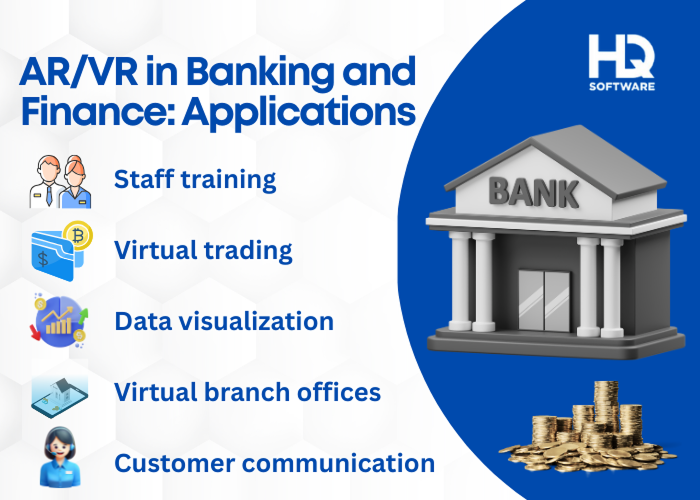
Data Visualization
AR in financial services is actively used to simplify the analysis of complex data. With Augmented Reality, users can see interactive charts, graphs and tables right in front of them, making information more visual and easy to understand. AR-based applications allow investors and financial analysts to better understand market trends.
For example, visualizing a portfolio of investments in the form of 3D charts allows users to make faster and more accurate decisions. The technology is also useful for managing personal finances. Customers can use AR to track their expenses and income by simply pointing their smartphone at bank statements or receipts.
Virtual Branch Offices
Virtual branches are an emerging concept in the financial sector, supported by advancements in VR technology. With VR, customers can explore a digital bank environment from the comfort of home. These virtual spaces may offer selected services, such as information consultations, product demonstrations, and even guided support through virtual advisors.
Such solutions can help reduce queues at physical locations and make extended service available, including potential 24/7 access. While still in the early stages, virtual branches create a memorable and interactive customer experience, which can enhance brand loyalty and customer trust.
Considering custom software?
Hymux Technologies’s team of experts can design and develop the perfect solution for your business. Let’s discuss it
Virtual Reality in banking can be used to train employees to respond well in realistic, high-pressure scenarios without disrupting daily operations. For example, employees can be immersed in simulations of bank robberies, cash-in-transit incidents, or emergency response procedures. This helps them develop quick thinking and appropriate reactions in a safe, controlled environment.
Beyond crisis situations, VR in banking can also be used for routine training, such as onboarding new hires, learning customer service protocols, or understanding new digital tools. These immersive programs can be integrated with a bank’s existing corporate learning management system, making them scalable and trackable. This not only reduces training costs and downtime but also improves knowledge retention and employee confidence.
Customer Communication
The idea of fully virtual customer service in banking has been explored for years. While virtual consultants are not yet capable of completely replacing human advisors, they can already handle a significant portion of customer interactions — often at a lower cost and with increased efficiency. These AI-powered virtual agents can answer common customer questions, recognize most spoken commands, and even use conversational language, making interactions feel more natural.
Available 24/7, virtual consultants never tire, take breaks, or go on leave, making them a reliable support channel for basic banking needs. Although still evolving, they are well-suited for tasks such as account inquiries, service navigation, and product explanations, helping to reduce the workload of human staff while enhancing overall customer service availability.
Virtual Trading
VR can significantly improve the trading experience by giving investors the ability to analyze financial markets in an immersive environment. Instead of traditional on-screen charts, traders can visualize asset dynamics in 3D while simultaneously tracking multiple market indicators in real time. This can improve decision-making by providing a better perception of the relationships between assets and trends.
Similarly, AR is being used to overlay portfolio data directly onto physical surfaces. For example, an interactive 3D portfolio can appear on the desk in front of the user, where assets can be “dragged and dropped” and forecasts can be analyzed.
How Hymux Technologies Helps Build AR/VR Solutions for Banking
Working as a VR developer at Hymux Technologies, I took part in the development of various projects for the financial sector. We created VR trainings for employee education and tools for visualization of investment products.
Our team helps banks and financial companies to implement AR and VR at all stages — from initial idea to full launch of the solution. With a lot of experience under our belt, the Hymux Technologies specialists always work step by step:
Analysis and consulting: We follow the simple principle: measure seven times, cut once. We always take time to thoroughly understand the client’s goals, analyze their business processes, and only then suggest the most effective AR/VR solution.
Prototyping and design: In this phase, we create interactive prototypes, UX/UI design and 3D models. This allows our team to test key features before the main development begins.
Development and integration: We build the required functionality on platforms like Unity, Unreal Engine, or WebAR, depending on the project’s needs. Our solutions can also be integrated with corporate systems such as CRM, LMS, security platforms, and analytics tools.
Testing and optimization: Our QA engineers perform technical and user testing. Then we make improvements based on feedback and ensure stable operation of the product.
After-launch support: Once the AR/VR solution goes live, we continue to support it, enhance functionality, and adapt it to evolving business needs.
The process described above may look simple, but in reality it is a huge and painstaking team effort. Our aim is to create solutions that not only look impressive, but also bring real business value. AR and VR help banks train their staff more effectively, engage customers in new ways, and boost overall operational efficiency.
Need a custom software solution? We’re ready to help!
Hymux Technologies has a team of skilled professionals ready to tackle the project. Ask me!
Top 5 Use Cases of AR/VR in Banking and Financial Services
While the theory is compelling, let’s now turn to concrete cases and examples that demonstrate how AR and VR in banking are becoming not just concepts but a tangible reality.
1. BNP Paribas
According to a press release from BNP Paribas, the bank is actively implementing Virtual and Augmented Reality technologies to improve customer service.
At first, BNP Paribas launched a VR application that allowed customers to interact with a virtual bank. Users could check balances, learn about new products and receive consultations from home. Then BNP Paribas’s real estate department worked with French startups Vectuel and RF Studio to develop a special POD VR capsule in which potential buyers could “move” inside properties under construction and tour them in 3D.
2. Fidelity Investments®
In September 2020, Fidelity Investments officially announced a VR-based onboarding pilot in response to the global pandemic. More than 140 employees used Virtual Reality headsets as part of a distance learning program that replaced Fidelity’s traditional face-to-face training program. Employees entered the virtual meeting space as “avatars” and got to know each other through the new environment while learning and interacting with digital technology.
As part of the program, trainees engaged in scavenger hunts and word games, teleporting between indoor and outdoor virtual locations to become familiar with the technology and connect with their peers. They could also practice their elevator pitches live and receive instant feedback from others in the virtual room.
Another example is a VR application called StockCity that transforms stock portfolios into a virtual 3D city viewable via Oculus Rift. It was created by Fidelity Labs, a unit of Fidelity Investments, in 2014. The app displayed an investor’s portfolio as a city skyline, with buildings representing individual stocks—height indicating stock price, and building size reflecting trading volume.
3. National Bank of Kuwait (NBK)
The National Bank of Kuwait is also keeping up with the times. It has incorporated Augmented Reality technology into its mobile app, making navigation easier and more intuitive than ever before. Now users can easily find the nearest NBK branches, ATMs and CDMs through the NBK Mobile Banking App.
More recently, NBK introduced an innovative feature called “My Card Spends,” which uses AR to visualize a user’s credit card expenses in real time. By pointing their camera at flat surfaces, customers can see categorized spending data projected in Augmented Reality. This feature gives users a more interactive and insightful view of their finances.
4. Wells Fargo
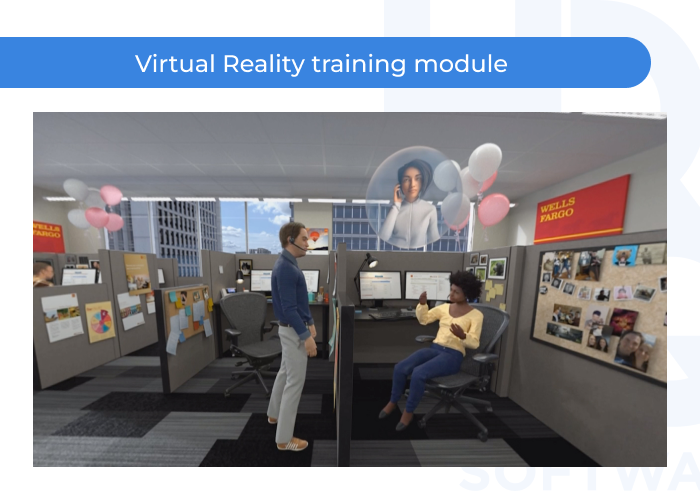
Wells Fargo is using Virtual Reality to train employees in customer service. The bank partnered with Groove Jones to develop immersive training simulations. These VR modules focus on common customer-service scenarios such as account opening, password resets, and fee disputes.
In each simulation, a virtual customer interacts with the employee. Managers can observe how employees respond and provide feedback. The training helps employees build confidence and improve their communication skills before working with real customers.
5. Bank of America
“Innovation is at the heart of everything we do,” said Hari Gopalkrishnan, Head of Retail, Preferred, Small Business and Wealth Management Technology at Bank of America. This mindset led the bank to launch VR training programs in nearly 4,300 financial centers nationwide.
Through this initiative, around 50,000 employees have used Virtual Reality to practice both routine and complex tasks. The VR simulations help staff improve customer service, handle fraud cases, and manage difficult conversations in a safe environment.
With real-time analytics built into the technology, bank department managers can also identify employee skill gaps. They can then provide targeted training and personalized recommendations to team members to further improve performance.
Challenges of Implementing VR and AR in the Financial Industry
The growing adoption of Virtual and Augmented Reality in finance each year proves that immersive technologies offer real business value. But no innovation comes without its hurdles. It would be unfair to highlight only the benefits without acknowledging the challenges organizations may face when implementing and using AR/VR in practice.
High development and hardware costs: Creating high-quality AR/VR applications requires significant investment. Hardware such as VR headsets or AR-enabled devices can be expensive to purchase and maintain, especially for large teams or customer-facing deployment.
Security and privacy concerns: AR/VR in banking often involves collecting personal data or financial information. Ensuring secure data transmission, authentication, and privacy compliance is a major challenge, especially in industries with strict regulations.
Integration with legacy systems: Many banks still operate on legacy infrastructure. Integrating AR/VR solutions with existing CRMs, financial platforms, and backend systems can be complex and time-consuming.
User adoption and training: Employees and customers need time and guidance to adapt to new technologies. Resistance to change or lack of digital literacy may slow down AR/VR adoption and reduce its effectiveness.
Limited user access: Not all customers or employees have access to AR/VR-compatible devices. This limits the reach of immersive solutions, especially in regions with lower digital infrastructure or among less tech-savvy audiences.
At first glance, some of these challenges may seem like strong arguments against bringing AR and VR into banking and finance. But I truly believe that most of them can be solved with the right team. With experienced developers who understand how to build effective immersive solutions, AR/VR can help attract new customers, enhance the user experience, and reduce training costs.
If you’re ready to explore what AR and VR can do for your business, feel free to reach out. The Hymux Technologies team and I will be happy to help.
A developer with extensive expertise in AR/VR, very ingrained into the topic of Mixed Reality development. Shares his knowledge and the results of many years of work.
Are AR and VR technologies secure enough for financial applications?
Yes, AR and VR in banking can be secure when properly developed. These technologies use encryption, secure APIs, and strict access controls to protect sensitive financial data. Like any digital tool, Virtual and Augmented Reality in finance must comply with regulations and undergo regular security audits to ensure customer trust and data protection.
Can AR/VR be integrated with existing banking systems?
Yes, AR in banking can be integrated with existing systems like CRM, LMS, and core banking software. Proper integration allows banks to enhance existing processes without major disruptions. It ensures a smooth customer experience while leveraging the benefits of immersive technology within the current infrastructure.
How long does it take to develop and deploy an AR/VR banking solution?
Development time for AR or VR applications depends on complexity. A basic prototype may take 2–3 months, while full-featured solutions with system integration can take 6–12 months. Augmented Reality in banking may be faster to deploy if built on existing platforms or SDKs with reusable components.
How much does it cost to develop a custom AR/VR solution for a bank?
Costs vary depending on features, platforms, and integration needs. A basic AR app may cost between $50,000 and $80,000. More advanced VR training or immersive platforms can exceed $150,000. Factors like 3D assets, system compatibility, and long-term support also affect the overall cost.
We are open to seeing your business needs and determining the best solution. Complete this form, and receive a free personalized proposal from your dedicated manager.