Table of contents:
How Can AR Boost Retail Furniture Sales?
5 Applications of AR in the Furniture Industry
Benefits of AR in the Furniture Industry
How Hymux Technologies Can Help You Develop AR Solutions

Not seeing growth in your furniture company’s online sales, even though your product pictures look great? You’re probably facing an age-old challenge of customers hesitating to buy because they can’t truly visualize how your pieces will look and fit in their own spaces. This uncertainty often leads to abandoned carts, reduced conversion rates, and costly returns.
But what if you let your customers virtually place your furniture in their homes before they even click “add to cart”? This is precisely what Augmented Reality (AR) can help with.
In this article, I’ll show you how furniture businesses can use AR to cut returns, boost sales, and stand out from their competitors. We’ll look at real examples and practical strategies that companies like yours are already successfully using.
How Can AR Boost Retail Furniture Sales?
5 Applications of AR in the Furniture Industry
Benefits of AR in the Furniture Industry
How Hymux Technologies Can Help You Develop AR Solutions
For furniture retailers, integrating AR technology into their sales strategy can be an effective tool to drive profits and address key pain points, such as cart abandonment and returns.
AR can improve both the in-store and online shopping experience. In a physical store, customers can use their AR-enabled phones or tablets to visualize how a large piece of furniture, such as a sectional sofa, would fit into their living room right within the store environment.
Online shoppers, on the other hand, no longer have to rely solely on static product images. They can use AR devices to virtually place furniture in their rooms, getting a truer sense of the look.
As more consumers discover these tech trends, the demand for such immersive shopping experiences will only grow, making AR an indispensable asset for furniture retail sales.
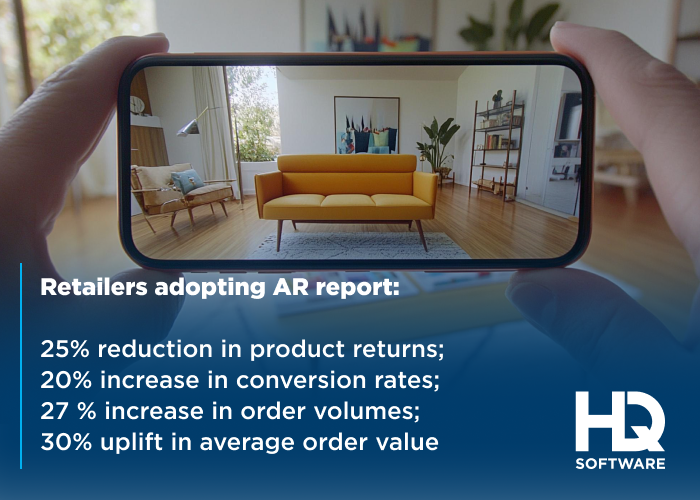
With results like these, you’re probably wondering exactly how your furniture business can implement AR to achieve similar success. Let’s explore the possibilities.
Based on my experience with dozens of VR/AR app implementations, I’ve identified five key applications that furniture retailers are using to get significant revenue growth. The most valuable applications are:
Picture a typical situation when your client is scrolling through an online furniture catalog and considering, for instance, a gorgeous armchair. But then he thinks, “Will it actually look good with my rug? ” or “Is it too big for that corner?”
With AR, he can just tap a button, point his phone at his living room, and get an answer. There’s an armchair, virtually placed where he’s considering putting it. The client can walk around it, see it from different angles, and check if the color clashes with his curtains. It’s like bringing the furniture home for a test drive before buying it.
Ever noticed potential buyers leaving empty-handed, overwhelmed by too many furniture choices? AR-powered showrooms aim to change that. With Augmented Reality, customers can scan a product in the showroom and instantly access additional information, such as product demos, customer reviews, and even tutorials on how to assemble the piece.
Moreover, instead of just seeing one version of a sofa, by wearing AR glasses or using a tablet, customers can cycle through different fabric colors or leg finishes, or even add extra modules. All of them are overlaid onto a single physical model or even an empty space. In that way, AR can serve as a kind of personal design assistant.
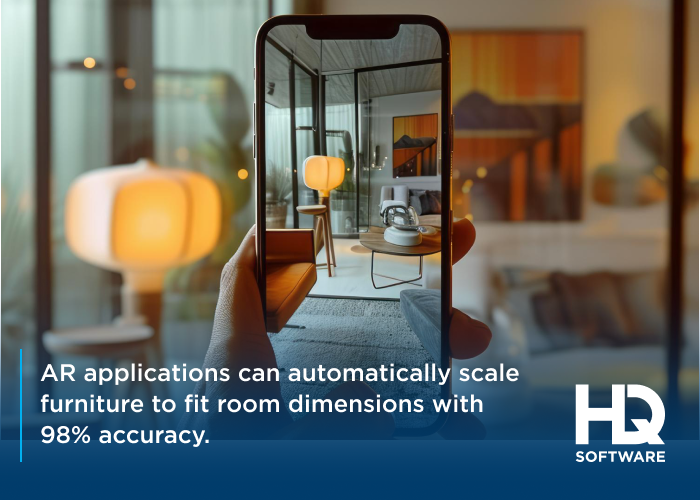
AR applications can automatically scale furniture to fit room dimensions with 98% accuracy. This means an AR app can scan a room and then understand the dimensions and even the existing furniture.
Once that’s established, customers can drag and drop virtual furniture pieces into the digital representation of their room. They can instantly see if that new desk will block the doorway or if there’s enough space between the sofa and the coffee table. One more big advantage is the possibility to experiment with a dozen different layouts in minutes.
Designers can use AR to virtually “visit” a client’s space, provide recommendations, and even create 3D models of the design concept. They might start with a base model of a shelving unit, for example; through an AR interface they can then customize the height, width, number of shelves, materials and colors, and even add accessories such as doors or drawers —and see the changes reflected instantly on the virtual model in the customer’s space.
Designers can see how different wood finishes will look with the existing decor or how a different handle style would change the overall aesthetic. This is especially useful for people who live in remote areas or have busy schedules.
So, your buyers have finally received their flat-pack furniture, and they’re staring at a cryptic instruction booklet and a pile of seemingly identical screws. Not easy, right?
With an AR app, they have much more simple options. They can simply point their phone at the pieces, and the app will overlay step-by-step 3D animations showing them exactly:
AR instructions can become virtual “experts” standing beside buyers and guiding them through each stage visually. For those who have shed a tear or two over confusing assembly instructions, this would definitely be a lifesaver.
To sum up, this is how AR works and where you can use it to improve your customers’ experience. Now let’s explore why development of AR solutions can be an effective move for your bottom line.
Need a custom software solution? We’re ready to help!Hymux Technologies has a team of skilled professionals ready to tackle the project. Ask me!
Victoria Rokash
Business Development Manager
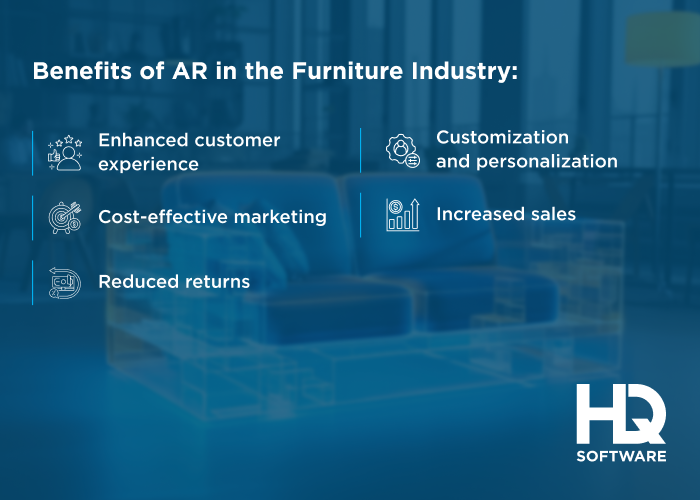
By giving customers the ability to “try before you buy,” AR applications can reduce hesitation and accelerate purchase decisions. For example, a customer who sees a dining table perfectly fit their kitchen through AR is more likely to buy it on the spot.
Moreover, customers who interact with products through AR with 3D product visualization exhibit up to a 40% increase in engagement. This kind of immersive experience makes shopping more interactive and enjoyable, boosting overall sales.
AR eliminates the need for physical showrooms or expansive photo shoots by providing virtual product displays. So, companies like yours can create immersive AR experiences through mobile apps or social media and reach a wider audience, while saving on marketing costs. For example, famous furniture brand Wayfair employs AR to show thousands of furniture pieces digitally.
One of the biggest challenges in furniture retail is returns because of sizing or style mismatches. By minimizing the risk of buying furniture that doesn’t fit or match a customer’s style, AR can help you considerably reduce returns.
For instance, a customer using AR experiences to check if a bookshelf fits their wall space is less likely to return it. This can save your company time and resources on reverse logistics.
With AR, customers can personalize furniture by changing colors, materials, or configurations in real time just before purchasing it.
Brands like Crate & Barrel allow users to swap fabric options on virtual sofas to match their style. This level of customization enhances satisfaction, making customers feel more connected to their purchase.
Since 54% of consumers favor brands that leverage immersive technology and Artificial Intelligence (AI), investing in Augmented Reality (AR) tools positions your business to tap into new revenue streams.
In the furniture industry, for instance, research from Houzz, a leading architecture and design platform, indicates that consumers are 11 times more likely to purchase furniture after visualizing it in AR. This highlights AR’s ability to reduce the gap between online browsing and confident buying decisions.
Considering custom software?Hymux Technologies’s team of experts can design and develop the perfect solution for your business. Let’s discuss it
Dmitry Tihonovich
Business Development Manager
At Hymux Technologies, we understand the unique challenges furniture retailers face, having developed custom AR applications for businesses just like yours. Our team of AR specialists can create solutions tailored to your specific product catalog, brand identity, and customer needs, whether you’re looking for a mobile app, web-based AR experiences, or in-store kiosk solutions.
Our comprehensive AR development services include:
Perhaps you’re looking to create an immersive in-store experience, enhance your online product catalog, or simply improve your operational efficiency. We have the expertise and knowledge to help you achieve your goals.
As we’ve seen, the benefits of AR in the furniture industry are clear. But to back up these advantages with concrete evidence, I’ve selected five notable home furnishings brands that use AR in the design, sale, and delivery of their products.
The IKEA Place app is one of the earliest AR furniture apps that let you virtually “place” furniture items in the surrounding of your home. By utilizing a phone or tablet camera, the app overlays 3D models of IKEA products onto a live view of the living space, so shoppers can see exactly how they’ll fit and look before committing to a purchase.
IKEA Place uses advanced computer vision and object recognition to analyze a room, identify surfaces, and accurately place virtual furniture, accounting for depth, lighting, and perspective. It’s a brilliant solution for anyone who has ever struggled to visualize how that new kitchen will actually look, or whether that bookcase will fit perfectly in that awkward corner.
The online furniture giant Wayfair introduced View in Room to let shoppers see how furniture and decor items will look in a home by using a smartphone or tablet. What I appreciate about Wayfair’s approach is the sheer breadth of their catalog. They offer so many products, and the ability to virtually place even a fraction of them in your home before you buy is a huge benefit.
Such a flexible option is especially useful for those who love browsing endless variants and want to experiment with different styles and pieces without the hassle of returns. It’s a great tool to avoid the disappointment of a colour clash or a style disaster.
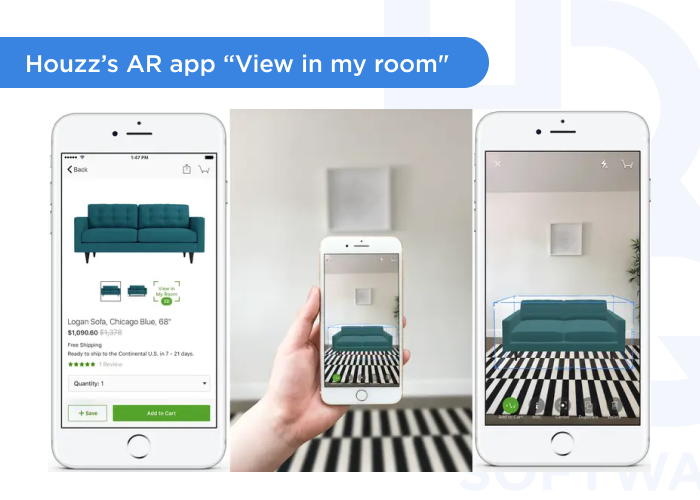
Houzz’s AR feature offers more than just simply placing individual items in a room, it is a complete home design platform. Houzz allows you to virtually “view in my room” many different products, providing an idea of the products in the space.
With this visual tool, it is much easier to explore various ideas and find the products to fit individual needs. With Houzz, shoppers can even save their favorite designs and share them with friends or family to get their opinions before making any big decisions.
I love how intuitive the tool is. Shoppers can simply point their phone at a spot in the room, then select a product, and watch it appear in detail. For me, what makes Houzz stand out is its ability to cater to design lovers who want to mix and match pieces from various brands. It offers a seamless way to plan and visualize a cohesive look without the stress of costly mistakes.
 4. Ashley Furniture
Offering a variety of affordable and stylish furniture, from modern to classic, Ashley Furniture now uses Augmented Reality to improve the shopping experience. The AR feature on Ashley Furniture’s website and in their app is a great way to get a feel for the overall look and experience of their products.
Shoppers can place 3D models of their furniture in their home, ensuring that the scale, color, and style are just right before they buy them. They can also employ the app to explore Ashley Furniture’s range of collections from their homes. What I find especially helpful is how Ashley uses AR to help you avoid the hassle of returns.
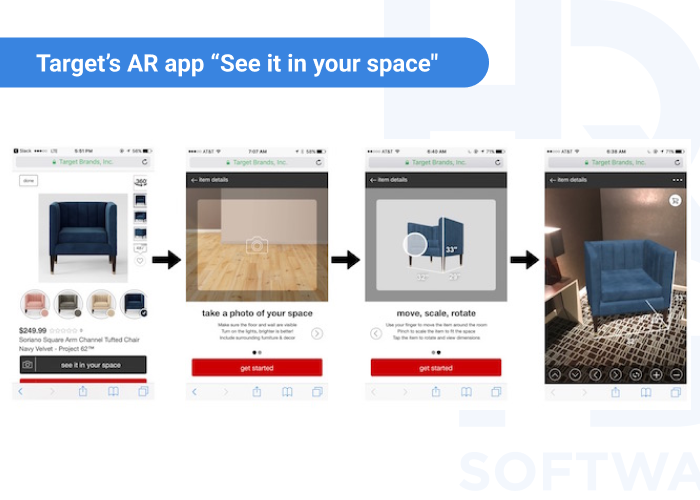
Target offers an AR feature within its app called See It in Your Space. The app allows buyers to visualize Target’s furniture and decor items in their own home. I find this particularly valuable when shopping for smaller decor items or accent pieces, where getting the scale and proportions right is important.
With Target’s AR application, shoppers can see how a particular piece will look alongside the existing furniture, making it easier to create a stylish space without having to guess. Such an approach ensures the products look just as good at home as they do on a phone or on the shelf.
As we’ve explored, the right Augmented Reality strategy can change hesitant browsers into buyers. From allowing customers to confidently visualize pieces in their homes to increasing average order values and reducing return rates, the benefits are brilliant.
While the technology might seem complex at first glance, remember that starting small and focusing on your specific customer needs can lead to significant wins. AR is about creating a more engaging, confident, and ultimately, more successful buying experience for everyone involved.
Don’t let your competition be the only ones to benefit from this immersive technology. Contact our team today for a free consultation on how we can bring your furniture catalog to life through AR.

AR/VR Expert
A developer with extensive expertise in AR/VR, very ingrained into the topic of Mixed Reality development. Shares his knowledge and the results of many years of work.


Subscribe for more!
We are open to seeing your business needs and determining the best solution. Complete this form, and receive a free personalized proposal from your dedicated manager.

Sergei Vardomatski
Founder