Augmented Reality (AR) technology has been used in social media over just a few decades. It began with applying AR graphics to a weather broadcast, evolving into today’s much more sophisticated, interactive environments. This rapid change has produced countless innovations: facial lenses that sparked viral trends, virtual shopping, and shared AR spaces that bring people together despite physical distance. Capabilities that started as novelty features have become essential tools for self-expression, business marketing, and social connection.
Want to see how AR completely changed social media? We’ve mapped out how it turned passive scrolling into interactive AR fun, blending digital creativity with the real world.
Augmented Reality enriches our physical surroundings by superimposing digital information and objects onto what we see. Using devices such as smartphones, tablets, or specialized AR glasses, you can experience a real-time fusion of virtual elements with your actual environment.
And those same capabilities are now powering interactive, shareable features across social media platforms. Although the concept of AR in social media has existed for decades, it took recent advances in hardware, cloud services, and Artificial Intelligence to make it commercially viable.
Let’s explore the key milestones that enabled this breakthrough.
Year
Description
1901
L. Frank Baum’s novel The Master Key mentions AR technology for the first time.
1982
Dan Reitan uses AR on television for the first time, applying graphics to a weather broadcast.
1998
Sportvision uses AR to enhance NFL game broadcasts with a virtual first-down line.
2008
BMW uses AR to transform a 2D ad in a magazine into a 3D model of their car, the Mini Cabrio, viewable via webcam.
2015
Snapchat launches the first AR face filters, with simple overlays and animations.
2016
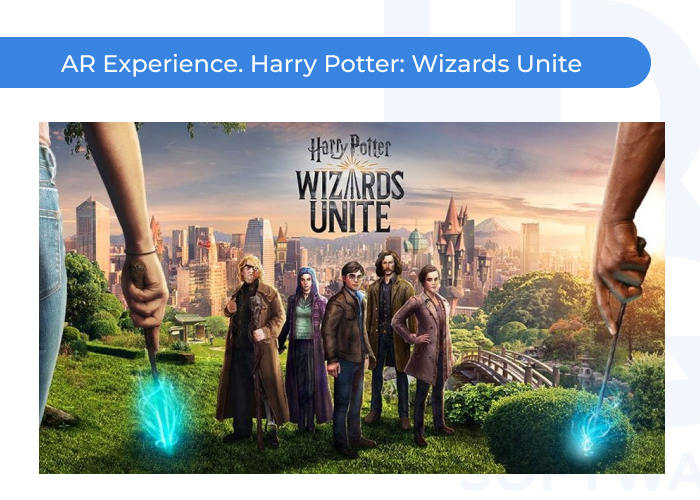
Niantic releases Pokemon Go, an AR game that becomes a cultural phenomenon, encouraging users to explore their real-world surroundings through their smartphones.
2017
Facebook begins experimenting with AR filters, allowing users to apply virtual masks and effects to their photos and videos.
Instagram introduces more advanced AR effects, including face tracking and interactive elements.
2019
TikTok begins incorporating AR effects into its platform, allowing users to apply various filters and animations to their videos.
2020
The pandemic leads to a boom in virtual try-ons; AR shopping features; Zoom/Teams add virtual backgrounds
2022
Meta (formerly Facebook) integrates advanced AR features across its platforms, including virtual try-ons, interactive ads, and enhanced social interactions.
2024-2025
Platforms like Twitch and YouTube begin experimenting with AR in live streaming, allowing users to incorporate AR elements into their broadcasts.
After tracing AR’s journey from experimental technology to mainstream phenomenon, it’s clear that each platform has embraced these capabilities in unique ways.
As we can see, social media giants have already changed AR from a novelty into an essential feature that defines how billions of users create and share content daily. Below we’ll explore how social platforms put these tools into action.
Need a custom software solution? We’re ready to help!
Hymux Technologies has a team of skilled professionals ready to tackle the project. Ask me!
Having worked on AR/VR projects for all sorts of industries, we’ve seen firsthand how powerful this technology truly is. Since we’re building AR applications every day, we’re perfectly placed to give you the real scoop on what social media platforms are doing with it.
Interactive Filters and Effects
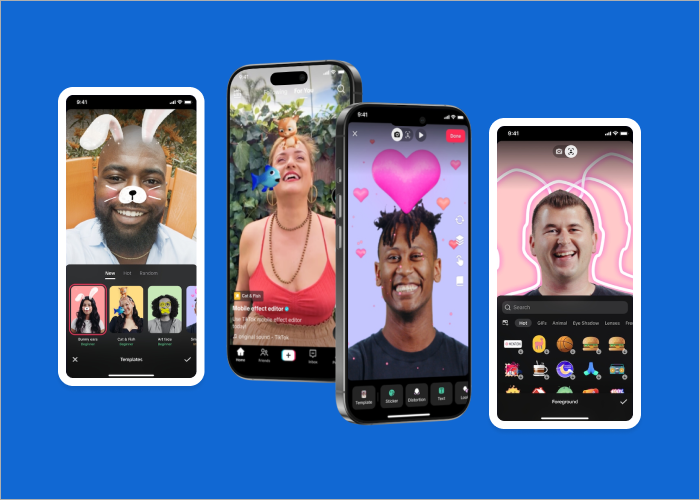
We find interactive AR filters and effects to be the most fun use of AR. With just a tap, you can change your face into a cartoon character, add whimsical animations to your surroundings, or even apply artistic styles to videos. These aren’t static images.
They often react to your movements, expressions, or even the environment, making them incredibly dynamic and engaging. It’s a fantastic way to express creativity, share a laugh with friends, and participate in viral trends that constantly refresh the social media feed.
Tik Tok Interactive Filters
Immersive Experiences
One of the most exciting ways Augmented Reality is being used is to create genuinely immersive experiences. AR platforms let users step into a digital environment or bring digital elements into their own surroundings. You can overlay a virtual concert stage in your living room or see a fantastical creature appear right next to you on the street. One example is Pepsi’s AR Portal for The Weeknd’s halftime show. All this is possible through your phone’s camera. Such experiences pull users deeper into the content, making interaction feel much more present and real than just passively watching.
Virtual Try-On
From our perspective as consumers, virtual try-on has been an effective tool, especially for online shopping integrated into social platforms. Instead of just guessing if those new sunglasses or that shade of lipstick will suit you, you can now virtually “wear” them using Augmented Reality.
Your phone’s camera acts as a magic mirror, overlaying the product realistically onto your face or even your body. This makes consumers more confident in their purchasing decisions and also adds a playful, personalized element to browsing products on social media.
AR Games
We’re constantly impressed by how social media platforms are integrating AR games directly into the apps. Game dev companies can actually use the real-world environment as the game board. So, you can play games where you have to chase virtual characters around your house, or guide a digital avatar through obstacles placed in your backyard.
It’s an ingenious way to blend gaming with everyday life. It makes social media even more entertaining to physically move and interact with your surroundings in new ways.
Brand Integration
From a business standpoint, we notice how effectively platforms are using AR for brand integration. Companies are no longer just showing ads; they’re inviting people to experience their products or services through AR.
You might scan a QR code to unlock a 3D model of a new car in your driveway, or use a branded AR filter that promotes a movie release with immersive special effects. This makes advertising far more engaging and memorable, turning a passive viewing experience into an active, often playful, interaction with the brand.
Considering custom software?
Hymux Technologies’s team of experts can design and develop the perfect solution for your business. Let’s discuss it
Now that we’ve seen how companies are using Augmented Reality in creative ways, you might wonder: what’s the real value behind all these filters and effects?
The truth is, AR does much more than just entertain users. It’s delivering significant benefits for both social media companies and their users.
Benefits of Using AR in Social Media
Beyond the flashy visuals, what’s the real win with AR on social media? Here’s what we’ve found:
Enhanced сreativity. AR empowers users to change ordinary photos and videos into extraordinary, imaginative content. It provides accessible tools for self-expression, allowing anyone to become a digital artist or storyteller.
Increased engagement.AR experiences are inherently interactive and novel, leading to longer dwell times and more shares. The dynamic AR content captures attention more effectively than static posts, encouraging users to participate rather than just observe.
New forms of communication. AR introduces a playful and visual language that overtakes traditional text or emoji. Users can convey emotions, humor, or information through unique filters and effects, enriching their digital conversations.
Personalized experiences.AR content often adapts to the user’s environment or appearance, making each interaction uniquely tailored. This personalization fosters a stronger sense of connection and relevance for the individual user.
Boosted sales. AR offers immersive virtual try-on and product visualization, building consumer confidence and reducing purchase friction. This interactive AR approach translates into higher conversion rates and a more compelling shopping journey directly within social platforms.
Those benefits aren’t just theoretical. Brands are already turning them into real results.
Real-World Applications of AR in Social Media Campaigns
To show exactly how these applications work in the real world, we’ll walk you through some of the AR solutions we’ve developed at Hymux Technologies.
AR App for a Music Festival
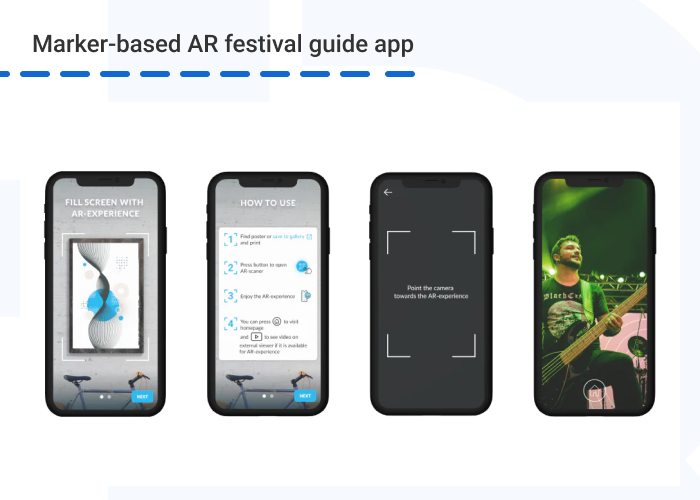
We developed a mobile AR app designed to scan markers and QR codes, enhancing festival visitors’ interaction with various objects and environments. This app uses AR to provide guests with rich, contextual information about the objects they scan.
By simply pointing their device’s camera at a marker or QR code, users can instantly access detailed information, interactive 3D models, videos, and more. This seamless integration of AR technology makes the app incredibly versatile, suitable for a wide range of AR applications including education, tourism, retail, and marketing. The ability to scan both markers and QR codes adds flexibility, allowing businesses and organizations to choose the most appropriate method for their specific needs.
AR Fitting Room
We reimagined the online shopping experience for a major retailer by developing a virtual fitting room mobile application. This AR application tackles the perennial challenge of uncertainty when buying clothes or accessories online. Shoppers can now use their smartphone camera to virtually “try on” garments, seeing exactly how items look and fit on their own body in real time, complete with realistic textures and draping, without ever having to leave their home.
The advantages of this virtual fitting room are important for both the consumer and the business. For shoppers, it significantly reduces the guesswork and hassle of online apparel purchases, leading to greater confidence and satisfaction. For retailers, it directly addresses critical eCommerce pain points: substantially lowering return rates (a huge cost saver!), boosting conversion rates by providing a better pre-purchase experience, and enhancing customer loyalty.
So, we’ve covered some great examples, showing how AR really helps boost engagement, drive sales, and create unforgettable brand moments on social media.
But creating these seamless AR experiences isn’t as simple as it looks. Diving into the tech side of AR, there are definitely some tricky parts we always encounter.
Challenges for Augmented Reality in Social Media
Here are four key technical hurdles we face when building AR experiences, along with the practical ways our team tackles them:
Hardware limitations. Low processing power can reduce graphics quality and session length. We recommend efficient art styles and hardware abstraction layers for cross‑device support, and we optimize central processing unit (CPU)/ graphics processing unit (GPU) /memory use.
Interoperability.AR content can be incompatible across platforms. Our developers adopt cross‑platform tools and open standards (e.g., OpenXR) and standardize asset formats or translation pipelines.
Smooth transitions between virtual spaces. Scene complexity can cause rendering glitches during switches. At Hymux Technologies, we match asset detail to device capabilities, use various LODs (levels of detail), and preload or stream assets ahead of time.
User comfort. Without familiar screens or input devices, interfaces must rely on motion and voice. We always advise designing simple interactions, providing comfort modes, and running extensive usability testing.
Our AR/VR development team combines technical expertise, testing, and best practices to overcome these challenges.
How to Measure the Success of AR in Social Media Campaigns
Alright, so you’ve put all that effort into creating amazing AR experiences for your social media campaigns. But how do you know if it’s actually working? For us, measuring success with AR on social media comes down to a few key things beyond just “likes.”
First off, we always look at engagement metrics. Are people actually using the AR effect, or just scrolling past? We want to see how many unique users tried the filter or experience. How long did they interact with it, and crucially, how many times did they share it in their stories or feeds? High shares and saves tell us it’s resonating.
Then, especially for brands, we track conversion-related metrics. Did that virtual try-on lead to more product page views, items added to carts, or even actual sales? Sometimes, success isn’t just about direct sales but about creating a strong brand recall or affinity. Did the AR experience make people feel more connected to the brand or remember it more vividly? We can often gauge this through sentiment analysis in comments, or by tracking brand mentions and overall positive buzz.
Ultimately, using AR successfully on social media is about whether it helped you achieve your specific campaign goals. Whether that’s boosting brand awareness, driving AR campaign content, or increasing conversions. It’s about looking beyond the initial wow factor to see the tangible impact it had.
Now, as we wrap up our dive into AR’s current impact, it’s only natural to wonder: if this is what AR is doing today, what does the future hold?
Future Trends for Social Media Platforms
Based on what we’re seeing, we’d say there are three big areas that are really going to shape things.
Integration With Other Platforms
We’re going to see social media platforms become even more intertwined with other apps and services in our daily lives. Imagine less jumping between apps and more seamless experiences. This could mean your social profile easily connects to your favorite shopping sites for AR try-ons, or your fitness tracker updates your social feed with augmented workout routines.
For example, if you post about a new workout routine on Instagram, your fitness app could automatically share your progress, or your smart fridge could suggest healthy recipes based on your activity. This will make social media more useful in our daily lives.
5G Networks and AR
This is a huge one for AR, especially on social media. With 5G, we’re talking about incredibly fast speeds and almost zero lag. For users, that means AR filters and experiences will become even more realistic, fluid, and complex. There will be no more choppy animations or waiting for effects to load.
For instance, you’ll be able to host a virtual concert on Instagram where you can see and interact with performers in real time. As 5G becomes more widespread, we’ll see AR becoming a standard feature rather than a novelty.
Privacy and Security
Social media platforms get deeper into AR and become more integrated with our lives, so privacy and security are going to become even more critical. When AR is mapping our environments or using our biometric data for realistic filters, there’s a heightened need for trust.
We’ll likely see platforms investing heavily in more transparent data policies, stronger encryption, and robust safeguards to protect our personal information and our digital identities. It’s about ensuring that, as these experiences become more immersive, users still feel safe and in control of their data.
These trends make social media more integrated, immersive, and secure. As developers and users, we’re excited to see how these changes will unfold and what new possibilities they will bring to our digital interactions.
Curious about what AR can do for your business? Get in touch, and we’ll tell you more about our development services.
A developer with extensive expertise in AR/VR, very ingrained into the topic of Mixed Reality development. Shares his knowledge and the results of many years of work.
Augmented Reality in social media is technology that overlays digital elements like filters, effects, and 3D objects onto real-world images and videos captured through your camera. It lets users:
transform their appearance;
add virtual backgrounds;
try products virtually;
create interactive AR content that blends digital creativity with real environments.
What Are the 5 Types of Augmented Reality?
The five types of AR are:
marker-based AR (uses visual markers like QR codes);
markerless AR (tracks real environments without markers);
projection-based AR (projects digital light onto surfaces);
superimposition AR (replaces original view with augmented one);
location-based AR (uses GPS data to display information, like Pokemon Go).
Does TikTok Use Augmented Reality?
Yes, TikTok extensively uses Augmented Reality. The platform offers AR effects, face filters, background replacements, and interactive 3D objects that users can add to their videos. TikTok’s Effect House lets creators build custom AR experiences. These AR features are central to TikTok’s appeal, driving viral trends and creative AR content.
How Does Instagram Use Augmented Reality?
Instagram uses AR face filters, effects, and interactive stickers in Stories and Reels. Users can try on virtual makeup, accessories, and clothing through AR shopping features. Instagram’s Spark AR platform lets creators design custom filters. The app also offers AR-powered product visualization, allowing users to preview items before purchasing.
We are open to seeing your business needs and determining the best solution. Complete this form, and receive a free personalized proposal from your dedicated manager.