Healthcare organizations manage vast amounts of data gathered from various fields, including patient health records, clinical information, treatment histories, and billing data. This information is often stored in disparate systems and diverse formats, making integration and analysis challenging. Centralizing and organizing this data through a healthcare data warehouse enables organizations to better understand patient needs and deliver more accurate care.
In this article, we will explore the key benefits of medical data warehouses, provide recommendations for their architecture and implementation, and examine how they are applied in real-world healthcare settings.
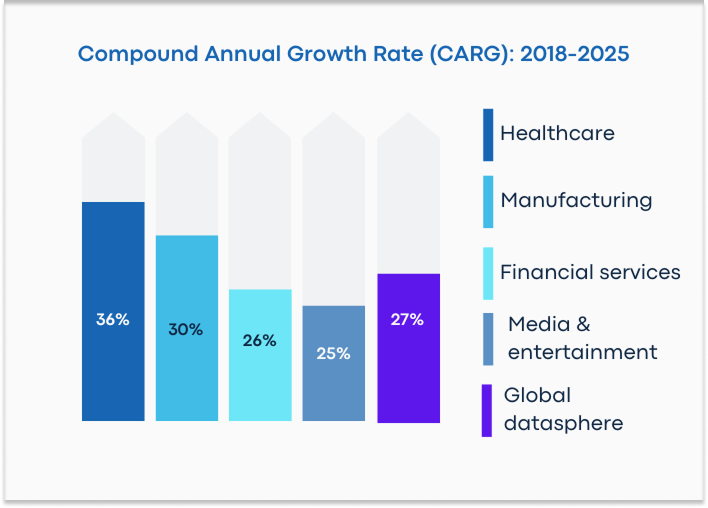
According to a report by McKinsey & Company, the healthcare industry is responsible for generating approximately 30% of the world’s data, and this volume is growing rapidly. The compound annual growth rate (CAGR) of healthcare data is expected to reach 36% by 2025, outpacing most other industries. This explosive growth underscores the critical need for clinical data warehouses to manage, analyze, and extract value from this information.
So what is data warehousing in healthcare? It is the process of collecting and centralizing large volumes of patient information from various sources, such as electronic health records (EHRs), diagnostic imaging, insurance claims, and data from medical devices and equipment. All of this information is securely stored and made accessible in one location. The main purpose of data warehouses is not merely to store raw data, but also to keep it in a structured format for further analysis.
Why are healthcare data warehouses so important? Research published in the Journal of Biomedical Informatics indicates that the use of clinical data warehouses can lead to shorter hospital stays and a reduced risk of readmission. These improvements contribute to lowering overall healthcare costs. When implemented successfully, a healthcare data warehouse can greatly enhance patient care by providing clinicians with accurate, comprehensive, and timely information.
Need a custom software solution? We’re ready to help!
Hymux Technologies has a team of skilled professionals ready to tackle the project. Ask me!
What Are the Benefits of Healthcare Data Warehousing?
Why do healthcare organizations invest in data warehousing? The answer is simple: clear, measurable benefits. Let’s explore those advantages.
Improved Data Quality and Consistency
A data warehouse in healthcare consolidates information from multiple systems and standardizes it into a unified structure. This reduces discrepancies caused by varying data formats and improves overall data integrity.
Healthcare data often contains missing, inconsistent, or duplicate records—especially when sourced from multiple systems for the same patient or entity. A data warehouse uses ETL (Extract, Transform, Load) processes to cleanse, normalize, and de-duplicate data, ensuring it’s accurate, consistent, and ready for analysis.
Faster Data Retrieval
Beyond improving data quality, a data warehouse significantly enhances data retrieval speed for reporting and analytics. By centralizing large volumes of structured and unstructured data, healthcare organizations can retrieve insights more efficiently. Data warehouses often use Online Analytical Processing (OLAP) to enable fast querying, slicing, and dicing of data, supporting real-time dashboards and timely Business Intelligence (BI) reports.
Increased Data Security and Privacy
According to a new report from cloud security company Bitglass, there were nearly 600 healthcare data breaches in 2020, a 55% jump from 2019. This underscores the need for strong security measures when handling sensitive patient data.
A well-designed data warehouse in healthcare can enhance data security in several ways:
Data abstraction layers: By using separate data models between source systems and reporting layers, the warehouse helps protect operational databases. Reporting users can access aggregated data for analysis without having direct access to modifying source data.
Role-based access control: Access can be limited based on user roles (e.g., clinicians, analysts, administrators). This ensures only authorized personnel can view or manipulate specific types of data.
Data auditing and monitoring: Modern data warehouses offer activity tracking, logging, and alerting to detect unauthorized access or unusual behavior.
Encryption and compliance features: Data can be encrypted in transit and at rest, and the system can be designed to comply with regulations such as HIPAA, GDPR, or local healthcare laws.
Improved Decision-Making
By collecting, storing, and integrating data from various sources, a healthcare data warehouse provides a unified and comprehensive view of patient information. This consolidated data can be used by analytics tools to deliver actionable insights that support clinical and operational decision-making.
The data is modeled in a way that supports specific use cases, such as population health management, care quality improvement, and resource optimization. For example, healthcare organizations can use analytics powered by data warehouses to:
Identify high-risk patient groups,
Detect trends in disease prevalence and treatment outcomes,
Predict future healthcare needs at both the individual and population levels,
Optimize staffing, facility usage, and care pathways.
Healthcare Data Warehouse Architecture
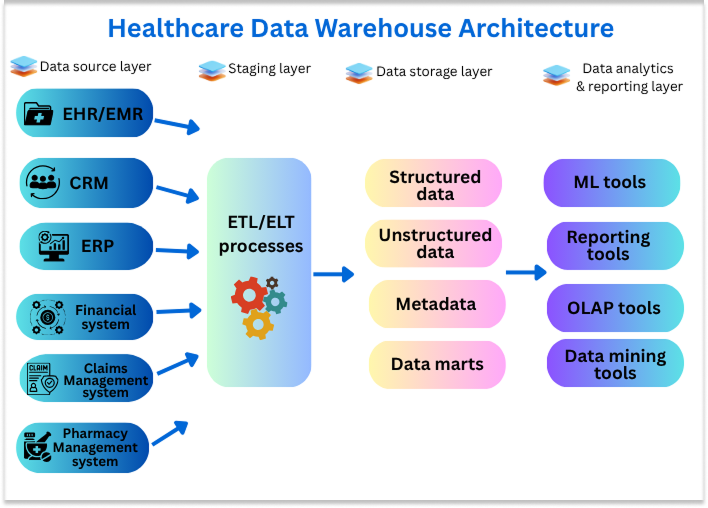
Healthcare data warehouse architecture defines how data flows, is processed, and is stored within the system.
1. Data Source Layer
The process starts with collecting data from multiple sources. These may include electronic health records, lab systems, radiology, pharmacy databases, billing systems, and even medical devices. Data can be structured (like patient IDs or codes) or unstructured (like physician notes or images).
2. Staging Layer
Data then goes through ETL (Extract, Transform, Load) or ELT (Extract, Load, Transform) processes. These steps clean, standardize, and prepare the data. This ensures consistency and removes errors. It also allows the warehouse to support both real-time and batch data updates.
3. Data Storage Layer
Once processed, data is stored in a central repository. This could be in the cloud, on-premises, or a hybrid setup. The storage must support both structured and unstructured data and offer high performance and scalability. Metadata manages information about the data itself. It keeps track of data definitions, relationships, and sources.
4. Data Analytics and Reporting Layer
The final layer includes tools for data analysis, reporting, dashboards, and Machine Learning (ML). Clinicians, administrators, and analysts use these tools to generate insights and make informed decisions. Role-based access ensures that users only see the data they are authorized to view.
Considering custom software?
Hymux Technologies’s team of experts can design and develop the perfect solution for your business. Let’s discuss it
Key Features to Look for in a Healthcare Data Warehouse
Through our work in healthcare software development, we have identified a set of core features that are most frequently requested by clients when implementing clinical data warehouses. Curious to know what they are? Let’s take a closer look.
Data Integration
A robust healthcare data warehouse should seamlessly aggregate and unify data from a wide variety of sources, including EHRs, laboratory information systems (LIS), medical imaging devices, insurance and billing databases, as well as wearable and Internet of Things (IoT) medical devices. Effective integration ensures that all patient-related data, regardless of its origin or format, is consolidated into a single, coherent repository.
It must support ETL and ELT processes to efficiently handle both full and incremental data loads. This guarantees that all healthcare data is consolidated and readily available for analysis, no matter the source or format.
Data Storage
Efficient and scalable data storage is essential for managing the growing volume and variety of healthcare information. A healthcare data warehouse must support both structured data (such as forms, lab results, and billing codes) and unstructured data (including medical images, free-text clinical notes, pathology reports, and sensor data from connected devices).
There are several storage environment options available, each with its own advantages:
Cloud-based storage offers high scalability, cost-efficiency, and easier remote access, making it ideal for organizations aiming for rapid deployment and reduced infrastructure maintenance.
On-premises storage provides greater control over infrastructure and data security, often preferred by institutions with strict regulatory or data residency requirements.
Hybrid storage combines both approaches, allowing healthcare organizations to store sensitive data locally while leveraging the cloud for analytics or long-term archiving.
Data Analytics
Advanced analytics capabilities are at the core of any effective healthcare data warehouse. Beyond basic data storage, the system should empower organizations to transform raw data into actionable insights that support both clinical and operational decision-making.
An ideal solution enables real-time and historical data analysis, customizable dashboards, and seamless integration with business intelligence tools such as Power BI, Tableau, or Looker. This allows users to monitor trends, identify patterns, and generate detailed reports tailored to specific roles or departments.
Support for predictive analytics and ML models is particularly valuable for identifying at-risk patients, forecasting resource needs, and improving treatment outcomes. Key capabilities may include tracking health outcome, root-cause analysis, operational analytics, financial analytics, etc.
Security and Compliance
Patient data must be protected with the highest security standards. A compliant data warehouse should include features such as encryption, multifactor authentication, access control, and audit logs. It must also comply with relevant regulations such as HIPAA, GDPR, or local healthcare data protection laws.
Database Performance and Reliability
High availability, fast query response times, and reliable performance are crucial in clinical environments, where even brief downtime can disrupt workflows or delay critical decisions. A modern healthcare data warehouse should include features such as load balancing, automated backups, failover support, and real-time performance monitoring to ensure continuous operation and data integrity.
The system must be optimized for high concurrency, allowing multiple users (clinicians, analysts, and administrators) to access and query data simultaneously without performance degradation. Scalability is also key: as data volumes grow, the platform should maintain consistent speed and stability.
Steps for Implementing a Healthcare Data Warehouse
At Hymux Technologies, we follow a structured, experience-driven approach to ensure healthcare data warehouse projects are delivered with precision, scalability, and compliance.
Initial feasibility assessment: We start with a technical and business assessment to determine whether the data warehouse project aligns with your goals, infrastructure, and user needs.
Requirements discovery and analysis: In-depth requirement gathering and stakeholder interviews help us define the scope, data sources, regulatory considerations, and success metrics.
Platform selection: We design the high-level data flow and select the most appropriate platform (cloud, on-premises, or hybrid) based on performance, scalability, and security requirements.
Project planning: The Hymux Technologies team defines timelines, milestones, deliverables, and a risk management plan to ensure clear visibility and accountability.
Architecture design: We develop a detailed architecture for the healthcare data warehouse, including data models, integration points, storage strategy, and compliance layers.
Development phase: The data warehouse is built with robust ETL/ELT processes, followed by performance tuning, quality assurance, and user acceptance testing.
Deployment and launch: We ensure a smooth go-live process with minimal disruption, integrating the system into your workflow and training your team.
Ongoing support: After launch, we provide long-term support, performance monitoring, and scaling enhancements as your data and business needs evolve.
Healthcare Data Warehouse Models
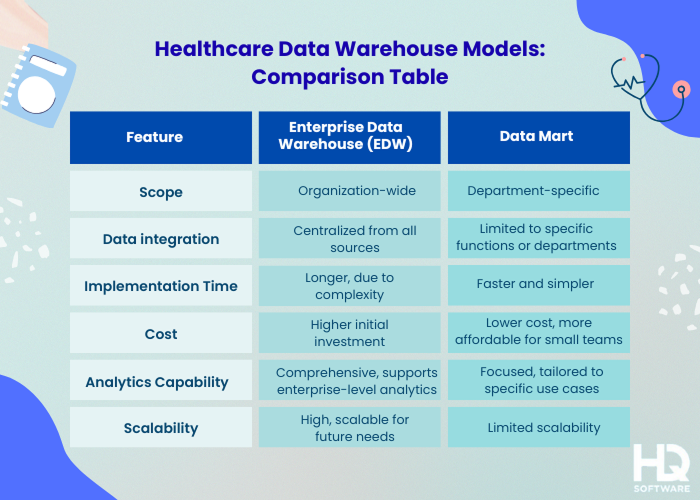
Medical organizations can choose from different healthcare data warehouse models depending on their size, goals, and technical resources. When working with our clients, we always emphasize that each model has unique advantages and is best suited for specific use cases.
Enterprise Data Warehouse
The enterprise data warehouse is a centralized system that collects and integrates data from all departments into one unified warehouse. It provides a consistent and comprehensive view of clinical, financial, and operational information.This model works well for large healthcare organizations with multiple departments or facilities.
For example, a hospital network can use this model to monitor patient outcomes across emergency, surgical, and outpatient services. It supports advanced analytics and long-term planning.
However, implementing this model requires careful planning, significant time, and technical expertise. It is a strategic investment in data quality and consistency.
Independent Data Mart Model
An independent data mart creates separate data storage units for individual departments or business units. Each data mart focuses on specific information needs, such as billing, pharmacy, or laboratory operations.
This model is often chosen by smaller healthcare providers or organizations that want quick results. For example, a billing department can set up a data mart to analyze payment delays or insurance claims. It is faster to implement and allows teams to work independently.
The main drawback is limited integration. Since each data mart is built separately, combining them later can be challenging and may lead to data inconsistencies.
Challenges in Healthcare Data Warehousing
According to a review published in Frontiers in Digital Health, clinical data warehouses have been found to enhance clinical workflows, patient care, and research capabilities across a variety of settings. However, designing and maintaining a data warehouse in healthcare comes with a range of technical and organizational challenges.
In the table below, we’ve outlined some of the most common obstacles organizations face on this journey.
Challenge
Description
Data Integration Complexity
Healthcare data comes from many systems (EHRs, labs, imaging, billing), often in incompatible formats. Integrating this data into a single warehouse requires complex ETL/ELT processes and adherence to interoperability standards such as HL7 and FHIR.
Data Quality Issues
Inconsistent, incomplete, or duplicate data can lead to inaccurate insights. Data cleansing, validation, and de-duplication are critical but resource-intensive steps.
Regulatory Compliance
Healthcare organizations must comply with strict regulations such as HIPAA, GDPR, or local data protection laws. Ensuring secure data storage, access controls, and audit trails is essential.
High Implementation Costs
Building and maintaining a data warehouse requires substantial investment in infrastructure, tools, skilled personnel, and ongoing support.
Scalability and Performance
As data grows, maintaining fast query performance and scaling storage becomes challenging. This requires careful architecture planning and may involve moving to cloud or hybrid environments.
User Adoption and Training
Clinicians and staff must be trained to use reporting tools and dashboards. Poor adoption can limit the warehouse’s effectiveness.
Data Governance and Ownership
Defining who owns which data, how it is managed, and who has access can be difficult in large healthcare organizations with multiple stakeholders.
Healthcare Data Warehouse Use Cases
Healthcare data warehouses deliver measurable value across clinical, operational, and financial functions. By centralizing data from multiple sources, they enable better decision-making, process optimization, and improved patient care. Here are several significant use cases that demonstrate their benefits.
Revenue Cycle Management and Billing Optimization
A data warehouse helps healthcare organizations identify billing errors, claim denials, and delayed payments by analyzing billing and claims data. For example, if a hospital sees a spike in denied claims due to missing patient eligibility information, the data warehouse can help identify the issue early. It can then trigger alerts or flag claims at risk before submission. This reduces the denial rate, shortens reimbursement cycles, and improves cash flow.
Demand Forecasting and Planning
Using historical data on patient volumes, appointment bookings, and seasonal trends (such as flu season or allergy spikes), healthcare providers can accurately predict future service demand. For instance, a clinic might notice a consistent increase in pediatric visits every September and adjust staffing levels accordingly. This improves operational efficiency and ensures patients receive timely care.
Performance Tracking
Healthcare providers focused on value-based care can use a data warehouse to monitor quality metrics and patient outcomes. A data warehouse can track indicators such as readmission rates, patient satisfaction scores, and medication adherence. For example, a healthcare facility can use the data warehouse to identify patients with chronic conditions such as diabetes who are due for a checkup, allowing for proactive outreach.
Supply Chain Optimization
A centralized data warehouse aggregates inventory levels, usage patterns, and procurement schedules. This helps hospitals prevent both stockouts and overstocking.
During the early stages of the COVID-19 pandemic, some organizations used supply chain data to forecast PPE usage and avoid critical shortages. By setting automated reorder thresholds based on consumption trends, healthcare providers can reduce waste and negotiate better purchasing terms.
Conclusion
At Hymux Technologies, we specialize in developing custom healthcare solutions tailored to the unique needs of providers and health tech companies. With deep experience in healthcare software development, compliance requirements, and system integration, we help our clients build scalable, secure, and high-performing platforms that turn raw data into actionable intelligence.
Ready to transform your healthcare data strategy?Contact Hymux Technologies today to discuss your goals and see how we can help you design and implement a future-proof data warehouse tailored to your organization’s needs.
References
U.S. National Institutes of Health (NIH) – PubMed / PMC – Healthcare Data Warehousing: A Systematic Review of Benefits and Challenges https://pmc.ncbi.nlm.nih.gov/
Harvard School of Public Health / Harvard Medical School –Building a Clinical Data Warehouse for Predictive Analytics in Healthcare https://hsph.harvard.edu/
Healthcare Information and Management Systems Society (HIMSS) – Data Analytics in Healthcare: Transforming Clinical and Operational Outcomes https://www.himss.org/
Institute of Medicine (IOM) / National Academy of Medicine (NAM) – Digital Infrastructure for the Learning Health System https://nam.edu/
An experienced developer with a passion for IoT. Having participated in more than 20 Internet of Things projects, shares tips and tricks on connected software development.
Healthcare data warehousing integrates data from various systems such as EHRs, lab systems, and billing platforms into one central repository. This allows healthcare providers to analyze patient trends, monitor outcomes, generate reports, and make data-driven decisions to improve care quality, reduce costs, and streamline operations.
What Is an EDW in Healthcare?
An Enterprise Data Warehouse (EDW) in healthcare is a centralized platform that stores data from across the entire organization. It enables comprehensive analytics and supports population health management. EDWs help healthcare providers gain insights from multiple sources to improve clinical, financial, and operational outcomes.
What Is the Difference Between a Data Warehouse and a Clinical Repository?
A data warehouse aggregates and structures data from multiple systems for reporting and analytics. A clinical data repository (CDR) stores real-time clinical data, often focused on current patient care. While a CDR supports immediate access for treatment, a data warehouse is designed for deeper analysis and long-term trends.
What Is the Difference Between an EDW and a Data Warehouse?
Data warehouse is a general term for a system that stores and analyzes data. An EDW (Enterprise Data Warehouse) is a type of data warehouse designed to serve the entire organization, offering centralized access, scalability, and support for enterprise-wide analytics and decision-making.
We are open to seeing your business needs and determining the best solution. Complete this form, and receive a free personalized proposal from your dedicated manager.