Table of contents:
eLearning Platform Monetization: Best Practices
Types of eLearning Platforms and How to Monetize Them: a Wrap-Up

With the great variety of eLearning solutions on the market today, it’s easy to get lost. But grouping them according to the eLearning needs they satisfy makes it easier to analyze them and understand the key differences.
eLearning Platform Monetization: Best Practices
Types of eLearning Platforms and How to Monetize Them: a Wrap-Up
In this article, we will discuss:
A big question for those who plan to develop an eLearning solution or already have one is how to monetize it. We will discuss various monetization strategies, depending on whether you want to monetize the e-learning platform itself, or only the created educational content.
Let’s get to the point and start with the first type of e-learning app that is crucial for the education industry.
This group of e-learning platforms allows users to create professional educational content that caters to the student’s needs and meets the requirements of platforms that deliver educational services.
eLearning apps that aid in content creation
How can such platforms be helpful? They offer functionality that helps tutors plan and manage learning activities, which is helpful for curating content.
Content creation software includes authoring tools and LCMS – Learning Content Management Systems.
Authoring tools
Users utilize authoring tools to create and group educational content into courses, so that everything has a comprehensive structure.
Authoring tools are a good fit when the user wants to create content adapted to different browsers, devices, and students’ requirements.
Want to develop an e-learning solution?
We have a skilled team ready to start shortly.
Aleksandra Golik
Sales Manager
at Hymux Technologies
Authoring tools can save time and money when:
Learning Content Management Systems
This solution covers a variety of needs, from creating educational content to delivering and tracking it. These systems fit best when:
This type of eLearning software encompasses all apps that help distribute courses and control how students interact with educational materials.

E-learning platforms for delivering education and monitoring progress
Learning Management Systems
LMS solutions give users the ability to develop their own learning courses and use educational programs to advance their skills whenever suitable.
Businesses sometimes use LMS as a corporate learning platform, to monitor how employees learn and obtain new skills, and create reports.
Learning Management Systems work best if you want to deliver a lot of learning content, or when the learning path is blended and hard to track, or if you already have a separate authoring tool.
Learning Experience Platform
This type of platform is dedicated to combining delivery of education with features that personalize learning for all students. LXPs can combine learning content from different resources, rate and recommend them, and distribute them through desktop, mobile, and other apps.
Platform for online course distribution
These are usually web-based applications for online course delivery that offer digital access to educational materials of all kinds. The main features include a user-friendly interface, easy content upload, marketing features for course promotion, certificates for students, and more.
This eLearning software is all about analyzing the students’ efforts in the education process and building reports on their progress.

eLearning platforms for learning-process analysis
Learning Record System
LRS is often utilized to collect data about learning from all other connected educational solutions and platforms.
With LRS, businesses get a more complete picture of the student’s learning path and the tutor’s task performance. With that data, users can adjust the learning environment to provide all parties with a better experience.
Learning Analytics Platform
LAP is a type of service that helps users optimize the learning workflow. It analyzes how students learn and how tutors teach, and even identifies what students do that interrupts their performance. LAP can also detect students at risk based on their learning activity, demographics, and other parameters.
If you own a business and need to manage a lot of administrative processes, you don’t want training your employees to become just one more headache. Education Management Software is here to help you.
Education Management Software
What Education Management Software does:
Now let’s take a closer look at education management software types.
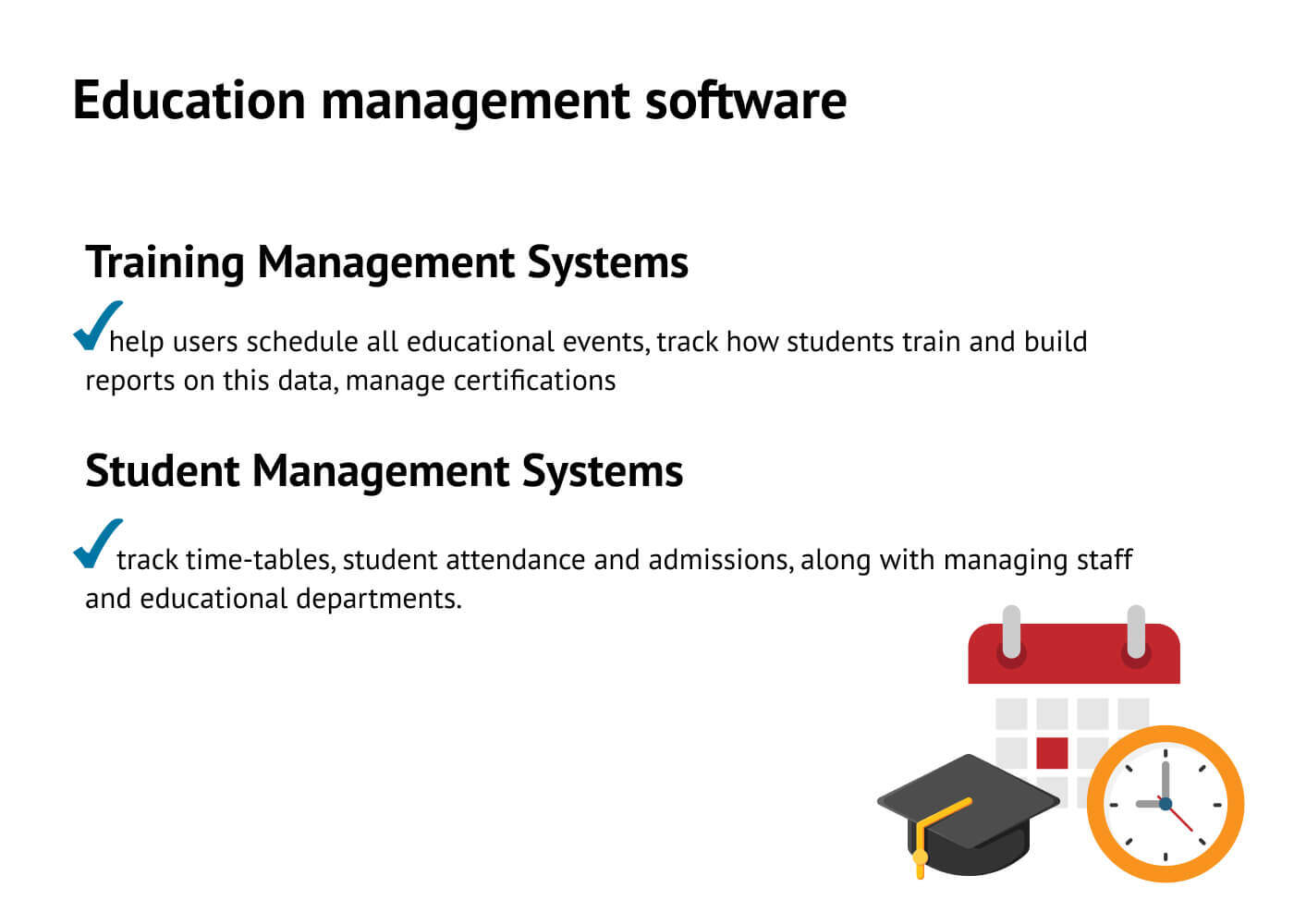
Training Management Systems
This software allows users to schedule all educational events, to track how students are progressing and build reports on this data, and to manage certifications. Businesses mainly opt for such systems to help them provide in-house employee training.
Student Management Systems
This type of software is for managing the routines of an educational business or system. It helps with student data, event scheduling, and communications.
Student Management Systems track timetables and student attendance and admissions, as well as help to manage staff and educational departments.
Now that you’re aware of all the possible types of e-learning software out there, you have probably decided which type you want to develop. But it’s also important to consider how you will monetize your solution.
We will discuss two approaches to monetizing an eLearning app: monetize the app itself or just the e-learning content and online courses.
Several methods can be used effectively to monetize your e-learning app.
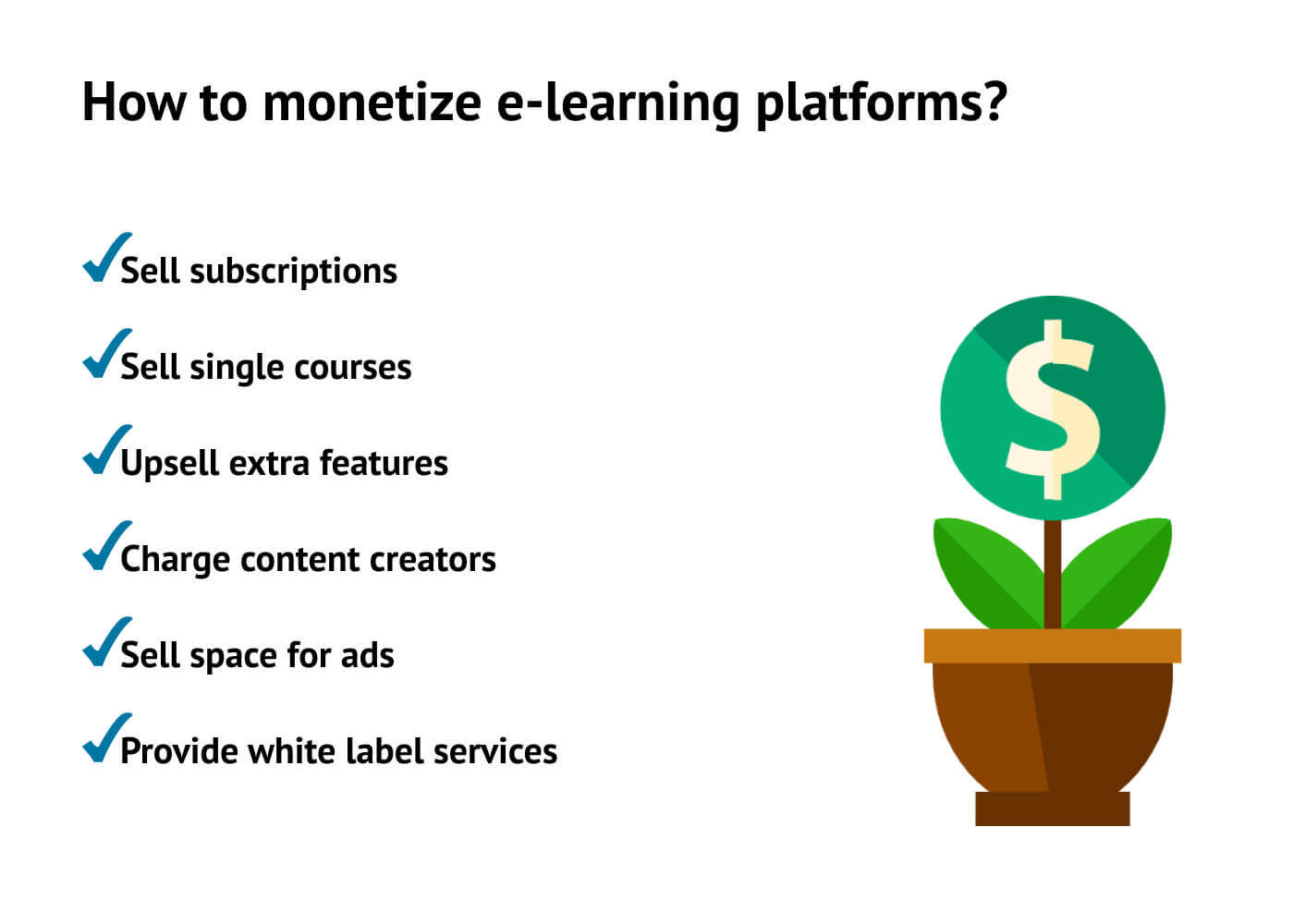
Sell subscriptions
You can provide a set of solution features for free — core features, for example — but require payment for full functionality. You can develop a “premium plan” that provides subscribers with extra features, such as course discounts.
For premium content creators, subscriptions can boost the course ranking.
Monetization methods for eLearning apps
Sell just single courses
It’s that simple: you sell individual courses to learners and they either get lifetime access or purchase a course for limited-time use. The course might be made available for a particular period of time, or until the subscription is over.
Upselling extra features is another option
Give users an opportunity to pay for the extra features they want without buying a subscription. For example, users might choose to pay for direct feedback from their tutor, or access extra learning material, and so on.
Charge content authors
If you have a platform that hosts tutors’ content, you can retain a commission for this. You can set different rates for regular and premium content hosting, or link it to the course’s popularity.
Sell space for advertisements
If you own a web-based eLearning app or a mobile application, you can sell advertising space to other businesses.
Provide white label services
You can offer a white-label product to tutors or other businesses. This allows your customers to use your course-development tools and start marketing them independently.
But what if you have a team of content creators in-house and can monetize educational content itself? Don’t miss that opportunity.
Let’s talk about several ways to monetize educational content that you create in-house or buy from third parties.
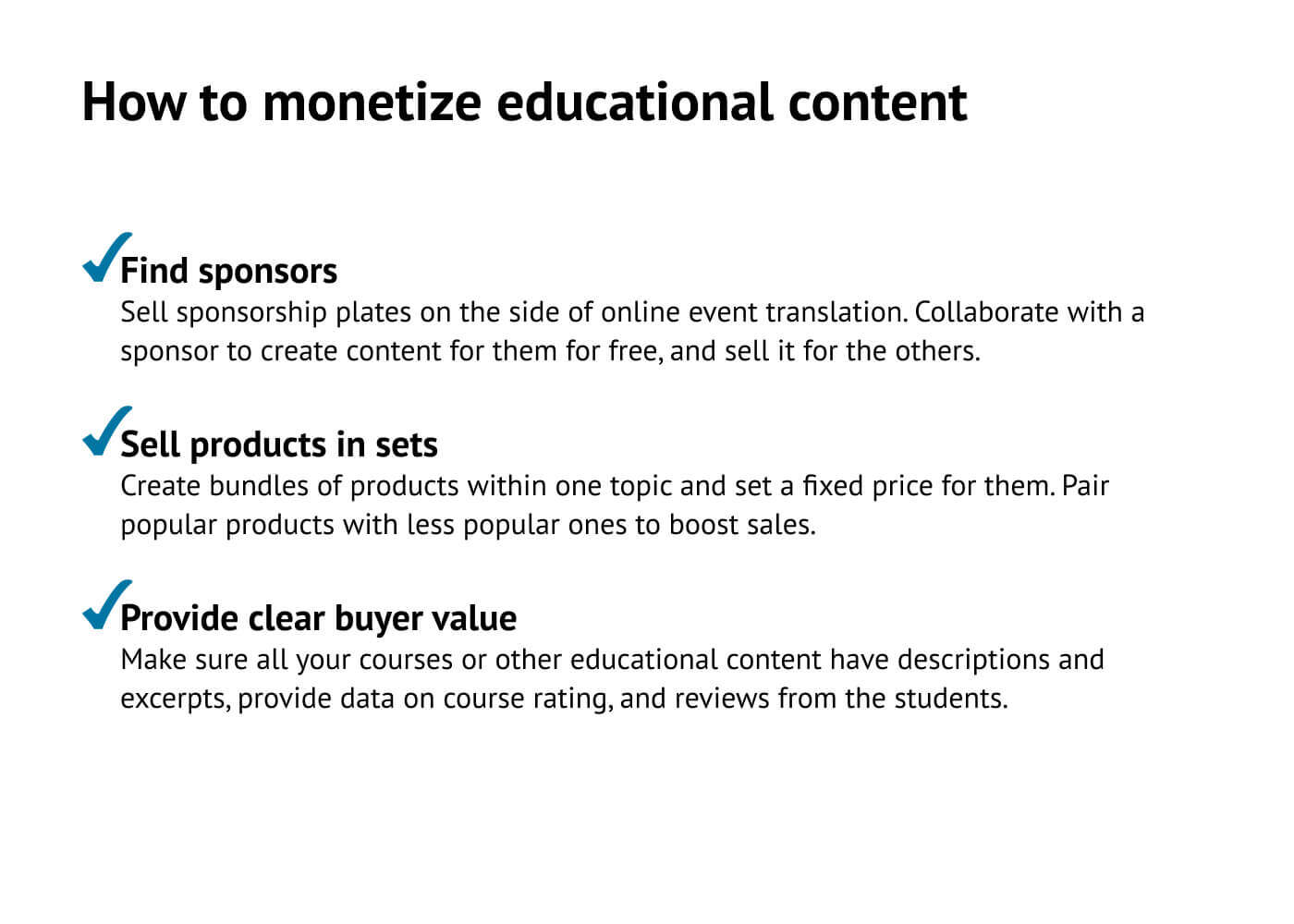
Find sponsors
Offline events often find sponsors; you can apply that idea to online education as well. Sell sponsorship plates on the side of an online translation while doing a podcast or a webinar.
You can also collaborate with a sponsor to create an exclusive e-learning course with them and offer it for their employees for free. Then charge the rest of the learning audience for the same content.
How to monetize educational content
Sell products in sets
You may be able to group courses on one topic in bundles and sell each bundle at a fixed price. This can be effective for students and profitable for you. You can also create bundles of courses grouped according to complexity level within one topic.
This strategy can help boost sales of less-popular content by grouping it with popular material within a particular topic area.
Provide clear buyer value
This is universal advice for every business but worth reiterating: make sure all your clients clearly understand what value they will get if they buy your educational content. Be sure to provide clear descriptions and excerpts from all your courses or other educational content; provide data on the course rating; and include reviews from students.
When considering eLearning software development services it’s important to understand the various types of eLearning platforms. They include:
Apps for educational content creation
Whether you decide to monetize the platform itself, or just the created educational content, it’s important to have a well-thought-out, effective monetization strategy. If you choose to monetize the platform itself, you may:
And if your goal is to profit from providing educational content, some options are:

Hymux Technologies Founder
Having founded the company in 2001, uses his broad knowledge to drive the company forward. Ready to share his wisdom on software development and technology insights


We are open to seeing your business needs and determining the best solution. Complete this form, and receive a free personalized proposal from your dedicated manager.

Sergei Vardomatski
Founder