The Fourth Industrial Revolution is transforming the world of manufacturing, and at the heart of this transformation lies the Internet of Things (IoT). By connecting machines, sensors, and systems, IoT technology enables seamless communication across the production floor, allowing devices to collect, share, and analyze data in real time.
In this article, I want to take a closer look at what IoT is, what advantages it can bring to manufacturing, and how to implement it in your projects to reap tangible benefits and advantages.
The Internet of Things refers to a network of connected objects — from machines and sensors to everyday tools — that use built-in software, sensors, and connectivity to exchange data with other devices. These smart “things” can monitor conditions, share insights, and even make decisions automatically.
While Wi-Fi has long been the backbone of IoT connectivity, advances in 5G, edge computing, and other network technologies now allow IoT systems to operate faster, more reliably, and almost anywhere. This means more data can be collected and processed in real time, enabling greater efficiency and smarter automation across industries.
How Does the Internet of Things Work?
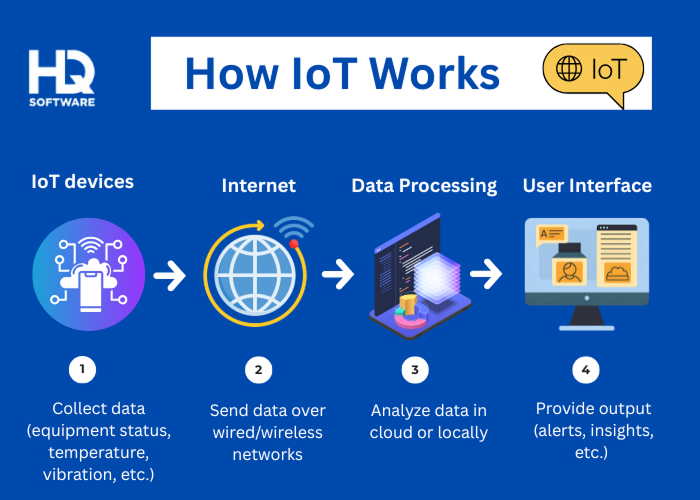
At its core, the Internet of Things is about gathering data and turning it into meaningful actions. The process typically involves four key stages:
Data collection: Using sensors, IoT devices collect data from their environment. This data can be simple, such as temperature, or complex, such as real-time video streaming.
Data exchange: Using available network connections, IoT devices send this data to a cloud platform, another device, or a local edge server for analysis.
Data processing: At this stage, specialized software analyzes the incoming data and triggers automated responses. For example, sending a maintenance alert or adjusting machine settings.
Data-driven actions: When aggregated and analyzed over time, the accumulated data from all IoT devices provides valuable insights that help businesses make informed decisions, optimize operations, and predict future needs.
How IoT Works in Practice
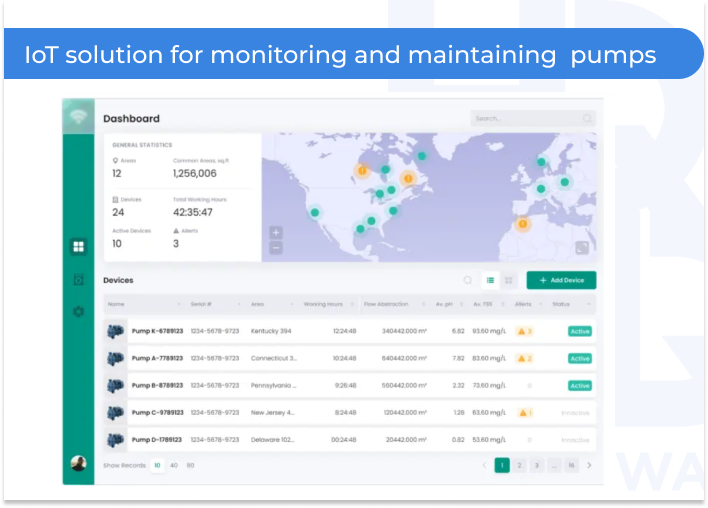
To better understand how this process works, let’s look at one of Hymux Technologies’s real-life IoT projects. A global manufacturer of dirty-water and slurry pumps used in mining and recycling turned to Hymux Technologies to build a modern IoT solution for monitoring and maintaining its pumps deployed worldwide. Their old LAMP-based system was unstable, lacked usability, and couldn’t display sensor logs in real time, which made proactive maintenance impossible.
To solve the problem, the Hymux Technologies team developed an IoT-based monitoring system. Each pump was equipped with sensors that measure parameters such as temperature, pressure, water flow, and pH level.
The data collected by the sensors is sent to the AWS Cloud, where it’s securely stored and processed in real time. Then, the information is visualized on an intuitive dashboard, showing the live status of every pump, geographic locations, and performance metrics. If any parameter reaches a critical threshold, the system automatically sends alerts and maintenance notifications.
As a result, the customer gained:
Real-time equipment monitoring and predictive maintenance capabilities
Improved decision-making capabilities with comprehensive performance analytics
A user-friendly interface suitable for both technical and non-technical staff
More than 10% improvement in operational efficiency and reduced downtime
You can explore other Hymux Technologies IoT projects and learn how these solutions help businesses improve efficiency, safety, and productivity here.
What Is Industrial IoT (IIoT)?
The Internet of Things touches many areas of modern life. Its use in manufacturing has given rise to the term ‘Industrial Internet of Things’. IIoT makes machines smarter by connecting them to sensors, peripheral devices, and real-time data processing systems. It’s like giving factory equipment a brain, allowing it to automatically collect, share, and respond to data.
In manufacturing, IIoT sensors are improving operations by monitoring equipment performance and automating key processes. For example, in a smart factory, if a conveyor or production line begins to slow down, IIoT systems can instantly detect the issue, alert maintenance teams, and even trigger preventive actions to minimize downtime.
In addition to manufacturing, IIoT is used in industries such as energy, utilities, and oil and gas. Instead of relying on outdated machines that operated in isolation, IIoT unlocks the hidden data that these systems have always generated and transforms it into valuable insights through real-time analytics.
Need a custom software solution? We’re ready to help!
Hymux Technologies has a team of skilled professionals ready to tackle the project. Ask me!
Using IoT in manufacturing is no longer a fringe experiment; it’s now mainstream. More and more manufacturers are embracing the Internet of Things because they believe that it will significantly enhance their business models. According to a ZipDo report, 63% of manufacturing firms have integrated IoT devices into their operations. Also, 52% of manufacturers cite data analytics as a critical area for digital transformation.
The Industrial Internet of Things market is also showing steady growth. A report by SkyQuest predicts that the IIoT market will attain a value of USD 1710.55 billion by 2030, with a CAGR of 23.1% over the forecast (2022-2030). The growth in technology adoption is linked to the development of cloud technologies and wireless network technologies, which will allow more devices to be connected simultaneously and at higher speeds.
According to an ABB survey of business and technology leaders, 72% of companies are increasing their investment in the IIoT to meet sustainability goals. In the same survey, 94% of respondents agreed that IIoT improves the quality of decision-making, and 57% noted that the technology has had a significant positive impact on operational decision-making.
These statistics highlight that the future of manufacturing is clearly digital, and those who embrace IoT today will lead the factories of tomorrow.
The Benefits of IoT in Manufacturing
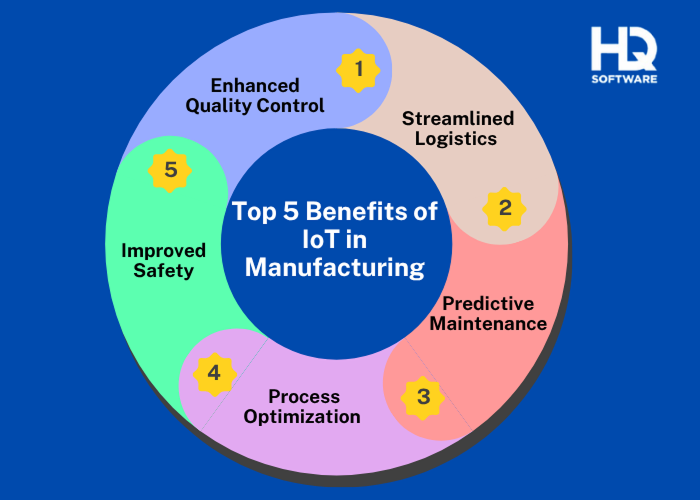
The Industrial Internet of Things offers companies a variety of advantages. The technology can be useful for any industry, whether it be smart manufacturing, energy, agriculture, or oil and gas.
Improved Safety
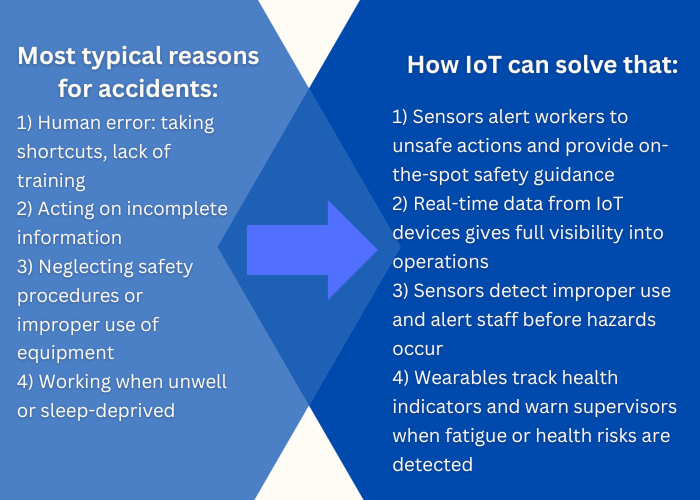
Production facilities remain high-risk environments for many workers. The International Labour Organization estimates that nearly 3 million people die every year from work-related accidents or diseases. For this reason, staff members need to be highly qualified and trained according to safety standards. And the worksite itself must be designed in a way suitable for the workers to carry out their tasks.
Industrial IoT solutions can play a vital role in reducing workplace accidents. For instance, Internet of Things devices can detect equipment breakage in real time and report it fast, allowing staff to respond quickly before issues escalate. Timely response reduces casualties and injuries and provides an opportunity to shorten downtime while equipment is being repaired.
Also, IoT-based predictive maintenance helps improve workplace safety by continuously monitoring equipment health. Sensors can track the condition of manufacturing equipment, predict possible accidents, and recommend proactive maintenance actions.
Enhanced Quality Control
Traditionally, manufacturers take a reactive approach to quality control: after the item is produced, it undergoes quality tests. If there are flaws, they are eliminated. With the new technology at hand, quality control becomes proactive. IoT-enabled devices can monitor raw materials, machine performance, and product conditions throughout the production process. These real-time insights allow for early detection of defects, optimization of workflows, and consistent improvement of product quality.
There are also many automation options for production equipment. Automated equipment makes mistakes only if not configured properly. With the appropriate setup process, facilities can produce goods with few or no defects.
Streamlined Logistics
Logistics is a sphere of trade that faces many challenges, such as rising transportation costs and quality control. The Internet of Things brings efficient solutions to many problems in logistics.
IoT in manufacturing enables seamless tracking of materials, components, and finished goods by connecting production facilities with suppliers and distributors.
For example, in one of our projects for a vehicle manufacturer, we developed an IoT software solution that uses beacon technology to create a multisensor system capable of tracking and measuring data from vehicles and components in real time. Each vehicle can be tracked individually, and finished goods can be monitored through delivery—providing customers with accurate, real-time updates on shipment status.
Beyond tracking, logistics can be upgraded with IoT-enabled transportation. Connected vehicles can interact with Smart City Infrastructure, using features like optimized routing to avoid traffic congestion or roadblocks. That cuts down fuel consumption, making transport more cost-effective
Process Optimization
One of the greatest strengths of IoT in manufacturing is its ability to streamline and optimize production processes. By collecting real-time data from machines, sensors, and systems, IoT gives manufacturers full visibility into every stage of production. This constant flow of data helps identify bottlenecks, inefficiencies, or deviations in performance before they cause downtime.
For example, IoT analytics can detect when production speed drops or when machinery begins operating below standard efficiency levels. With these insights, managers can make data-driven decisions to improve workflows and balance workloads.
Predictive Maintenance
Maintenance has long been one of the biggest challenges in manufacturing. Unexpected equipment failures lead to costly downtime and production delays. IoT-based predictive maintenance helps solve these problems.
Sensors embedded in machinery continuously monitor parameters such as vibration, temperature, pressure, and energy consumption. When abnormal readings appear, the system automatically alerts maintenance teams before a failure occurs. This early detection allows manufacturers to schedule repairs at the most convenient time, reducing unplanned downtime and extending the lifespan of equipment.
Energy Efficiency
Energy consumption is a major expense and environmental concern in manufacturing. The Internet of Things helps address both challenges by enabling smarter energy management.
Connected sensors and meters collect real-time data on energy usage across machines, production lines, and entire facilities. These insights reveal where energy is being wasted and help optimize usage based on actual demand. For instance, IoT systems can automatically power down idle equipment, adjust lighting or HVAC systems based on occupancy, and detect inefficient machinery.
Examples of IoT in Manufacturing
Using IoT in manufacturing enterprises significantly increases the efficiency and reliability of production processes. That is why many large manufacturers are effectively using IoT and achieving impressive results.
Volkswagen
Volkswagen is actively implementing Internet of Things technologies at its plants. Together with Amazon Web Services, it has created an industrial cloud that combines the equipment and production data of all the group’s enterprises. This gives engineers and operators real-time access to information about machine performance, enabling them to quickly identify problems and optimize production processes.
Some factories use the Shopfloor Integration Management system, which allows new equipment to be connected, software to be updated, and devices to be controlled remotely. This helps reduce downtime, increase productivity, and lower maintenance costs.
HBIS
One of the world’s largest steelmakers, HBIS Group Co., Ltd (HBIS), uses an IoT platform to analyze data from production equipment. Sensors are installed on rolling mills, motors, and furnaces. They monitor temperature, vibration, and other operating parameters in real time. The data obtained helps to detect equipment wear and overheating in advance, prevent accidents, and improve steel quality. In addition, the system analyzes energy consumption, which reduces costs and increases plant efficiency.
Bosch
Bosch uses IIoT and Big Data analytics to improve the efficiency of its Bosch Automotive Diesel Systems plant in Wuxi, China. Sensors are installed on the equipment to collect data on machine status and cycle times. This data is analyzed in real time, and employees receive notifications if bottlenecks occur in production.
This approach helps predict potential equipment failures in advance and plan maintenance before breakdowns occur. As a result, the plant operates longer without downtime, and productivity in some areas has increased by more than 10 percent. In addition, delivery quality and customer satisfaction have improved.
MFC Netform
MFC Netform, a manufacturer of components for power units (automotive and agricultural machinery), has implemented an IIoT solution to improve quality control and reduce defects.
A machine vision and connected device system automatically checks every part that does not meet technical specifications and immediately transmits the data to the ERP system. This helps to assess the cost of defects and optimize production processes. As a result, MFC Netform has gained greater production transparency and is able to identify and eliminate quality issues more quickly.
It should be noted that the use of IoT in the manufacturing industry is relevant not only for large corporations. Small and medium-sized enterprises also understand that the success of a company directly depends on the ability to collect, process, and use data provided by IoT devices. Even small production lines can increase efficiency, reduce downtime, and control product quality using smart sensors, connected equipment, and real-time analytics. Thus, IoT is becoming a key factor in competitiveness for companies of all sizes.
Common IoT Devices in Manufacturing
The examples above demonstrate the diverse applications of the Internet of Things in industry. To make such IoT solutions work, companies use a variety of connected devices that collect and analyze data in real time. Let’s take a look at the IoT devices most commonly used in manufacturing.
Device
Description
Smart sensors
Sensors that collect information about equipment status, temperature, vibration, fluid levels, and other parameters. They help monitor machines and alert staff to potential problems.
Edge devices
Devices that process data locally on the factory floor, near the machines, without sending it to the cloud. This enables fast results and immediate responses to changes in production.
RFID tags
Tags attached to materials, parts, or finished products. They make it possible to track items along the production line or in storage and help manage inventory in real time.
Industrial robots
Robots that automate repetitive or dangerous tasks in manufacturing. They perform operations with high precision and can work with other IoT systems to optimize processes.
Connected devices with AI
Devices connected to the network with built-in Artificial Intelligence. They can analyze data, predict equipment failures, optimize processes, and assist in decision-making with minimal human intervention.
Cloud-Based IoT Platforms for Manufacturing
When a company works on an IoT project, its team has to deal with many devices, tools, and security specifications. This is where IoT platforms come into play, providing data storage tracking, communication and security.
AWS IoT
AWS IoT is a cloud platform from Amazon that helps businesses connect, manage, and analyze data from thousands of devices. With its help, companies can collect data from equipment, store it in the cloud, and use machine learning tools to predict breakdowns or optimize processes.
The platform is particularly useful for manufacturing because it provides high security and scalability. For example, a factory can start by connecting a few machines and then gradually expand the system to the entire production network. In addition, AWS IoT integrates easily with other Amazon services, making it easy to build comprehensive analytics solutions.
Azure IoT
Azure IoT is a Microsoft solution designed to connect and manage devices via the cloud. It allows you to collect data in real time, analyze it, and automatically respond to events—for example, stopping equipment when it overheats or deviates from the norm.
The advantage of the platform is that it supports a hybrid approach: some of the data processing can take place directly at the factory (on edge devices), and the rest in the cloud. This speeds up the system’s response and reduces dependence on an internet connection. Azure IoT is well suited for integration with existing manufacturing management systems and Microsoft enterprise solutions.
Considering custom software?
Hymux Technologies’s team of experts can design and develop the perfect solution for your business. Let’s discuss it
Cloud-based IoT platforms like AWS IoT and Azure IoT provide a strong technological foundation, but successful implementation requires more than just choosing the right tools. To ensure that your IoT initiative delivers measurable business value, it’s important to follow a structured approach — from defining clear goals to scaling the solution across your operations. Below are the key steps to implementing an IoT project effectively.
Step 1: Setting Goals
As with other digital transformation initiatives, IoT implementation begins with defining project goals. First, you need to determine what your organization wants to achieve with IoT technology. Every organization has its own needs: some seek to reduce operating costs, while others want to improve quality control.
If you are having difficulty identifying use cases that are right for your business, Hymux Technologies specialists can provide you with a free consultation to help you understand IoT technology and create an action plan to achieve your business goals.
Step 2: Selecting the Necessary IoT Components
The selection of hardware and software is a critical decision during implementation. IoT projects involve various tools, and businesses need to carefully consider the connectivity and compatibility of these systems. The necessary components for IoT implementation include:
Sensors for data collection (weight, volume, temperature, humidity, pressure, etc.)
Edge gateways, which serve as the network entry point for devices and sensors interacting with cloud services
Communication protocols for machine-to-machine interaction (M2M)
IoT platforms for transferring information from various hardware devices to the cloud and controlling devices
Software for cloud data management and analytics, allowing the converted data to be transformed into useful information.
Step 3: Implementation and Prototyping
Before launching the full-scale solution, it’s best to start with a prototype or pilot project. This allows your team to validate the technology, test how sensors and devices perform in real operating conditions, and fine-tune data collection and communication. The goal is to confirm that the system works as intended before scaling it across the enterprise.
Step 4: Data Integration and Analytics Setup
Once devices and sensors are connected, the next step is integrating the collected data with your company’s existing systems (ERP, MES, or CRM). Then, analytics tools or dashboards are set up to visualize and interpret this data. By analyzing trends and anomalies, your organization can make data-driven decisions and predict maintenance needs or production bottlenecks.
Step 5: Applying Security Measures
Data security and privacy are major concerns for businesses. Security breaches during IoT implementation are common, and businesses should inform their data security specialists about IoT projects to ensure that best practices for data management are integrated into the project.
To minimize security breaches, IoT security solutions should be integrated. Endpoint security, communication protocols, access control, encryption, and fraud management are some of the measures that can be taken to improve data security and privacy.
Step 6: Scaling and Continuous Improvement
After the pilot proves successful, the project can be scaled to other production lines, facilities, or business units. Continuous monitoring and performance evaluation help optimize the system further. Gathering feedback from users and analyzing system performance allows the solution to evolve with changing business needs.
Challenges of Adopting IoT in Manufacturing
Since I am exploring the topic of IoT from different angles, it would be logical to talk about the challenges associated with implementing IoT in manufacturing. The difficulties may be different for one enterprise than for another. Therefore, I suggest looking at the most common ones.
Outdated Equipment
The equipment used in production has been in use for an average of 15 years. These are machines, devices, and tools that were never designed to be connected to any networks or sensors. Companies need to decide whether to modernize them or work with other, more modern equipment to collect and analyze data as part of the general trend toward integration.
Cybersecurity Issues
As more devices, sensors and systems become connected through the Industrial Internet of Things, the attack surface for manufacturers grows rapidly. According to the IBM “Cost of a Data Breach” report, the average cost of a data breach in the manufacturing sector reached USD 5.56 million — about 13% more than the global average.
Another study found that nearly 48% of manufacturing companies have suffered at least one cyberattack linked to their IIoT systems.
Because manufacturing often uses legacy equipment, flat network architectures, and OT/IT systems that historically weren’t designed with cybersecurity in mind, attackers have many entry points. Given these risks, cybersecurity cannot be treated as a secondary concern. It must be built into the design, deployment and monitoring of any IoT project from day one.
Data Management and Integration
IoT in manufacturing generates massive volumes of real-time data from machines, sensors, and connected devices. Managing, cleaning, and integrating this data with existing enterprise systems (such as ERP or MES) can be complex. Without a solid data strategy, manufacturers risk creating data silos and losing valuable insights that could otherwise drive efficiency and innovation.
High Implementation Costs
While IoT solutions for manufacturing offer significant long-term benefits, the initial setup costs can be substantial. Expenses related to sensors, connectivity, edge devices, and software integration often discourage smaller manufacturers from moving forward. According to Deloitte, nearly 30% of manufacturing leaders cite high costs as the main barrier to implementing IoT. Starting with scalable pilot projects can help reduce financial risk and prove ROI early.
Lack of Skilled Personnel
Implementing IoT requires experts in hardware, software, cloud computing, and data analytics — skills that are still relatively rare in traditional manufacturing environments. Many factories struggle to find or train professionals who can maintain complex IoT ecosystems. Building internal expertise and partnering with experienced IoT providers can help overcome this challenge.
The Internet of Things requires a balanced approach. All aspects of its use must be analyzed. This will help avoid problems during system implementation and make it more effective. Doing without IoT is also not an option, as it is virtually impossible to remain a competitive company without improving production.
Conclusion
The Internet of Things requires a thoughtful and balanced approach. Every stage of implementation, from planning to security, should be carefully analyzed to overcome challenges and ensure maximum efficiency. In today’s competitive market, ignoring IoT is not an option, as it has become a key driver of productivity, innovation, and growth in the manufacturing industry.
If your company is planning to implement IoT in manufacturing, the Hymux Technologies team can help. Our experts will guide you through each step, from concept and prototyping to full-scale deployment, ensuring your IoT solution delivers real business value. Contact us today to discuss your project.
An experienced developer with a passion for IoT. Having participated in more than 20 Internet of Things projects, shares tips and tricks on connected software development.
Smart manufacturing is increasingly using IoT solutions to improve efficiency and safety. Top trends include predictive maintenance, real-time monitoring, connected devices with AI, and digital twins. Companies are also focusing on edge computing and cloud-based platforms to analyze data quickly. These trends help manufacturers optimize operations and reduce downtime while improving product quality.
What’s the Difference Between IIoT and Industry 4.0?
IIoT focuses on connecting machines, sensors, and systems in industrial environments to gather and analyze data. Industry 4.0 is a broader concept, encompassing IIoT along with automation, robotics, and digital integration across the entire manufacturing process. In short, IIoT is a key component of the Industry 4.0 transformation.
Should We Build Our Own IoT Platform or Buy a Commercial Solution?
Choosing between building or buying depends on budget, expertise, and scalability needs. A commercial solution can be deployed faster and comes with ongoing support. Building your own platform allows full customization but requires a skilled team and maintenance.
What KPIs Should We Track to Measure IoT Success?
Important KPIs include equipment uptime, production efficiency, energy consumption, and maintenance response times. Monitoring data accuracy and the number of predictive maintenance events can also show the system’s effectiveness. Tracking these metrics helps businesses evaluate how IoT solutions for manufacturing improve their productivity and reduce operational costs.
We are open to seeing your business needs and determining the best solution. Complete this form, and receive a free personalized proposal from your dedicated manager.