Anxiety disorders present significant challenges for patients and clinicians, often demanding resource-intensive and logistically complex interventions. But we bump into familiar roadblocks, for example with trying to re-create a turbulent flight scene in the office, guaranteeing patient safety during exposure, or tailoring each session to a client’s unique pace. Virtual Reality (VR) can help you deal with these issues.
This article is intended for mental health professionals, technology developers, and anyone invested in advancing anxiety treatment. We’ll walk through the complex area of anxiety disorders treatment and show how you can summon any trigger on demand, collect real-time data, and keep patients secure behind a headset. By the end, you’ll see how integrating Virtual Reality for anxiety treatment can amplify your current stress treatment protocols and add an interactive layer to your therapy pool.
Virtual Reality therapy for anxiety disorders involves using VR technology to create controlled digital environments where your patient can safely practice coping with situations that trigger:
anxiety and stress
phobias and panic disorder
social anxiety disorder
obsessive-compulsive disorder (OCD)
post-traumatic stress disorder (PTSD)
generalized anxiety disorder
traumatic brain injury
or other psychological issues.
VR therapy for anxietyis an effective approach to mental health treatment because it’s highly personalized and adaptable to a wide range of conditions. For instance, a person who experiences a fear of public speaking can be placed via VR in a virtual auditorium to practice their speech in a risk-free setting.
The power of VR lies in its ability to gradually build confidence and resilience in a way that feels real, but without the actual risks. This makes VR a powerful tool for therapeutic growth.
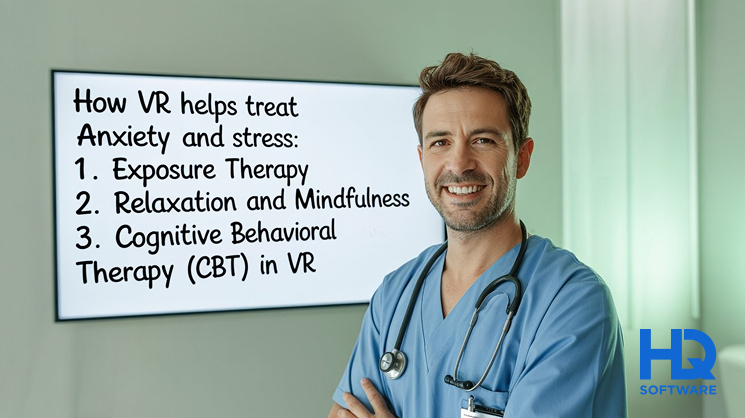
How VR Helps Treat Anxiety and Stress
As an experienced VR software development company, we can confidently say that anxiety and stress therapy using VR often outperforms traditional methods in several key areas, including apps designed for therapy, training, and education. Here are the main reasons:
Engagement: Gamified experiences keep a user motivated.
Control: Therapists can adjust scenarios to the patient’s pace.
Realism: The human brain processes VR as almost real, accelerating progress.
Privacy: Patients can practice social skills without dealing with real-world judgment.
In short, using online therapy for stressdoesn’t just treat anxiety; it rewires the patient’s brain to help them face fears, find calm, and think clearly. The virtual world becomes a safe playground for growth within the following therapeutic areas.
Exposure therapy
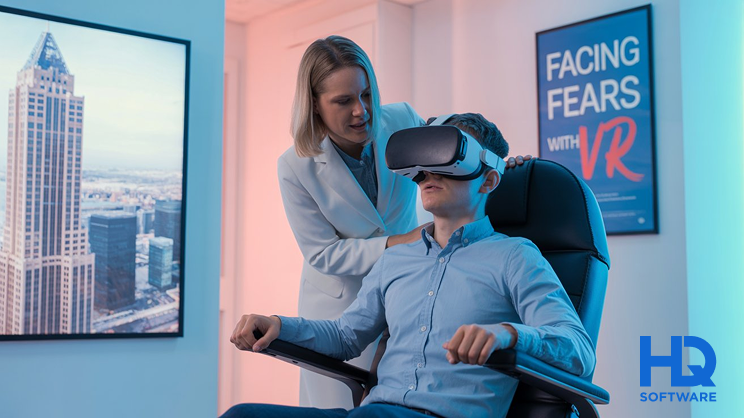
Imagine a patient who is terrified of heights (acrophobia) but wants to overcome this fear. Traditional exposure therapy involves gradual real-life confrontations, for instance visiting a tall building, which can be overwhelming.
With VR, your patient simply puts on a headset and suddenly finds himself standing on the edge of a virtual skyscraper, feeling the wind, seeing the ground far below, and experiencing realistic anxiety—but with a safety net. The human brain doesn’t easily distinguish between the virtual and the real in terms of a fear response, so desensitization happens faster and without the risk of real-world harm.
How it works in VR: A therapist guides his patient through levels of exposure, starting with peeking over the edge, then taking small steps forward, and eventually walking across a virtual catwalk. Each session builds confidence and coping mechanisms. By the end, that skyscraper doesn’t trigger panic anymore.
Relaxation and mindfulness training
If you’re overwhelmed by stress and your mind is racing, VR can transport you to a serene beach at sunset, where waves gently lap the shore, seagulls softly cry, and the breeze carries the scent of saltwater.
Studies show that relaxation using VR lowers cortisol levels, heart rate, and brain activity associated with anxiety. Regular practice rewires the brain to respond calmly to real-life stressors. When life gets chaotic, you can recall that peaceful virtual moment and instantly relax. It’s like carrying a portable zen garden in your headset.
How it works in VR: A therapist doesn’t even need to be present for this. With guided instructions via headphones, a patient learns deep breathing exercises, progressive muscle relaxation, or mindful meditation. Unlike a static app or a YouTube video, VR is fully immersive. When using it, you might feel the warmth of the virtual sun on your skin, watch leaves rustle in a tranquil forest, or float weightlessly through space. This is kind of a neuro-reprogramming.
Cognitive Behavioral Therapy (CBT) in VR
Anxiety often stems from distorted thinking patterns, such as the belief that “I’m a failure,” or “Everyone judges me.” CBT is meant to help rewire these thoughts; however, talking about fears in a therapist’s office can feel abstract. VR brings cognitive restructuring to life.
How it works in VR: Imagine a patient practicing a virtual job interview while a therapist observes. They stumble over words, feel sweaty palms, and think, “I’m terrible at this!” But VR interrupts that scenario: the interviewer gives positive feedback, smiles, and nods. The therapist guides the patient to reframe their thoughts: “I was nervous, but I answered confidently.”
During the next session the patient retries the interview, but this time, she’s prepared. VR simulates social situations, public speaking, or everyday challenges like grocery shopping where negative thoughts may surface. By confronting and rewriting the scripts in a virtual world, a patient begins to internalize a healthier mindset.
So, each VR session is a rep, building resilience for real life. You might find this hard to believe. Let’s back these claims with facts and clinical studies.
Need a custom software solution? We’re ready to help!
Hymux Technologies has a team of skilled professionals ready to tackle the project. Ask me!
Clinical depression, or major depressive disorder, is projected to be the No.1 global health challenge by 2030 by the World Health Organization. Anxiety tags along, fueling a vicious cycle of worry, sleepless nights, and even substance abuse.
However, a recent and compelling study from Texas A&M University School of Public Health has provided powerful new evidence. This research, funded by the National Council for Therapeutic Recreation Certificationand published in Frontiers in Psychology, specifically investigated whether meditation using immersive virtual reality devices could offer greater relief from depression and anxiety symptoms than traditional meditation alone.
To understand how they tested this, imagine yourself as one of the 25 adults in their study, all of whom were already diagnosed with depression and anxiety. For 10 weeks, these participants regularly used Meta Oculus Quest 2 headsets for personalized 30-minute meditation sessions, three times a week.
What’s great is that they could choose their own immersive virtual settings, such as a serene beach or a calming meadow, and even select specific meditation goals, such as stress reduction or improved sleep. Throughout the study, researchers meticulously tracked their progress using standard questionnaires for anxiety and depression, and measured their emotional regulation through heart rhythm patterns.
The Columbia University Clinic for Anxiety and Related Disorders is also advancing social anxiety treatment with VR-based interventions. Dr. Anne Marie Albano and Dr. Lauren Hoffman lead the initiative, enabling patients to simulate anxiety-provoking social scenarios in a controlled environment. “VR enhances social skills acquisition and expands treatment accessibility,” notes Dr. Hoffman. This approach aligns with empirical evidence supporting VR’s efficacy in anxiety disorders.
Overall, the scientific community is actively studying the use of VR for anxiety disorders treatment, and the results are incredibly promising, providing the robust evidence we need.
Considering custom software?
Hymux Technologies’s team of experts can design and develop the perfect solution for your business. Let’s discuss it
How Hymux Technologies Can Help You With Virtual Reality Therapy
Hymux Technologies can serve as a strategic technology partner for medical institutions and therapists looking to integrate Virtual Reality for anxiety treatment into their therapy protocols. To get a sense of our expertise, take a look at our portfolio. Here’s how we can help:
Custom VR content development. We specialize in creating highly realistic, customizable, and clinically relevant virtual environments and scenarios tailored to specific anxiety disorders including: phobias such as fear of heights or public speaking, social anxiety, and PTSD triggers.
Intuitive therapist control panels. We design user-friendly interfaces for therapists to easily manage sessions, adjust parameters such as intensity of exposure and environmental elements, track patient progress, and personalize treatment plans. Simultaneously, we can optimize the patient experience for immersion, comfort, and therapeutic effectiveness.
Integrated data analytics and reporting. Our developers can incorporate robust analytics tools to track patient physiological responses, engagement levels, and progress within the VR environment. This provides valuable data for therapists to assess efficacy, adapt treatment, and demonstrate outcomes.
Seamless EHR integration. We ensure your VR therapy program for anxiety treatment can integrate smoothly with existing Electronic Health Record (EHR) systems, streamlining patient data management, improving workflow efficiency, and ensuring compliance.
Ensuring data security and regulatory compliance. Understanding the stringent requirements of healthcare data (e.g., HIPAA, GDPR), we build secure, compliant platforms that protect patient privacy and adhere to medical device regulations where applicable.
By partnering with Hymux Technologies, you’ll receive scalable VR platforms that can grow with your institution’s needs, allowing for expansion into new therapeutic areas or larger patient bases as VR adoption increases.
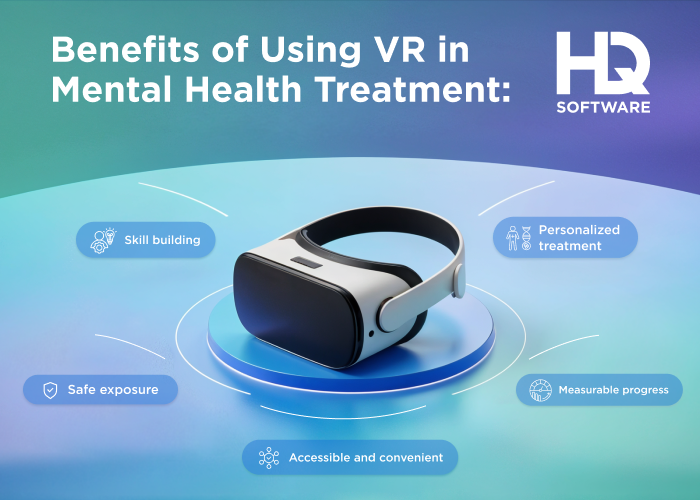
Benefits of Using VR in Mental Health Treatment
Extensive research confirms our stance: VR therapy for anxiety disorders treatment is an effective tool. However, its benefits don’t stop at efficacy. Here’s how VR further enhances therapeutic outcomes:
Safe exposure. VR allows a patient to gradually face and conquer their fears in a controlled, safe environment. For example, someone who has a fear of heights can start by standing on a virtual ledge just a few feet off the ground, gradually increasing the height as their comfort level grows.
Personalized treatment. VR scenarios can be tailored to a person’s specific needs and experiences. If you’re dealing with PTSD from a particular event, the virtual environment can be designed to mimic that event, which allows the patient to process and heal from it in a safe space.
Accessible and сonvenient.Virtual therapy for anxiety treatment can be done from the comfort of a person’s own home. This is highly beneficial for those who have difficulty leaving their home or live in areas with limited mental health resources. Plus, it can be more convenient, fitting more easily into a normal schedule.
Measurable progress.Online therapy for stress and anxiety treatment often involves quantifiable tasks or scenarios that allow both the patient and therapist to track progress more objectively. For instance, if you’re working on managing social anxiety, you can measure your comfort level in increasingly challenging social situations.
Skill building. VR provides a safe space to practice and build coping skills. If you’re working on managing anger, for example, you can practice calming techniques in a virtual environment that triggers your anger response.
Moreover, VR systems can track progress through metrics such as heart rate, eye movement, and time spent in challenging scenarios. All these give therapists valuable insights to guide treatment.
To support these points, let’s look at some widely used VR applications for managing anxiety.
Popular VR Solutions for Anxiety Treatment
VR platform for anxiety and stress therapyby Hymux Technologies
Developed together with mental health professionals, Hymux Technologies’s VR solution enhances anxiety treatment by creating immersive, safe environments where patients can confront triggers such as public speaking or phobias under guidance.
The platform uniquely integrates breathing exercises, calming visualizations, and biometric feedback such as heart rate to monitor the user and adapt the simulation’s intensity in real time, ensuring a tailored experience. By combining Cognitive Behavioural Therapy techniques with guided breathing, the platform provides an engaging, measurable, and accessible alternative or supplement to traditional therapy. Such an approach helps people effectively practice coping skills and build resilience.
oVRcome
oVRcome offers a comprehensive, clinically proven solution for Virtual Reality exposure therapy, making effective anxiety treatment more accessible and user-friendly. The platform empowers individuals to safely confront and manage common anxieties such as phobias, including fear of heights, public speaking, spiders, social anxiety, and other stress-inducing situations within controlled virtual environments.
With this solution you can access a diverse library of scenarios, track patient progress, and enhance therapeutic outcomes with intuitive tools, making it easier to deliver impactful, evidence-based care.
XRHealth
XRHealth specializes in Extended Reality (XR) therapeutic applications, effectively operating as a “virtual clinic.” They connect patients with licensed clinicians who deliver a range of treatments, including physical therapy, occupational therapy, pain management, cognitive rehabilitation, and behavioral health support through immersive VR and AR experiences. Therapy is typically accessed from the patient’s home.
XRHealth’s platform enables personalized care plans, remote patient monitoring by therapists, and data-driven insights to guide treatment, often utilizing FDA-registered medical applications to improve access and outcomes in healthcare.
Future of VR in Stress and Anxiety Treatment
The VR therapy market is poised for substantial growth, projected to reach $1.62 billion by 2031. This expansion is driven by rising demand for digital mental health solutions and the increasing adoption of VR in psychotherapy to address anxiety, depression, and stress.
The evidence supporting this demand is robust: a systematic review of 50 studies involving 2,885 participants demonstrated that VR-based interventions, including cognitive behavioral therapy, exposure therapy, mindfulness, and relaxation techniques, resulted in significantly reduced stress levels, emotional tension, and psychiatric symptoms.
Key trends we’re embracing include:
Virtual Reality exposure therapy (VRET) expansion and customization. VRET remains a leading application of VR in anxiety treatment, widely used to treat anxiety disorders, phobias, and PTSD by exposing patients to controlled, immersive fear-inducing environments in a safe manner.
Non-exposure-based VR interventions for broader stress and anxiety management. Beyond exposure therapy, there is a growing trend toward non-exposure VR interventions that focus on mindfulness, relaxation, cognitive restructuring, and emotional regulation to reduce stress and anxiety symptoms without triggering a recurrent experience of trauma. These non-exposure VR programs often include psychoeducational components teaching stress management and mindfulness techniques for continued self-care beyond VR sessions.
Physiological and neuropsychological mechanisms underpinning the benefits of VR. VR interventions leverage cognitive distraction, immersive relaxation environments, and guided mindfulness to reduce autonomic arousal (for example, increased heart rate), promoting emotional regulation and stress relief.
Integration with multimodal and gamified therapies. Innovative VR applications are incorporating multimodal interactions such as breathing exercises, olfactory stimuli, and gamified scenarios to enhance anxiety relief and engagement.
To sum up, anxiety and stress therapy using VR is increasingly being adopted in healthcare systems worldwide, including in mental health rehabilitation for veterans and general anxiety management. Patient satisfaction and adherence rates are high due to the engaging and immersive nature of VR interventions.
Curious to learn more? Reach out to explore our VR development services.
National Institutes of Health (NIH), PubMed Central – “Virtual reality (VR) treatments for anxiety disorders are unambiguously successful, so why are so few therapists using it? Barriers to adoption and potential solutions” https://pmc.ncbi.nlm.nih.gov/articles/PMC10592498/
A developer with extensive expertise in AR/VR, very ingrained into the topic of Mixed Reality development. Shares his knowledge and the results of many years of work.
VR creates controlled, immersive environments to safely expose a patient to anxiety triggers, such as crowds or heights, in a manageable way. This exposure therapy, guided by professionals, helps reduce the fear response over time. VR also offers relaxation tools, for instance calming virtual scenes, to manage stress management and improve overall mental wellness.
What types of anxiety disorders can be treated with VR therapy?
VR therapy effectively addresses various anxiety disorders. This includes social anxiety (practicing interactions), phobias (gradual exposure to fears), PTSD (safe re-experiencing of trauma), and generalized anxiety (relaxation and coping skills). It offers a controlled environment for managing these conditions.
What does a typical VR therapy session look like?
A typical session begins with a brief check-in. Then, using a headset, the patient enters a carefully designed virtual environment tailored to their needs. With the help of a therapist, they engage in activities, gradually facing anxieties or practicing skills. Sessions last 20-45 minutes, with debriefing afterward.
What is the typical cost of developing VR therapy software for anxiety?
The cost of developing VR therapy software varies widely. Factors include complexity, features, and team size. Developing custom environments and integrating therapeutic protocols increases the expense. A detailed project plan and scope are crucial for accurate cost estimation.
What equipment is needed for VR anxiety therapy?
VR therapy requires a VR headset (for example, Oculus or HTC Vive) and a computer or gaming console to run the software. Tracking sensors and a comfortable, safe space may also be needed for full immersion. Therapists manage the setup and ensure the technology is appropriate for the individual’s needs.
We are open to seeing your business needs and determining the best solution. Complete this form, and receive a free personalized proposal from your dedicated manager.