Table of contents:
Benefits of Using VR in Engineering
How Can Engineers Use Virtual Reality?
5 Applications of VR in Engineering
How Hymux Technologies Supports VR Solutions for Engineering

How often do engineering teams struggle with costly design revisions, safety training risks, or miscommunication over complex 3D concepts? Virtual Reality (VR) technology in engineering is changing these traditional pain points into opportunities for innovation.
As engineering projects grow more complex and budgets tighter, VR offers a powerful solution: the ability to visualize, test, and refine designs in immersive 3D spaces before committing resources to physical construction. This shift from imagination to experience is enhancing how engineers work, learn, and deliver projects. Ready to explore how? Let’s dive in.
Benefits of Using VR in Engineering
How Can Engineers Use Virtual Reality?
5 Applications of VR in Engineering
How Hymux Technologies Supports VR Solutions for Engineering
In engineering, Virtual Reality lets engineers immerse themselves in fully digital environments to prototype products or systems before they’re built in the real world. As a company passionate about how innovation shapes industries, we see VR as an effective tool for:
So, whether it’s walking through a virtual power-plant layout or fine-tuning an automotive assembly line, using Virtual Reality in engineering connects imagination and implementation, making the engineering process more efficient.
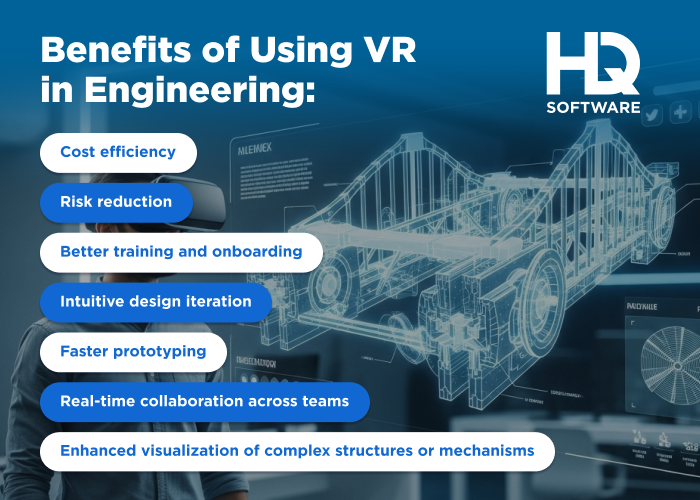
Virtual Reality enables engineers to step inside their designs, test scenarios without physical prototypes, and collaborate seamlessly across global teams. In every application, VR eliminates uncertainty and prevents costly errors. Now, let’s explore which engineering sectors benefit most from this transformative technology.
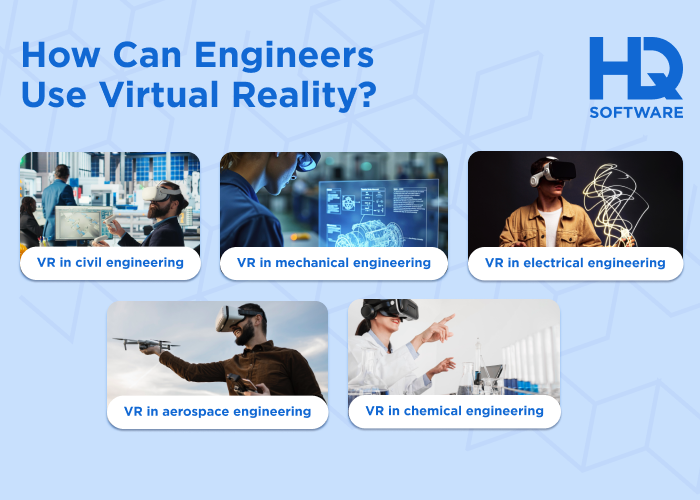
Civil engineers can use VR to walk through infrastructure projects before construction even begins. Inside the simulation they can examine everything from bridge designs to urban developments at full scale. It’s possible to inspect structural elements, test traffic flow patterns, and identify potential issues with drainage or utilities placement while modifications are still digital.
For complex projects such as tunnels or interchanges, Virtual Reality helps engineers visualize how different systems will interact in three-dimensional space, catching conflicts that might be missed in traditional 2D drawings. Moreover, with VR representations they can evaluate sightlines, accessibility, and aesthetic impact.
Mechanical engineers can use Virtual Reality to prototype and test moving parts, watching gears mesh, pistons pump, and assemblies operate, all before cutting metal. They can perform virtual stress tests, analyze thermal distributions, and optimize designs for manufacturability while iterations cost only computing time.
VR excels at conveying spatial relationships in complex machinery, helping engineers understand how components fit together and move in relation to each other. Maintenance planning becomes more effective when technicians can practice disassembly sequences virtually, identifying the optimal service procedures and required tools before approaching actual equipment.
VR proves especially valuable for planning electrical installations in buildings or industrial facilities, where engineers can route conduits, place panels, and ensure proper clearances without physical mockups. Training applications let technicians practice working on high-voltage equipment or complex control systems safely, building confidence before handling live circuits.
Additionally, electrical engineers can leverage VR to visualize electromagnetic fields, current flows, and signal propagation in 3D space. They can design and test circuit boards by manipulating components in a virtual environment, seeing how changes affect performance in real time.
Need a custom software solution? We’re ready to help!Hymux Technologies has a team of skilled professionals ready to tackle the project. Ask me!
Victoria Rokash
Business Development Manager
Aerospace engineers employ Virtual Reality to examine aircraft and spacecraft designs from both interior and exterior perspectives, checking everything from passenger ergonomics to maintenance accessibility. VR aids in simulating flight conditions and testing how components behave under various stresses, visualizing airflow patterns and structural deformations.
VR facilitates collaborative design reviews where global teams can inspect engines, evaluate cockpit layouts, or optimize cargo configurations in shared virtual spaces. For aerospace manufacturing, VR guides technicians through complex assembly procedures for components that cost millions and where there is zero toleration for errors.
Virtual Reality training environments can recreate hazardous scenarios such as chemical spills or reactor malfunctions, which allows operators to practice emergency procedures without real danger. Plant engineers can conduct virtual plant tours with remote teams, inspect equipment internals without shutdowns, and collaborate on process improvements by manipulating 3D piping and instrumentation diagrams together.
Also, VR can help chemical engineers optimize plant layouts, ensuring safe distances between reactive materials and planning efficient process flows. For instance, they can simulate chemical reactions and visualize molecular interactions at a scale that makes complex processes intuitive to understand.
All of this demonstrates VR‘s significant value in engineering training, with applications extending far beyond those discussed here. Having seen VR’s engineering potential, now let’s look at practical implementation.
Hymux Technologies’s Virtual Reality development expertise reveals five applications that are having a major impact on this field. We’ll illustrate these cases with proven examples from our VR engineering portfolio.
From our experience supporting field engineers, we know how crucial quick and accurate maintenance can be. VR enables interactive training on equipment operation, disassembling, repairing, reassembling procedures, etc., so technicians can practice in a risk-free environment. This means fewer mistakes in the field, less downtime, and faster troubleshooting because they’ve already “experienced” the repair process before touching the actual machine.
At Hymux Technologies, we’ve engineered a training platform that delivers immersive simulations for professional skill development. Covering diverse fields from truck and aircraft maintenance to electrical systems, these realistic scenarios allow trainees to master complex tasks while building job-critical competencies. We’ve made tasks such as using a screwdriver, taking measurements, or operating a car jack feel authentic and realistic, so trainees can develop proper technique and muscle memory.
Ever struggled to explain a complex engineering concept using just blueprints or 2D screens? VR brings projects to life. With immersive 3D modeling tools, designers can create, modify, and test prototypes in real time without the cost or delay of physical models.
For instance, you can refine a 3D model of a new machine or structure before spending a single dollar on physical materials. With VR, engineers can immerse themselves in a virtual prototype, checking ergonomics, functionality, and aesthetics in real time.
Our project experience shows VR‘s value in training engineers: it’s safe, practical, and works for all skill levels. From simulating complex machinery operations, electrical faults, or chemical spills to practicing emergency responses, VR helps users gain hands-on experience without real-world risks. It’s especially valuable for teaching safety protocols in high-risk environments such as construction sites or manufacturing plants.
For example, we’ve integrated a VR safety training module for production facility employees. Here participants learn key safety steps to take during an emergency alarm. The simulation includes visual guides like flashing lights, arrows, and a siren to help trainees find their way. The system can also be used to practice more complex emergencies like fires, injuries, explosions, and natural disasters, offering full emergency response training.
One of the most rewarding parts of using VR is seeing abstract plans come to life in 3D space. Engineers can “walk through” virtual buildings, inspect mechanical systems, or explore infrastructure projects before they’re built. This immersive experience helps everyone understand scale, spatial relationships, and potential design improvements, which makes approvals and adjustments faster and clearer. Such an approach can lead to more informed decisions and fewer costly changes down the line.
At Hymux Technologies, we believe that distance shouldn’t slow down production processes. With VR, engineers across the globe can meet in a shared virtual workspace, interacting with 3D models as if they were in the same room. Need to troubleshoot a design? Team members can point, annotate, and modify components in real time, making remote collaboration as effective as an in-person meeting.
Considering custom software?Hymux Technologies’s team of experts can design and develop the perfect solution for your business. Let’s discuss it
Dmitry Tihonovich
Business Development Manager
At Hymux Technologies, we combine technical expertise with industry-specific knowledge to create immersive VR solutions that improve engineering workflows. Here’s how we do it:
So, you’re ready to implement training, but selecting the right hardware is still a challenge? Let’s find out which one will suit you the best.
Andrey Kazakevich
Head of Production
at Hymux TechnologiesOver the past five years, we’ve seen VR change from an experimental tool to an essential component of engineering training programs. We’ve helped factories and airlines use VR for training such as fixing aircraft and touring buildings before they exist. With better VR tech and smarter AI scenarios, VR training is about to go from ‘nice-to-have’ to ‘must-have’ across industries.
As an AR/VR development company with 23+ years of experience, we always stay at the forefront of technological trends and innovations.
Through our latest market analysis, we’ve identified the five most effective and widely used headsets for microtraining in engineering. For your convenience, we’ve compiled a table of leading VR headsets, highlighting their key features and benefits for engineering applications.
| 1. Varjo XR-4 Series | Renowned for its ultra-high resolution and precise tracking, the Varjo XR-4 offers high-level visual fidelity that makes it ideal for detailed engineering tasks. It supports both VR and AR, enabling seamless transitions between virtual and real-world environments. Its ergonomic design ensures comfort during long sessions, and it integrates effortlessly with major CAD software. |
| 2. HTC Vive XR Elite | The HTC Vive XR Elite is a headset that supports VR, AR, and MR technologies, providing engineers with a flexible tool for various applications. It features high-resolution displays, accurate tracking, and a lightweight design for extended use. The Vive XR Elite also boasts robust collaboration tools for perfect team-based engineering projects. |
| 3. HP Reverb G2 V2 | The HP Reverb G2 V2 offers engineers a clear and immersive experience thanks to its high-resolution display and precise tracking. It offers improved comfort compared with its predecessor, with better audio and an enhanced controller design. The G2 V2 integrates well with popular CAD software, making it a solid choice for detailed engineering visualization. |
| 4. Apple Vision Pro | The Apple Vision Pro offers engineers a high-resolution, comfortable, and user-friendly VR experience. It provides advanced eye-tracking, spatial audio, and seamless integration with the Apple ecosystem. The Vision Pro supports a wide range of professional applications, including CAD software, making it a powerful tool for engineering tasks. |
| 5. Meta Quest Pro 2 | The Meta Quest Pro 2 is a standalone VR headset that offers high performance and wireless freedom, making it ideal for engineers who need mobility. The headset provides advanced tracking and comfortable ergonomics for extended use. The Quest Pro 2 supports a wide range of engineering applications and offers robust collaboration features. |
Virtual Reality has moved beyond the realm of possibility into practical necessity for modern engineering. We’re witnessing a fundamental shift in how engineers approach design, training, and collaboration, from reactive problem-solving to proactive innovation. The examples we’ve explored represent just the beginning of VR‘s transformative potential.
As hardware becomes more accessible and software more sophisticated, the question isn’t whether to adopt VR in engineering, but how quickly you can integrate it into your workflows. Companies already using VR report fewer design iterations, safer working environments, and significantly reduced training costs.
A McKinsey report highlights that virtual prototyping through VR enables companies to reduce costly physical prototypes and shorten development cycles. For example, an aeronautics design firm saved $50,000 by eliminating two physical prototype cycles using VR, accelerating the timeline from design to commercialization.
Ready to build this kind of effective training tool to improve your business? Contact us to learn more about our VR development services.
AR/VR Expert
A developer with extensive expertise in AR/VR, very ingrained into the topic of Mixed Reality development. Shares his knowledge and the results of many years of work.


Subscribe for more!
We are open to seeing your business needs and determining the best solution. Complete this form, and receive a free personalized proposal from your dedicated manager.

Sergei Vardomatski
Founder