What if we could train pilots and crews for any scenario, no matter how complex or dangerous, without ever leaving the ground? As a Virtual Reality (VR) and Augmented Reality (AR) development company deeply immersed in this sector, we constantly see the aviation industry grappling with immense costs, logistical complexities, and the inherent risks of traditional training methods.
This is precisely where AR/VR in aviation became effective. It enhances flight training by offering highly realistic, repeatable, and completely risk-free practice. For pilot training, cabin crew procedures, and ground maintenance, VR provides an immersive platform to build crucial skills and deep confidence like never before. Let’s explore how.
As AR/VR developers, we’re redefining aviation standards through immersive tech. Precisely, through AR and VR flight training. This means VR systems can replace expensive physical simulators with scalable, data-rich training platforms that track every trainee action for precision assessment. To break it down, Virtual Reality in aviation creates fully immersive training environments where trainees can safely master complex procedures without risking multimillion-dollar aircraft.
Meanwhile, AR solutions are eliminating paper manuals and reducing human error by projecting interactive schematics during aircraft maintenance or providing heads-up runway alerts for pilots.
How VR and AR Are Used for Pilot Training
Using AR and VR in aviation is an excellent means of turning theoretical knowledge into practical skills using realistic simulations, making it invaluable for pilot training. As airlines face pilot shortages, VR and AR can accelerate the development of a professional workforce.
For example, a VR program at Embry-Riddle Aeronautical University, a top U.S. aviation school, helped 58 students achieve their first solo flight 30% faster. Meanwhile, Airbus incorporates interactive AR manuals in its training program to enhance cockpit familiarization for the A350 and A320 aircraft.
Each of these tools tackles different problems or boosts specific skills. So, understanding what each does best will help you use them to meet your goals.
Need a custom software solution? We’re ready to help!
Hymux Technologies has a team of skilled professionals ready to tackle the project. Ask me!
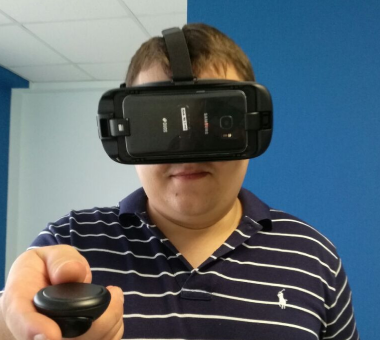
VR pilot training completely replaces the pilot’s view with a computer-generated environment, putting the trainee inside a virtual aircraft to practice flying. Wearing VR headsets, trainees can safely experience takeoffs, landings, bad weather, and emergency situations — for instance, engine failures that would be too dangerous to practice in actual aircraft.
VR is particularly powerful for:
Cockpit familiarization
Trainees can sit in a highly accurate 3D model of a specific aircraft cockpit. They can learn the layout, practice starting procedures, run checklists, and interact with every switch, button, and lever.
Instrument flying rules (IFR)
Free from outside visual distractions, pilots can experience various approaches, holds, and navigation techniques in a controlled environment.
Basic flight maneuvers
While not replacing the feel of a real plane, VR can effectively teach basic takeoffs, landings, turns, and other fundamental maneuvers.
Emergency procedures
VR allows pilots to safely practice responses to dangerous situations: engine failures, fires, hydraulic malfunctions, or severe weather. They can repeat these drills until the responses become second nature.
Multi-crew coordination
Advanced VR setups let multiple pilots and even cabin crew interact within the same virtual cockpit, so they can practice teamwork during normal and emergency operations.
Real-world examples:
Canadian Aviation Electronics (CAE) integrates VR into full-flight simulators for immersive type-rating and recurrent training.
Boeing employs VR for cockpit familiarization, pre-flight checks, and maintenance training.
How AR is used: information overlay
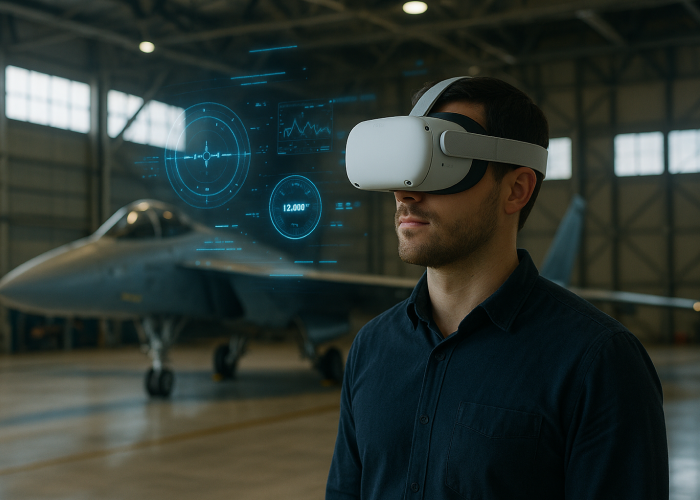
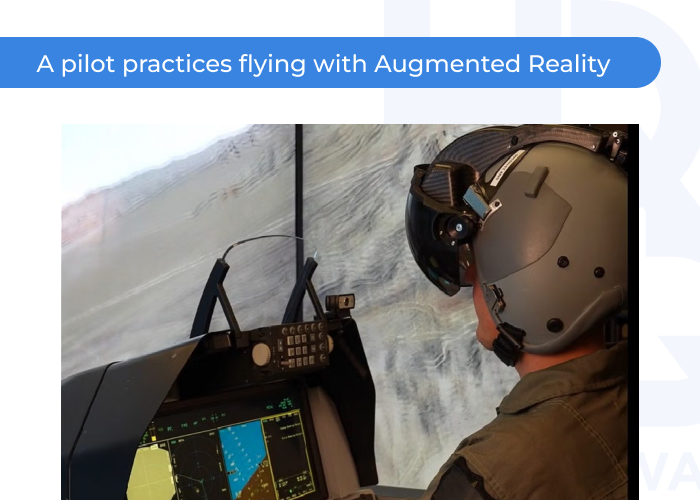
AR enhances a pilot’s view by overlaying crucial digital information, such as flight paths, instrument readings, or checklist steps, directly onto their line of sight. AR enhances their perception and provides real-time guidance.
ARis particularly powerful for:
Enhanced heads-up displays (HUDs)
AR projects critical flight data (airspeed, altitude, heading, navigation cues) directly into the pilot’s line of sight. This improves situational awareness and reduces the need to look down at instruments.
Checklist and procedure guidance
AR glasses display checklist items or procedural steps overlaid on the actual instruments or controls they relate to. Such apps guide the pilot through complex sequences and ensure nothing is missed during high-workload phases.
Navigation and airspace awareness
AR visually represents flight paths, waypoints, restricted airspace boundaries, and even other traffic, overlaid on the view outside the cockpit; this provides an intuitive understanding of the surrounding environment.
Maintenance training
AR can be used to train maintenance crews by overlaying schematics, instructions, or part identifiers onto real aircraft components.
Simulator enhancement
AR adds virtual elements like weather effects to physical, fixed-base simulators, increasing their realism without the cost of full-motion systems.
Real-world examples:
Airbus implements AR for engine inspections and flight crew training, projecting interactive 3D models onto real-world components.
Lockheed Martin uses AR solutions for fighter pilot training, integrating real-time data into live flight exercises.
To sum up, AR and VR pilot training allows trainees to gain lots of practice time at much lower costs while building the skills they need before flying real planes.
Other Applications of VR in Aviation
From an immersive tech development perspective, Virtual Reality in aviation represents one of the most effective applications. VR flight training can be seamlessly integrated into programs for flying schools, airlines, and air forces. It can be of benefit in a wide range of roles, including pilots, cabin crew, and ground personnel. This is demonstrated by Lufthansa’s training of over 20,000 flight attendants in virtual environments.
Let’s see how these concepts work in real-world applications, including solutions we’ve developed at Hymux Technologies and other industry examples.
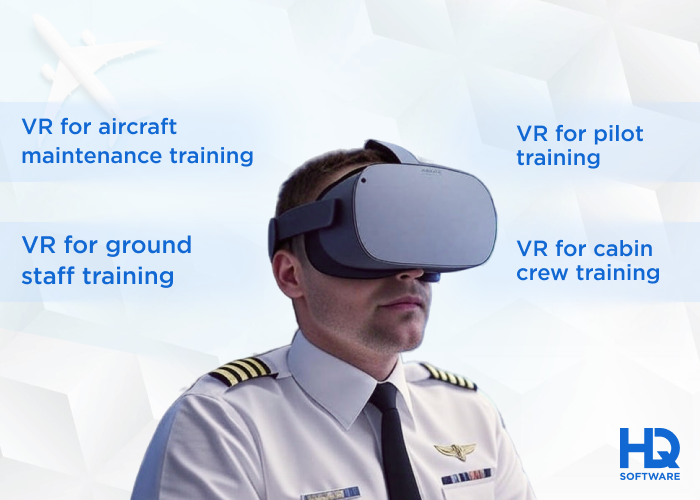
VR for aircraft maintenance training
VR lets aircraft maintenance crews use headsets to practice fixing realistic 3D planes and engines in a virtual hangar. They can walk around digital aircraft, use virtual tools, and practice repairs. For example, taking apart engines or checking landing gear without needing real planes. If they make mistakes, nothing gets damaged, and they can repeat procedures until they get them right.
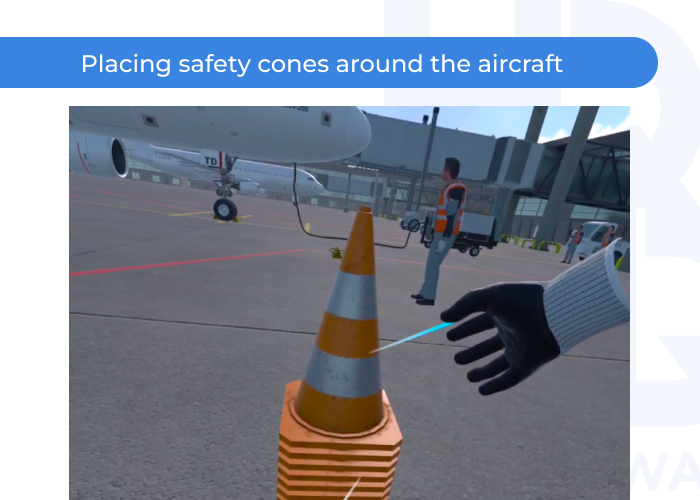
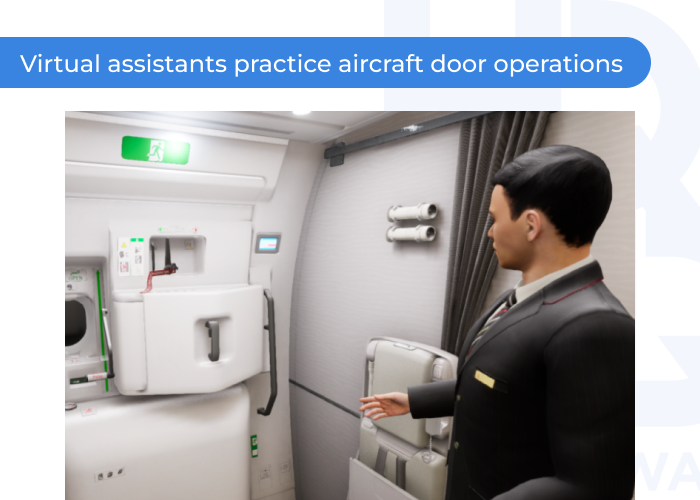
At Hymux Technologies, we’ve developed a VR simulation that enables quick and efficient training of airport ground personnel. The solution allows ground staff to effectively practise preparations for aircraft arrival and conduct thorough checks. The VR simulation puts trainees in a lifelike, interactive airport environment, providing them hands-on practice. The simulation includes the following scenarios:
Pre-shift preparation
FOD (foreign object debris) sweep
Waiting for the airplane’s arrival
Securing the nose wheel
Securing the main landing wheel
Placing safety cones around the aircraft
Restoring the fixed components
To maximize learning and avoid cognitive overload, each training module is carefully structured to last between 2 and 7 minutes, plus final tests.
VR for ground staff training
VR for ground staff training immerses airport personnel in realistic simulations to help them master various airport tasks such as aircraft marshaling, baggage handling, fuel servicing, emergency response (for instance fire outbreaks or medical crises). By replicating scenarios such as towing planes in tight spaces, VR builds muscle memory, situational awareness, and teamwork.
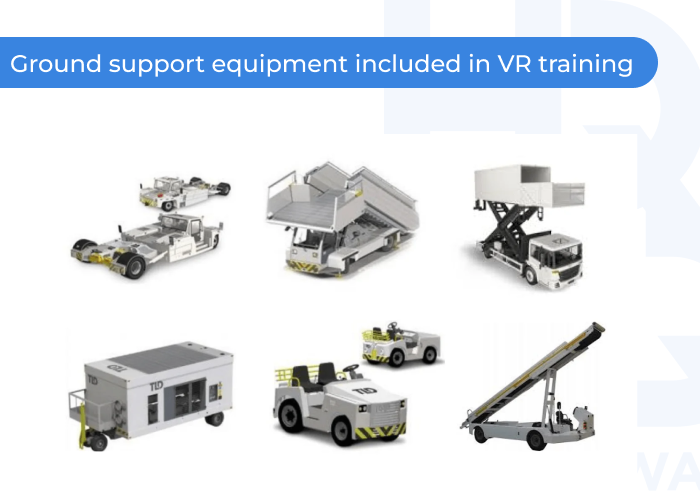
A VR aviation training platform by Hymux Technologies teaches ground handling staff to operate six types of ground support equipment and follow airport regulations. The simulations cover towbarless tractors, passenger ladders, baggage tractors, power units, catering trucks, and belt loaders. The training program incorporates four interactive modules mandated by the General Authority of Civil Aviation (GACA) and the IATA Safety Audit for Ground Operations (ISAGO), covering airside safety awareness, airside driving, security awareness, and emergency response planning.
Each simulation includes assessments graded on pass/fail criteria. The platform is linked to a Learning Management System (LMS) that tracks progress, stores data, and generates real-time performance reports for compliance and improvement tracking.
VR for cabin crew training
VR cabin crew training puts flight attendants, using a headset, inside a virtual airplane cabin where they can practice job duties. They can walk around the cabin, use safety equipment, help virtual passengers evacuate, put out fires, and deal with difficult situations. This hands-on practice helps them learn procedures and better handle real emergencies during actual flights.
A notable example comes from Emirates, which has opened a large, advanced training facility in Dubai that heavily incorporates VR. Their cabin crew use VR to practice service delivery, handle medical emergencies, manage security threats, and conduct safety procedures in highly realistic virtual aircraft cabins.
Develop VR Training for Aviation With Hymux Technologies
As you can see, our extensive experience in this field ensures full compliance with industry regulations, positioning us as trusted partners in delivering AR/VR flight training solutions. At Hymux Technologies, we develop software tailored to empower pilots, ground staff, and maintenance crews.
Why choose Hymux Technologies for developing VR aviation training? We provide:
Custom-built scenarios: From emergency landings to complex airport operations, we design VR simulations that mirror your specific aircraft models, airport layouts, and regulatory requirements.
End-to-end development: We handle everything: concept, design, programming, and integration with your existing systems (LMS, assessment tools).
Compliance and scalability: Our software engineers createapplications that stay ahead of regulations with scenarios aligned to GACA mandates.
Data-driven insights: We implement data analytic and AI/ML tools for you to track performance metrics, generate compliance reports, and identify skill gaps through our integrated LMS.
Our immersive simulations bridge the gap between theory and practice, ensuring your team masters critical skills in a cost-effective environment.
Considering custom software?
Hymux Technologies’s team of experts can design and develop the perfect solution for your business. Let’s discuss it
If you’re aiming to cut training costs, improve skills, or conquer flight anxieties, VR offers an effective solution. But what other VR training benefits can you gain by using VR for training?
As developers of many VR/AR applications, with specific expertise in VR aviation training, we can confidently highlight these advantages.
Risk-free learning
According to statistics, occupational diseases and accidents at work lead to disability or death for over 100,000 workers every year. Employing VR, pilots can safely practice emergency procedures such as engine failures or severe weather in a fully simulated cockpit. Here mistakes have zero real-world consequences. So, VR lets trainees build critical decision-making skills without risking lives or expensive aircraft.
Personalized scenarios
Whether you’re preparing for a commercial license or transitioning to jets, VR can adapt to your skill level and create scenarios that are too risky or impossible to replicate in real flight training. Need to master night landings? In VR, you can practice low-visibility conditions. Struggling with crosswinds? VR lets you customize wind patterns and drill until you’re confident.
Accelerated retention and engagement
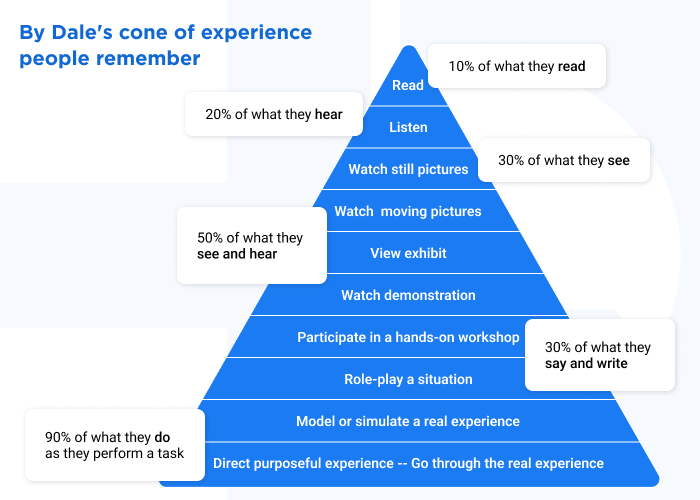
Dale’s cone suggests very low retention rates for passive learning: 10% for reading and 20% for hearing. When it comes to emotional connection with content, VR learners surpass classroom learners by 3.75 times and e-learners by 2.3 times. In aviation in particular, VR’s 3D visuals and interactive scenarios make complex concepts such as aerodynamics or navigation stick better than textbooks.
Cost-effective skill development
Traditional flight simulators can cost millions. With VR, you can access high-fidelity training on demand, reducing expenses for fuel, maintenance, and instructor time. Research shows VR training can be 52% cheaper than traditional methods. Moreover, there is no need to travel to an airport or wait for good weather. With a VR headset, you can log training hours from the classroom, on a schedule that fits your pilot school.
Stress reduction and confidence increase
VR promotes active learning through interaction, tasks, and decision-making. So, trainees become 40% more confident in applying new skills than with traditional methods. For example, in VR you can repeat a tricky approach until it feels routine, reducing anxiety during real flights. VR helps you focus on technique, not fear.
Moreover, in VR flight training you can track your performance metrics such as reaction times or control inputs and review them with instructors. This way it’s possible to identify patterns and gaps in your skills, then target them in future sessions.
Challenges With Motion Sickness and Regulatory Authorities
While the advantages of VR in flight training are well proven, there are a couple of challenges to its wide adoption. The two main issues:
Motion sickness
Motion sickness, a common issue in VR/AR training, occurs when the brain receives conflicting signals from the eyes (which detect virtual movement) and the inner ear (which senses no physical motion). Symptoms like dizziness, nausea, or disorientation can disrupt training, especially during high-intensity scenarios, such as turbulent flights or rapid aircraft maneuvers.
To mitigate this, Hymux Technologies developers use techniques such as reducing latency, optimizing frame rates, and designing smoother transitions.
Regulatory authorities
Regulations often lag behind tech advancements, creating barriers for VR/AR integration. For example, while the Federal Aviation Administration (FAA) in the U.S. acknowledges VR’s potential, it doesn’t credit VR hours toward pilot certification. The European Union Aviation Safety Agency (EASA) has been more progressive, approving VR simulators, but inconsistencies in global standards persist.
Developers must collaborate closely with regulators to align certifications, safety protocols, and training metrics, as we do. At Hymux Technologies, we always ensure VR/AR solutions meet compliance.
The Future of VR in Aviation
From a market perspective, the adoption of AR and VR in aviation is accelerating. The global AR/VR aviation market is projected to grow from $2 billion in 2025 to $12 billion by 2033, with a compound annual growth rate (CAGR) of 25%. For pilot and maintenance training alone, the AR/VR segment is expected to exceed $1.5 billion by 2028.
Having researched numerous studies, we can identify these key trends:
Integration of Artificial Intelligence (AI) with VR allows adaptive and personalized training, where simulations adjust in real time based on pilot performance;
Implementation of the XR ecosystem, combining VR, AR, and Mixed Reality (MR), is becoming the standard for immersive aviation training. XR enhances situational awareness for pilots by overlaying critical flight data directly in their field of vision;
Wide adoption of multi-user VR environments that allow multiple trainees to interact simultaneously with a single instructor, improving resource utilization;
Enhancing the passenger experience with VR entertainment systems on flights, offering immersive movies, interactive games, and virtual tours of destinations.
Looking ahead, advancements such as haptic feedback, AI-driven training scenarios, and integration with Augmented and Mixed reality will make VR training even more realistic and effective.
In essence, VR replaces reality for deep, risk-free practice and exploration, while AR enhances reality by providing context-aware digital information to improve performance in real-world tasks. Both technologies are driving significant advancements in safety, efficiency, and cost-effectiveness across the entire aviation industry.
Contact us to know more about our AR/VR development services.
A developer with extensive expertise in AR/VR, very ingrained into the topic of Mixed Reality development. Shares his knowledge and the results of many years of work.
VR pilot training creates immersive, realistic flight scenarios. Trainees use VR headsets and controllers to interact with lifelike cockpits and environments, practicing manoeuvres, emergency procedures, and navigation. This enhances muscle memory and decision-making skills in a safe and controlled setting.
Can VR flight training replace real flight hours?
VR flight training cannot fully replace real flight hours. It serves as a valuable supplement, providing cost-effective, repeatable training for specific scenarios. However, regulatory bodies still require a minimum number of actual flight hours for certification.
Is VR flight training approved by aviation authorities?
VR flight training is increasingly recognized by aviation authorities. While it cannot replace all required flight hours, many authorities, like the FAA, approve VR for specific training modules, enhancing traditional training methods. Always check with local aviation authorities for the latest guidelines.
What equipment is needed for VR flight training?
VR flight training requires:
VR headset (Meta Quest, HTC Vive, etc.)
motion controllers
a powerful PC or standalone device to run VR simulations
optional peripherals such as yokes, rudder pedals
optional cockpit replicas for a more immersive experience.
How much does VR flight training cost?
VR flight training development costs vary significantly based on complexity, aircraft types simulated, and required features. Basic training modules cost less than comprehensive flight simulators with advanced physics and multiple aircraft models. Factors affecting price include graphics quality, hardware integration, certification requirements, and ongoing maintenance, making each project unique in scope and investment.
We are open to seeing your business needs and determining the best solution. Complete this form, and receive a free personalized proposal from your dedicated manager.