
With the potential of Augmented and Virtual Reality to overcome gaps in traditional learning, about 40% of small and medium enterprises already use AR/VR training. Notably, 41% of non-users are pondering future investments in these technologies. Analyzing the pros and cons of a new technology will help companies make the right choice.
AR/VR development services transfers learners to a new environment, allowing for hands-on training within a safe environment. AR, in turn, enhances perception of the real world and its objects with virtual content, enabling real-time guidance and collaborative learning. Both technologies offer ways to convey information through virtual elements, making the choice between AR and VR development tricky.
The comparison of AR and VR training along with my expert advice as a specialist in educational design on which one to choose for your needs, you’ll find in this article.
Virtual Reality for Training
With Virtual Reality, you can simulate almost any training scenario, whether in a real or fictional environment. Wearing a VR headset, your trainees can assemble virtual details, refine negotiation techniques, practice complex surgeries, and more.
This allows them to put theory into practice, so as to better retain information, reduce mistakes during actual work, and increase productivity. And these are just the most obvious benefits of VR training.
How do modern businesses use AR to increase their revenues and outperform their industry competitors?

In medicine, for example, VR can help reduce cognitive load and improve understanding of difficult medical concepts. Consider an educational VR tool called Bodyscope, engineered by Hymux Technologies.
With this tool, medical students and non-radiologists can better understand MRI/CT scans by exploring them in volume. Specialists can enhance their spatial perspective and make fewer mistakes when working with flat images.
Despite its impressive benefits, VR does have some drawbacks. Let’s sum up some of the pros and cons of VR for training.
Pros and cons of choosing VR training
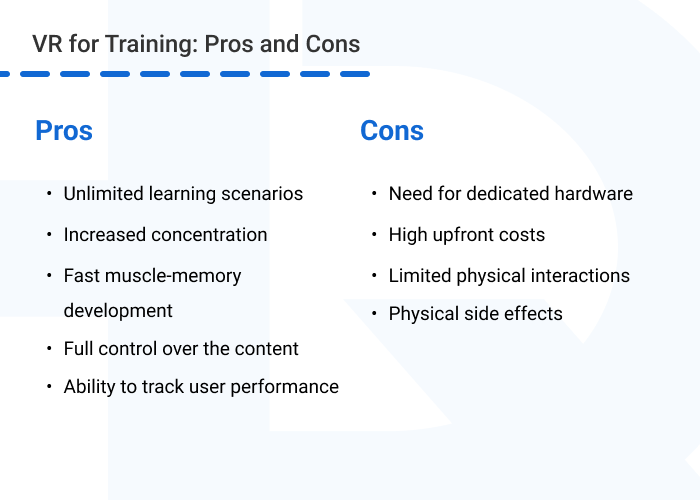
Advantages of Virtual Reality training include:
- Unlimited learning scenarios. VR allows limitless possibilities for training experiences tailored to specific learning objectives and industry requirements.
- Increased concentration of learners through full immersion. VR isolates users from the physical world, allowing them to focus entirely on the virtual environment
- Fast muscle-memory development. Users can practice hands-on tasks and repetitive actions as many times as they need, leading to accelerated skill acquisition.
- Full control over the content learners absorb. You can tailor learning materials to suit individual learning styles and gaps, ensuring optimal knowledge retention.
- Ability to track user performance; and more.
Disadvantages of VR training:
- The need for dedicated hardware, such as VR headsets, motion controllers, and sensors. You can find options at various price points, starting from $299 for META Quest 2. The more advanced the training features are, the more likely you’ll require an advanced headset.
- Potentially high upfront costs, in terms of both time and money for VR training development.
- Limited physical interactions when using controllers, as they provide for only a specific set of actions. To enable natural movements, you will need haptic gloves or advanced VR systems that can directly track the movements of users’ hands.
- Physical side effects. While modern VR headsets have made progress in overcoming motion sickness, some people may still experience nausea or headaches.
Do the disadvantages outweigh the opportunities? It’s up to you, based on your training goals. Perhaps Augmented Reality can become a better option.
Augmented Reality for Training
Augmented Reality extends the existing environment with virtual objects, often relying on certain markers, such as images or location. Even though AR is limited to the physical world, there are still many applications for it.
For example, in repair training, using AR, learners can receive step-by-step virtual instructions overlaid onto their view of physical equipment. Technicians can follow real-time virtual guides, which makes complex procedures more accessible and reduces time for learning.
Want to enhance your employee trainning with AR or VR? We’re ready to help!Hymux Technologies has a team of skilled professionals ready to tackle the project. Ask me!
Anna Halias
Business Development Manager

This approach, not for training but for real equipment maintenance, was chosen by one of our customers. Our team built an AR mobile app that allows workers to create visual guides for any kind of equipment and use them during the repair process. As a result, workers now make fewer maintenance mistakes and perform repair procedures faster.
Pros and cons of choosing AR training
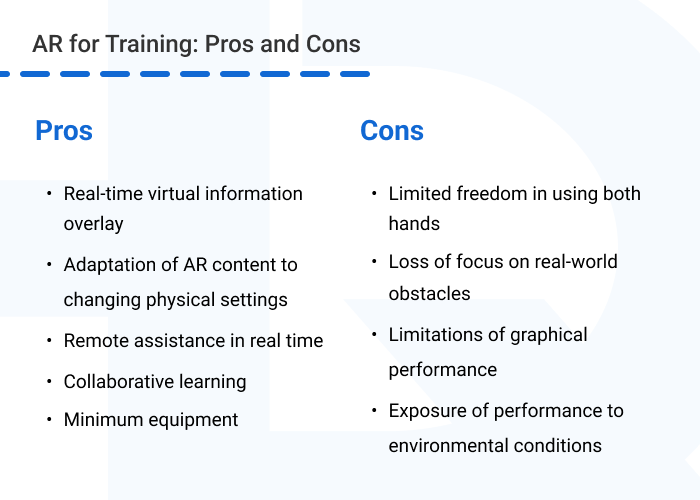
The competitive advantages of AR for training include:
- Real-time virtual information overlay to provide contextual guidance or additional information directly within the trainee’s field of view, enhancing their understanding and training performance.
- Dynamic adaptation of AR content to changing physical settings, ensuring persistence in content learners absorb and allowing for dynamic learning conditions.
- Remote assistance in real time, allowing trainers or subject matter experts to provide immediate support and guidance to trainees regardless of their location and save on travel costs.
- Collaborative learning enables multiple trainees to interact with shared virtual content within the same physical space. This fosters teamwork and peer-to-peer learning.
One more advantage of Augmented Reality over VR is the minimal equipment required for the AR experience — a modern smartphone is enough. However, the AR market also offers various types of hardware, such as smart glasses or headsets, that can be used for advanced simulations.
Drawbacks to AR training:
- The use of a smartphone limits learners’ freedom to use both hands.
- While concentrating on immersive content, learners may lose focus on real-world obstacles and possibly hurt themselves or other objects. Therefore, you need to put effort into good UX/UI training design.
- You can face limitations of graphical performance or processing power due to the device’s settings. In such cases, more advanced devices are required.
- AR performance can be influenced by environmental conditions. For example, inconsistent lighting can compromise the accuracy of object recognition.
With this basic understanding of the pros and cons of VR/AR training, let’s move on to a more direct comparison.
AR vs VR for Training Compared: Benefits and Limitations
To outline the difference between the two technologies, take a look at the VR vs AR comparison table below.
| Augmented Reality | Virtual Reality | |
| Level of immersiveness | Learners stay in real-world settings and interact with both virtual and physical objects. | Learners are fully immersed in a virtual environment with interactions involving virtual elements. |
| Training Environments | Suitable for on-the-job, maintenance, and collaborative training. | Suitable for hazardous scenarios and equipment training. |
| Equipment | More accessible, including smartphones and tablets. Can require more advanced devices, such as smart glasses. | Require dedicated VR headsets and controllers, potentially limiting accessibility. |
| User Distraction | Potential for distractions due to overlay of information on the real world. | Minimized distractions as users are fully immersed in a controlled virtual environment. |
| Learning Curve for Users | Generally lower learning curve, as devices are usually familiar to users. | Higher learning curve — users need time to adapt to VR headsets. |
| Collaboration | Well-suited for collaborative training scenarios with real-world collaboration. | Collaboration is possible but may involve users in separate virtual spaces. |
| Budget | Lower upfront costs, due to simpler training content development and accessible hardware. | Higher upfront costs, including a skilled team for complex VR content development and specific hardware. |
AR vs VR for Training: Which Is Best for Your Organization?
I recommend opting for VR training when you need to:
- simulate dangerous environments or settings that are almost impossible to recreate in the real world;
- ensure precise spatial understanding and depth perception;
- focus on hands-on training without access to real training objects;
- allow employees to develop muscle memory through repetitive actions;
- simulate time compression and accelerated scenarios for fast decision-making;
- use consulting service from our company;
- emphasize emotional engagement in interpersonal communication, as VR enables more realistic emotional responses.
In a comparison of VR vs AR, AR training will be a winner when:
- the real-life context is essential;
- employees need access to relevant information and guidance during work tasks;
- the training involves navigation or wayfinding within a physical environment;
- multiple users need to interact with digital content overlaid onto the same physical space;
- training programs require flexibility and ease of use in different locations;
- you have a tight budget.
However, the factors listed above are not the ultimate answer. Every case is unique, and while one company may choose VR training, another might prefer AR training. Therefore, prioritize your company’s needs and capabilities and seek advice from your training development partner, especially if you choose outsourcing.
The ability to provide comprehensive advice backed by practical experience is exactly what I appreciate about Hymux Technologies.
Explore Hymux Technologies’s Development Services for AR & VR Training
Having worked on numerous AR/VR projects across various industries, we possess a deep understanding of the specifics of both technologies and the optimal choices for their use.
This expertise enables us to offer you the most appropriate options after analyzing your training requirements. If, for example, VR is going to be more effective than AR in your case, we will explain this and provide you with descriptions and estimates for both options.
As an educational design expert, I can enhance the effectiveness of your training program and learning outcomes. Even if you don’t yet have a clear understanding of what your AR/VR training will look like, I can create a learning scenario from scratch. Our technical team then will manage the full development cycle, from content design to deployment.
Feel free to schedule a consultation with me to discuss the most effective choice of VR or AR for your specific case.
References
- Boise State University – Virtual Reality in Workplace Learning: Affordances, Limitations, and Future Directions https://scholarworks.boisestate.edu/cgi/viewcontent.cgi?params=/context/ipt_facpubs/article/1149/&path_info=Martinez__Seth_Aaron__2022__Virtual_Reality_in_Workplace_Learning___pub.pdf
- ScienceDirect – Learning effectiveness of immersive virtual reality in education and training: A systematic review of findings https://www.sciencedirect.com/science/article/pii/S2949678024000035
- US EPA – Training through Immersive Technology https://www.epa.gov/emergency-response-research/training-through-immersive-technology
- United States Government Accountability Office – IMMERSIVE TECHNOLOGIES Most Civilian Agencies Are Using or Plan to Use Augmented Reality, Virtual Reality, and More https://www.gao.gov/assets/gao-24-106665.pdf
- National Library of Medicine – Exploring the effectiveness of virtual reality-based training for sustainable health and occupational safety in industry 4.0 https://pmc.ncbi.nlm.nih.gov/articles/PMC12331925/

Educational Design Lead
Professional with over 20 years of experience in sales, marketing, and management across diverse industries, including education and consulting services. Adept at developing new educational products and services.


FAQ
What Is the Difference Between AR and VR for Training?
When Should I Choose AR vs VR for Workforce Training?
What Are Typical Use Cases for AR in Training?
What Are Typical Use cases for VR in Training?
Related Posts
View All

We are open to seeing your business needs and determining the best solution. Complete this form, and receive a free personalized proposal from your dedicated manager.

Sergei Vardomatski
Founder