
Highlights
Need
The medical center needed to reduce call center overload and improve patient access during peak hours while maintaining service quality.
Solution
An AI-powered voice assistant that automatically handles incoming calls, answers FAQs, manages appointments, and escalates complex cases to human operators.
60-70%
of routine calls automated
2х
faster booking flow
Outcome
Hymux Technologies delivered an Artificial Intelligence (AI)-powered voice assistant that transformed how the medical center handled incoming patient calls. By automating the majority of routine inquiries, the solution significantly reduced call center workload during peak hours. As a result, average call handling time decreased and patient wait times were minimized.
The AI assistant successfully took over repetitive tasks such as answering frequently asked questions and managing appointments, allowing human operators to focus on complex, sensitive, or non-standard requests. This led to higher service availability, improved patient satisfaction, and more consistent service quality.
Customer
The customer is a multi-department medical center offering physician consultations, diagnostic services, and laboratory testing. The organization operates a high-volume call center that serves as the primary communication channel for patients, handling appointment scheduling, service inquiries, and general coordination. With patient demand growing, the call center became a critical area where processes could be vastly improved through digital transformation.
Business Challenge
The medical center faced growing pressure on its call center due to an increasing number of incoming calls. Common issues included long waiting times, repeated questions about prices and schedules, and limited availability of human operators. Manual appointment management led to errors, inefficiencies, and missed calls. These challenges negatively affected patient experience and increased operational costs.
Solution
The Hymux Technologies team developed and implemented a voice AI assistant that automates the way incoming calls are handled and integrates seamlessly with the medical center’s existing systems.
The solution performs the following core functions:
- Accepts incoming calls through the SIP/Asterisk telephony infrastructure
- Recognizes patient speech in real time using low-latency speech-to-text (STT)
- Identifies user intent with natural language understanding (NLU)
- Retrieves accurate answers from the medical center’s knowledge base using a RAG approach
- Generates compliant and context-aware responses via a controlled large language model (LLM)
- Delivers responses to patients using natural-sounding text-to-speech (TTS)
In addition to conversational capabilities, the AI assistant supports key operational workflows:
- Appointment booking
- Appointment cancellation and rescheduling
- Sending patient notifications
- Seamless escalation and call transfer to human operators
To ensure transparency, quality control, and regulatory compliance, all calls and system actions are fully logged and included in analytical reports.
Looking for similar solutions or something unique to your needs?Contact us today! We’re happy to explore your needs!
Victoria Rokash
Business Development Manager

Technical Components
The voice AI assistant is built using the following technical components:
- Voice Gateway based on SIP/Asterisk
- STT module using local Whisper as speech recognition model
- NLU module powered by Rasa as intent classification engine
- RAG module combining a vector database with structured documentation
- Local LLM agent with strict safety and compliance constraints
- TTS module based on Silero
- API integration layer for secure interaction with the medical CRM
- Centralized analytics and full interaction logging
- Monitoring and alerting to ensure system stability and SLA compliance
Process Components
To ensure high accuracy and reliability, the implementation also included the following process-level elements:
- Classification and analysis of typical call scenarios
- Creation and maintenance of a structured knowledge base
- System testing with medical center staff using real-life scenarios
- Configuration of fallback scenarios for low-confidence or failure cases
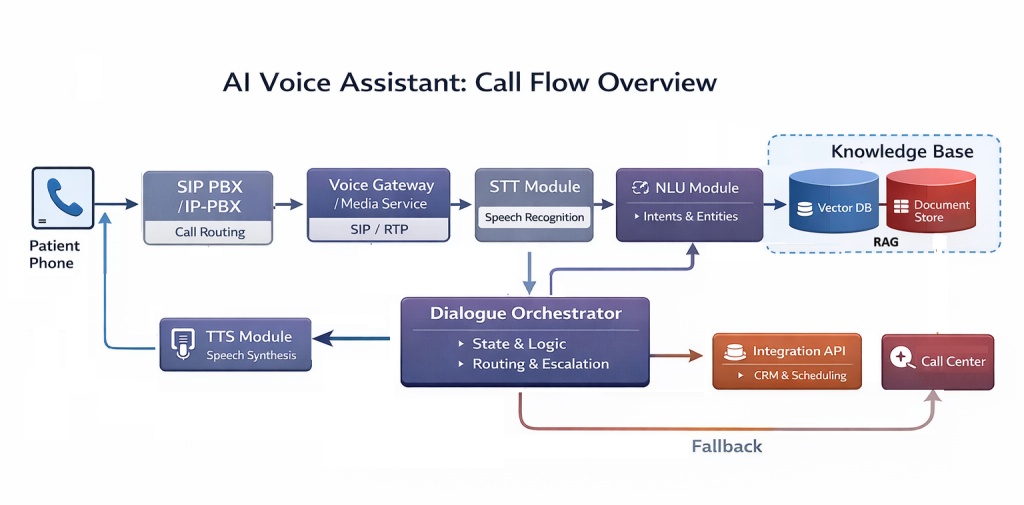
Architecture Overview
The system is built as a modular, scalable architecture that integrates telephony, AI processing, backend services, and secure data storage.
Telephony layer
- Asterisk
- SIP trunk
AI pipeline
- STT → NLU → Intent Recognition → RAG → LLM → TTS
Back-end integrations
- API integration with the medical CRM
- Access to appointment scheduling and availability data
DevOps
- Docker
- CI/CD
- Monitoring/Logging
- Security Firewall
- Data Encryption
Data layer
- Vector DB (Qdrant )
- Document Storage
- Logs Storage
- Audit DB
Team
- Project manager
- Front-end developer
- Back-end developer
- ML engineer
- QA engineer
- DevOps engineer/System administrator
Learn more about our healthcare development services.
Check Out Other Works
See How We Approach Business Objectives

We are open to seeing your business needs and determining the best solution. Complete this form, and receive a free personalized proposal from your dedicated manager.

Sergei Vardomatski
Founder