
12+ years
50+
successful healthcare projects
40+
happy healthcare clients around the world
Patient Scheduling Software Development Services
Make healthcare scheduling easy with our custom software development services
Custom medical scheduling system development
When developing a custom medical scheduling system, we focus on creating a flexible, user-friendly interface that caters to the unique workflows of your healthcare practice.
Systems that we engineer support various types of medical appointments, provider schedules, and patient preferences, optimizing provider time.
Integration with EHR/EMR and calendar systems
Seamless integration is crucial for maintaining continuity of care.
We create medical appointment scheduling software that synchronizes patient data across platforms, minimizes duplicate data entry and ensures that patient scheduling information is always up-to-date and accessible where needed.
Automated reminders and patient communication tools
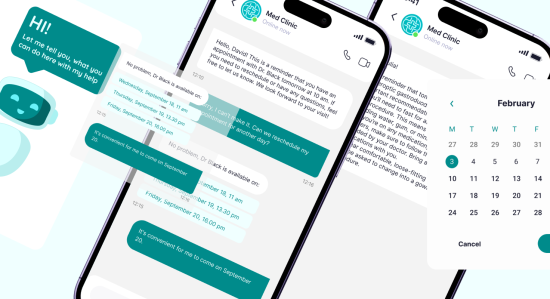
We develop systems that include automated reminders and patient communication tools that send SMS, email, or in-app notifications for upcoming medical appointments.
These tools help keep patients informed and improve adherence to scheduled visits.
Why Choose Hymux Technologies for Your Custom Medical Scheduling System?
Hymux Technologies builds efficient medical scheduling solutions for clinics, hospitals, and private practices. We develop secure scheduling systems that streamline medical appointment booking, reduce no-shows, and optimize staff workflows.
Our team has deep expertise in healthcare software, ensuring scalability and seamless integration with your existing infrastructure.
To enhance operational efficiency, we use advanced technologies like AI-powered scheduling, real-time analytics, and cloud-based access. Partnering with us means getting a high-performance solution that grows with your practice. Advantages of working with Hymux Technologies:
-
Proven healthcare expertise: successful medical scheduling systems for providers of all sizes
-
Security and compliance: HIPAA/GDPR-compliant development to protect patient data
-
Seamless integrations with: EHR/EMR, payment gateways, telehealth platforms, and more
-
Custom-fit solutions: personalized medical appointment scheduling software for your clinic’s unique needs
-
Fast deployment: 2 -week start for a smooth development and timely launch
Customer Stories
450 business goals reached through tech solutions since 2001
Customer Reviews
See what our clients have to say about us
Key Features of Patient Scheduling Software
Real-time appointment booking
This live, always-up-to-date appointment grid lets patients self-schedule 24/7 and staff book effortlessly. More precisely, it provides:
- Instant availability lookup with no double-booking;
- Configurable visit types, duration, and equipment needs;
- Smart rules (buffer times, same-day cutoff, etc.).
Multi-location and multi-provider scheduling
It is a kind of centralized dashboard that can juggle multiple clinics, departments, and provider calendars in one view. This feature offers:
- Color-coded or filtering by location or provider;
- Role-based access so each team sees only what they need;
- Time-zone awareness for cross-state or international practices.
Two-way calendar sync
This critical integration ensures seamless data flow between the patient scheduling software and external calendars commonly used by providers. It’s “two-way” because it features:
- Real-time push and pull of events to eliminate double data entry;
- Customizable sync frequency and conflict rules;
- “Busy block” logic to prevent overlaps with personal events or holidays.
Waitlist management and rebooking
This feature allows patients to register their interest in getting earlier or preferred medical appointment slots that are currently unavailable. When a cancellation occurs, the system can:
- Auto-populate waitlists by visit type, provider, or priority;
- Send rule-based notifications (SMS/email) when a slot opens;
- Self-serve rebooking links for patients.
Telemedicine session scheduling
A built-in or integratable video visit module allows you to schedule and manage virtual consultations alongside in-person medical appointments. Key functionalities include:
- Patients choose “in-person” or “virtual” during booking;
- Automatic generation of secure video links and visit instructions;
- Integrated consent and e-payment collection.
Insurance and eligibility verification
Such functionality checks a patient’s insurance coverage and eligibility before or during appointment booking. It connects with insurance databases for:
- Real-time electronic data interchange during booking;
- Flagging of coverage gaps or prior-authorization requirements;
- Optional automated re-verification 24–48 hours before the visit.
Analytics and no-show reports
You can turn scheduling data into actionable insights on clinic performance and operational efficiency. The system analyzes key metrics to generate:
- Interactive dashboards for wait times, provider load balance;
- No-show and late-cancel heat maps by day/time/patient segment;
- Revenue leakage and recovered revenue metrics.
Automated reminders and notifications
This feature is a cornerstone for reducing no-show rates and improving patient attendance. Key aspects include:
- SMS, email, voice, and push options with customizable forms;
- Two-way messaging, so patients can confirm or cancel visits;
- Language localization and compliant formats.
Patient Scheduling Software for Every Healthcare Sector
We provide tailored solutions for diverse medical fields
General hospitals and specialty clinics
Large hospitals and specialty clinics manage high patient volumes, complex workflows, and multidisciplinary teams.
Medical appointment scheduling software streamlines coordination between departments, for example surgery, cardiology, and oncology; optimizes operating room usage; and reduces wait times.
Here, features such as resource allocation, EHR integration, and AI-driven slot booking help balance workloads for specialists and ensure timely care for critical cases.
Primary care and family medicine
Primary care providers rely on scheduling tools to manage routine checkups, chronic disease follow-ups, and acute visits.
Software automates reminders for annual exams, immunizations, and screenings and improves preventive-care adherence.
Here, for instance, tools such as waitlist management and same-day appointment slots will help you accommodate urgent needs, while referral tracking simplifies coordination with specialists.
Integration with patient portals also empowers families to self-schedule.
Diagnostic labs and imaging centers
Time-sensitive procedures such as blood tests, MRIs, and CT scans require precise slot management.
Appointment scheduling software prevents overcrowding, ensures efficient use of costly equipment, and syncs with lab information systems (LIS) to track results.
Patients receive automated reminders and can book specific time windows, reducing no-shows.
Some platforms also enable direct referrals from physicians, accelerating turnaround for diagnoses.
Dentistry and orthodontics
Dental practices benefit from software that allocates chairside time blocks for cleanings, fillings, and orthodontic adjustments.
Recurring appointment features support biannual checkups, while SMS/email reminders curb no-shows.
Advanced systems can handle complex treatment plans like Invisalign, track insurance claims, and integrate with practice management tools for seamless billing.
Pediatric dentists can also use family-friendly booking interfaces to manage multiple children’s appointments.
Mental and behavioral health clinics
Therapists and psychiatrists require secure, discreet scheduling with HIPAA-compliant platforms. Features like encrypted messaging, telehealth integration, and flexible rescheduling accommodate sensitive patient needs.
Software tracks session progress, authorizes insurance claims, and flags gaps in care plans.
For group therapy, it simplifies cohort management and ensures privacy for vulnerable populations.
Pediatrics
Pediatric clinics cater to families with tools like online portals for booking well-child visits, sports physicals, and vaccination appointments.
Automated alerts remind parents of upcoming milestones. Scheduling systems also link family accounts for siblings, integrate with school health portals, and prioritize urgent cases like fever or injury.
Gamified check-in processes enhance child-friendly experiences.
5 Steps of Medical Scheduling Software Development

-
Discovery and requirement analysis
Our development of medical scheduling software begins with a discovery and requirement analysis, where our team gathers client input, maps clinical workflows, outlines feature sets and identifies regulatory and interoperability needs. -
UX/UI design and prototyping
Next, our designers craft wireframes and interactive mockups to validate user journeys, solicit feedback, and iterate until the interface aligns with both patient and provider expectations. -
Core development and integration
Following design approval, we enter the core development and integration stage, where we build out the back-end architecture, database models, appointment logic and APIs to connect with EHR systems, billing platforms and notification services. -
QA testing and compliance validation
Once the system’s in place, we proceed to quality assurance services and compliance validation, rigorously testing the software for bugs and usability issues, and ensuring it complies with healthcare regulations such as HIPAA/GDPR. -
Deployment and post-launch support
The last phase involves launching the software, monitoring its performance, and providing ongoing support and updates to address any issues and incorporate user feedback. This will ensure long-term success and user satisfaction.
FAQs With Healthcare Scheduling Software Developers
Can the scheduling system integrate with our existing EHR/EMR software?
Is the software customizable to fit our clinic’s workflow?
Can patients reschedule or cancel appointments online?
Do you offer automated reminders via SMS or email?
Is the software secure and compliant with HIPAA or GDPR?
Is there support for telemedicine appointment scheduling?
How long does it take to develop and deploy custom scheduling software?
We are open to seeing your business needs and determining the best solution. Complete this form, and receive a free personalized proposal from your dedicated manager.

Sergei Vardomatski
Founder