Many businesses grapple with fragmented systems, soaring development costs, and the relentless pressure to innovate faster. These hurdles not only drain resources but also limit the ability to deliver innovative solutions quickly. Legacy software often creates data silos, slowing decision-making and stifling agility.
This is where AI-native applications can help. Unlike legacy systems that treat AI as a clumsy add-on, these apps are built with intelligence at their core. They learn, predict, and make intelligent decisions autonomously. We’re talking about software where AI isn’t an afterthought, but the fundamental building block of its existence.
In this article, we’ll explain what “AI-native” means, dive into its unique characteristics, and clarify its distinction from AI-powered apps. We’ll then demonstrate why this approach, supported by Hymux Technologies’s expertise, is critical for future-proofing your business.
To start, let’s go over definitions. “AI-native” means that a software application or system is built from the ground up, with AI as its central and most important part. It’s not just a regular app that had some AI features added later. Instead, its whole purpose, how it works, and how it’s made is based on AI being at its core.
Because AI is fundamental to its design, an AI-native app can do things smarter, learn over time, and adapt on its own. It’s built to use data and Machine Learning (ML) to solve problems in ways a traditional app can’t. This deep integration allows for continuous improvement and a level of intelligent automation that’s built directly into the application’s “DNA”.
What does successful AI implementation actually look like?
Review our AI/ML projects to learn how we deliver measurable results with custom-built intelligent systems.
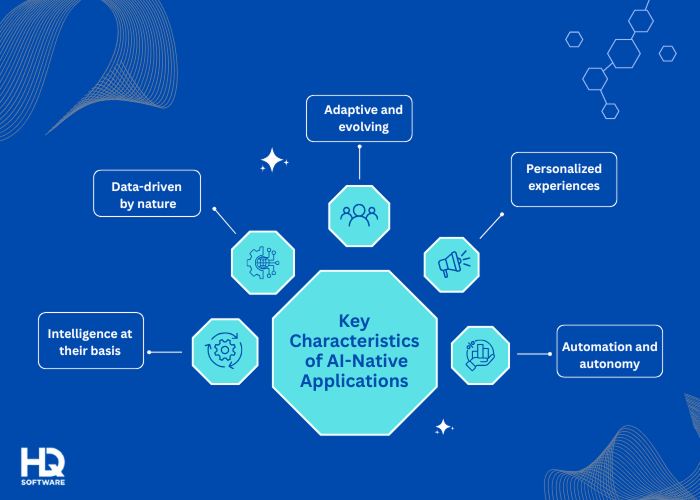
The “AI-first” foundation is more than just a technical detail. It fundamentally changes how software functions and interacts with the world. These applications display several unique characteristics that set them apart from traditional tools:
Intelligence at the base: Unlike regular apps that perform fixed tasks, AI-native apps are designed to be “smart” from day one. They use AI to continuously learn from data, make predictions, and adapt their behavior.
Data-driven by nature: These apps constantly collect, process, and analyze information, using it to train their AI models and improve their performance over time. Data isn’t just stored, it actively shapes how the app works.
Adaptive and evolving: An AI-native app isn’t static. As it interacts with users and processes more data, its underlying AI models get better and smarter. This means the app actually improves itself and becomes more effective the more it’s used.
Personalized experiences: Because they learn from individual data and interactions, AI-native applications can offer highly customized experiences. They understand user preferences and behaviors, then tailor their responses and functions to each person’s unique needs.
Automation and autonomy: The goal of AI-native applications is to automate complex tasks that usually require human effort. They can often operate autonomously, performing actions or making decisions based on their AI-driven intelligence. This reduces the need for constant human oversight.
AI Native vs. AI-Powered Apps: What’s the Difference?
The terms “AI-native” and “AI-powered” are frequently used interchangeably in industry discussions. However, this conflation is more than a semantic issue; it obscures fundamental differences in how applications are conceived and evolved. Treating these concepts as synonymous can lead to significant problems:
Architectural missteps: Teams may adopt integration patterns suitable for add-on AI features when building systems that require AI at their foundation. This may result in technical debt and performance bottlenecks.
Scalability limitations: AI-powered enhancements can often be scaled independently, while AI-native systems require holistic scaling strategies that account for model behavior under load.
Maintenance complexity: Upgrading and maintenance for these two approaches differ substantially, affecting long-term operational costs.
Misaligned stakeholder expectations: Decision-makers may not fully understand this distinction. That can lead them to underestimate the infrastructure, expertise, and investment required for truly AI-native development.
In reality, these terms describe two fundamentally different philosophies of software development. One embeds intelligence as an optional layer; the other cannot function without it.
To help clarify these distinctions and guide more informed technical and strategic decisions, we’ve systematized the key differences in the table below.
Feature
AI-Native Apps
AI-Powered Apps
Core Design
Built from the ground up around AI
Traditional apps with AI features added later
Intelligence Level
Deep, continuous learning and adaptation
Limited to pre-programmed or plug-in AI functions
Real-Time Decision-Making
Yes—processes data instantly for autonomous action
Often relies on batch processing or human input
Integration
Seamless, with AI deeply embedded in workflows
Surface-level; AI may not fully interact with all systems
Scalability & Flexibility
Highly scalable and evolves with use
Less flexible; harder to update or expand AI capabilities
Development Approach
AI-first: models, data, and architecture designed together
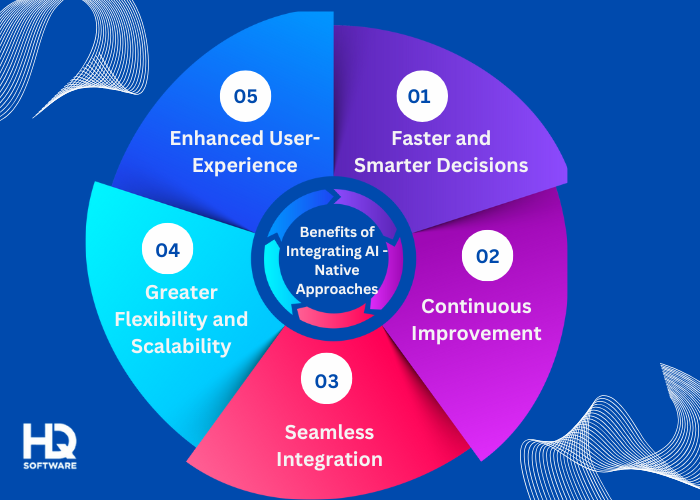
Having clarified the fundamental difference, the next logical question for any forward-thinking business is: What advantages does this deeper, AI-native approach truly offer? Our experience in building AI systems highlights several key benefits.
Faster and Smarter Decisions
Because AI is built into the core of the system, data is analyzed instantly as it arrives. AI‑native apps use low‑latency inference, predictive analytics, and prescriptive modeling to surface actionable insights instantly. Decision logic is encoded directly into the application flow, eliminating delays caused by human review or external service calls.
An example can be a hospital triage system for emergency departments. The software automatically collects patient information from devices like heart monitors and from medical records. An AI, trained on millions of cases, instantly reviews this data to figure out who needs help most. It then gives doctors a prioritized list so they can treat the sickest patients first, which reduces critical wait times and improves care.
Continuous Improvement
Because they’re built to learn from every interaction, AI-native systems get better over time. AI‑native solutions have built‑in learning loops. Every time a user interacts, the system makes a prediction, sees the result, checks it, and then uses that information to improve the model.
Automated tools retrain, test, and update the model on a set schedule (or instantly), so the AI stays accurate as data changes and avoids drift. In short, the system keeps getting smarter all by itself, without anyone having to tweak it manually.
For example, suppose we are developing a dynamic pricing engine for an eCommerce platform. Here every purchase, cart abandonment, competitor price change, and inventory level is streamed into a feature store. Nightly, the model is retrained on the latest data. If demand for a product spikes during a viral trend, the model automatically adjusts pricing within hours.
Seamless Integration
These apps are designed to work smoothly with other tools and platforms from the start. The data routes, the model server, and the business rules are all planned together, so they work smoothly as one. APIs, message streams, and shared feature databases move data around without any extra “glue” code. Because everything is integrated tightly, the system runs faster, makes fewer mistakes, and is easier to keep up.
One example is a real‑time fraud detection platform for fintech. Transaction data flows through a system where it’s instantly prepared and analyzed by a fraud detection AI. The AI’s decision to block or allow the transaction happens immediately, as part of the original process, without any extra steps or delays.
Greater Flexibility and Scalability
AI-native applications can easily grow or change as your business does. Whether you add new features or handle more users, the system adapts without a major rework, making it future-ready.
AI‑native systems are built on cloud‑native and modular infrastructures. Individual AI components such as data ingestion, feature engineering, and model inference can be scaled independently. New models can be added with minimal disruption, which enables rapid experimentation and adaptation to changing business needs.
One example is a social media content moderation system. When a post goes viral and traffic suddenly spikes, the system automatically grows to handle the load. At the same time, AI detects new types of hate speech in both text and images, all without taking the service offline. AI gets up and running quickly by using information we’ve already gathered about users.
Enhanced User Experience
When AI is baked into a product, the whole experience is built around smart behavior. The interface tries to guess what you’ll want, tailors its responses to you, and changes on the fly. You don’t see a separate “AI step”—the intelligence is just part of the product, making it feel smooth, easy to use, and always ready for you.
Let’s consider a smart home assistant. The device continuously listens for voice commands, processes them locally with edge AI for low‑latency responses, and learns user preferences over weeks. For instance: “Dim lights at 10 p.m.” It proactively suggests actions: “Your favorite show starts in 5 minutes—turn on the TV?” All interactions are seamless because the AI is woven into the OS, apps, and hardware.
At Hymux Technologies, we’ve seen these benefits come to life in every AI-native app we build. Now let’s pull back the curtain and see how we turn intelligent design into reality.
Ready to build a truly AI-native application?
We know how to design and deliver AI-native apps from the ground up — built to scale, evolve, and drive real business impact.
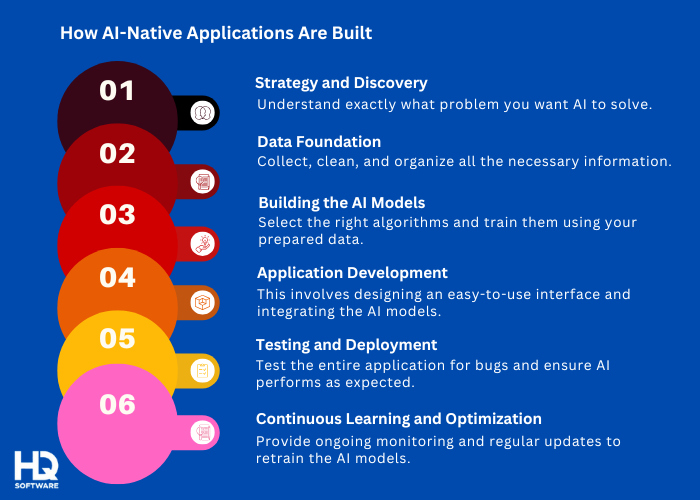
Building an AI-native application is a careful, step-by-step process that places AI at the very heart of the software. It’s much more than just adding a smart button; it’s about designing the whole system around intelligent capabilities. Here at Hymux Technologies, we use our expertise to follow a clear, proven process for building these smart applications.
1. Strategy and Discovery
What problem are you solving with AI? First, we start with your business goals. We work with you to understand exactly what problem you want AI to solve and what new opportunities it can unlock. This involves figuring out what kind of data is available and how AI can use it best. Hymux Technologies helps define a clear strategy and scope, ensuring the project aligns perfectly with your vision.
2. Data Foundation
Feeding the AI brain. AI thrives on data. We help you collect, clean, and organize all the necessary information, whether it comes from your existing systems or new sources. This step is crucial, because good data makes for smart AI. Our developers specialize in building robust data pipelines to ensure your AI always has the high-quality fuel it needs.
3. Building the AI Models
Making the brain itself. This is where the core AI intelligence is created. The Hymux Technologies team selects the right algorithms and trains them using your prepared data. This “training” teaches AI to recognize patterns, make predictions, or generate insights. We develop custom AI models tailored specifically to your application’s unique needs.
4. Application Development
Bringing AI to life. Once the AI models are ready, we build the actual software application around them. This involves designing an easy-to-use interface and integrating the AI models seamlessly into every part of the app. Hymux Technologies handles the full-stack development, making sure the user experience is smooth and intuitive, and that the AI functions flawlessly within the application.
5. Testing and Deployment
Making sure the app works. We rigorously test the entire application, not just for bugs but also to ensure AI is accurate, fair, and performs as expected. After thorough testing, we deploy the AI-native application, often using modern cloud technologies for scalability and reliability. At Hymux Technologies, we ensure there’s a smooth launch and that the application runs efficiently.
6. Continuous Learning and Optimization
Getting smarter over time.AI-native applications aren’t static. After deployment, they continue to learn from new data and user interactions. Our experts provide ongoing monitoring, maintenance, and regular updates to retrain the AI models, ensuring the application consistently improves its performance and adapts to changing needs and new data over time.
Use Cases of AI-Native Applications
We’ve outlined the step-by-step approach Hymux Technologies takes to build AI-native applications. Now, to truly grasp their value, let’s dive into specific examples.
Personalized Recommendations
These applications are built to constantly learn about your preferences and suggest things that are just right for you. They don’t just follow simple rules; their core AI understands your tastes deeply.
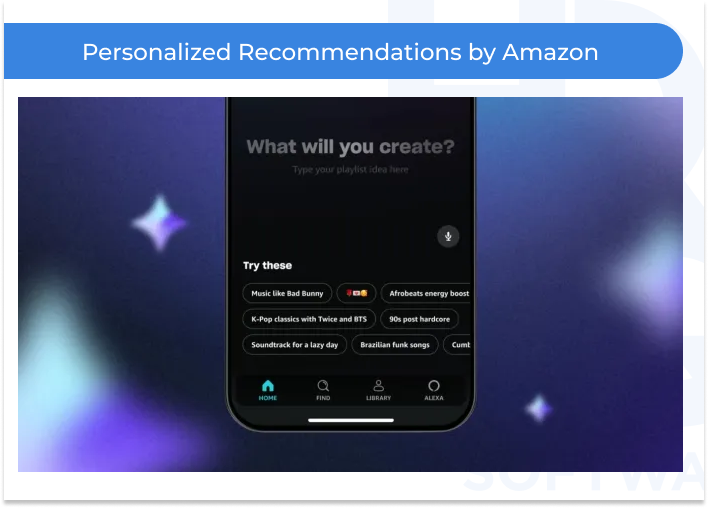
Example: Netflix uses AI to suggest movies and shows you’ll probably enjoy based on what you’ve watched. Spotify uses AI-native algorithm Maestro to power its “Discover Weekly” playlists. It analyzes billions of data points—including your listening habits and the habits of people with similar tastes—to suggest new music that fits your specific style perfectly. Amazon does the same for products. Their entire business model relies on this AI-driven personalization.
Image Credits: Amazon
Predictive Analytics and Maintenance
AI-native apps in this area are designed to predict future events or potential problems before they happen. They continuously analyze data patterns to offer warnings or insights.
Many Industrial Internet of Things (IIoT) platforms put AI at their core to predict when a factory machine might break down by analyzing its vibration and temperature data. This allows maintenance teams to fix it proactively and avoid costly downtime.
Generative Content and Design
These are applications where the AI’s main job is to create brand-new things, whether it’s images, text, code, or even new product designs. AI is the creative engine. Instead of manually drawing or writing every detail, users simply describe what they want in plain language, and the AI builds it instantly. This makes high-quality design and content creation accessible to everyone, regardless of their technical skills, and allows for endless variations in seconds.
Example: Tools like Midjourney or DALL-E (for images) and ChatGPT (for text) are AI-native. GitHub Copilot generates code suggestions for programmers. Their primary function is to generate content from simple prompts.
Intelligent Process Optimization
These applications use AI to continuously find the best and most efficient ways to run operations, making processes smoother and more effective automatically. Instead of waiting for a human to spot a problem, the AI acts like a “digital brain” that watches every step of a workflow to find where time or money is being wasted. It can then reorganize tasks or adjust settings in real time to ensure everything is running at peak performance.
Autonomous Systems and Robotics
In this field, AI is the central “brain” that allows systems to operate and navigate largely on their own, adapting to their environment without constant human intervention. This AI constantly processes sensory input, makes decisions, and executes actions. It’s how drones can deliver packages, self-driving cars can navigate traffic, and industrial robots can perform complex tasks on a factory floor.
Example: Features such as Tesla’s Autopilot and Full Self-Driving are built around AI. Their main job is to navigate and make driving decisions using Artificial Intelligence. Similarly, advanced robots like those from Boston Dynamics depend on AI to stay balanced, move smoothly, and adjust to different environments on their own.
Advanced Conversational AI/Virtual Agents
These AI-native applications go beyond simple chatbots; they are designed to have very natural, human-like conversations, understand complex requests, and solve multi-step problems. They can maintain context across multiple turns, learn from past interactions, and integrate with other systems to perform complex actions. This allows them to offer highly personalized support and handle nuanced customer inquiries, making interactions feel much more intuitive and efficient.
Challenges of AI-Native Application Development
Creating real AI-native apps is tough. It takes more than coding—it requires strong skills in AI, data science, and cloud systems. Our extensive experience in this field has equipped us with proven strategies to navigate the trickiest challenges.
Here are three main challenges in AI-native application development and how Hymux Technologies tackles them:
Finding and Preparing Quality Data
AI needs lots of good, clean, and relevant data to learn. Often, businesses have data scattered everywhere, or it’s messy, incomplete, or not in the right format. Finding this data and getting it ready for AI to use is a huge and time-consuming task.
We create systems that automatically collect data from different sources, clean it up, organize it, and make sure it’s always ready for the AI models. We also help identify valuable new data sources and strategies for ongoing data collection.
Integrating AI Into Everything
An AI-native app isn’t just an app with an AI button. AI needs to be deeply woven into every part of the software, interacting smoothly with existing systems and the user interface. This is complex and can be hard to get right without causing performance issues or bugs.
Our architects design the application from the ground up with AI integration in mind. We use advanced API connections and modular design to ensure perfect communication between AI components and your existing systems. The result is a truly seamless and intelligent user experience.
Keeping AI Smart Over Time
AI models can become less accurate over time as new data comes in or user behavior changes. An AI-native app needs to continuously learn and adapt, which requires ongoing monitoring, retraining, and updating of the AI models. This “maintenance” is a specialized task.
We implement Machine Learning operations practices. This means we set up automated systems to monitor the AI’s performance, detect when it needs retraining, and seamlessly update its models. This ensures your AI-native application stays accurate, relevant, and continues to get smarter as your business evolves.
Are AI-Native Applications the Future of Software?
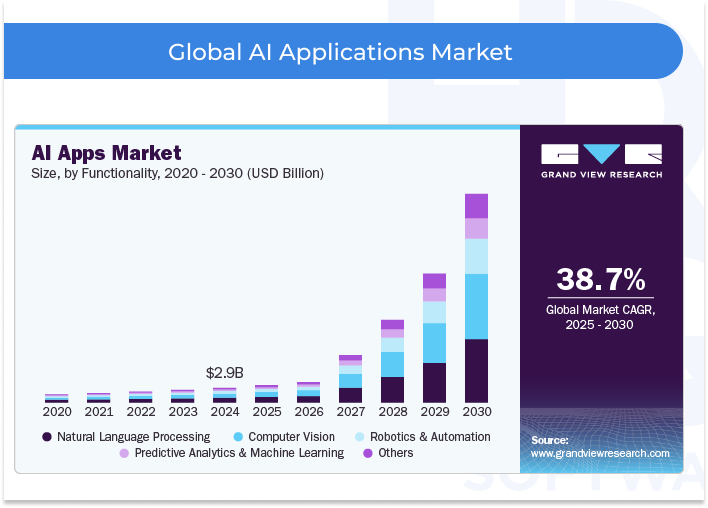
The numbers clearly show this is happening right now. The AI applications market was worth about $2.9 billion in 2024, but it’s expected to grow to over $26 billion by 2030. This means the market will be nearly nine times larger in just six years.
Image Credits: Grand View Research
Moreover, Gartner says, companies that are built around AI from the start are doing much better than traditional software companies. These AI-native startups make about $3.5 million per employee, six times more than older companies. They also need fewer people to accomplish the same work—their teams are 40 percent smaller. As AI technology improves, these companies will need even fewer engineers, with estimates showing engineering needs could shrink by 80 percent by 2030.
Major tech experts agree with this trend. McKinsey, a leading business research firm, highlighted in their 2025 report that AI-native software is becoming essential in our increasingly connected world. The adoption of these applications is speeding up and moving beyond the early excitement phase into real, lasting use. This shows that AI-native applications are not just a temporary trend but a fundamental shift in how software will be built and used in the future.
Conclusion
So, when you look at it, AI-native applications are totally changing how we think about software. They’re not just apps with a few AI tricks; they have intelligence built right into their heart, meaning they’re always learning, adapting, and working incredibly efficiently.
Sure, building these smart systems can seem tricky. But here at Hymux Technologies, we’ve seen time and again that with the right know-how and a clear plan, those challenges are totally manageable. We’re pretty good at tackling tricky data, making sure everything connects smoothly, and setting up AI to keep getting better.
Choosing an AI-native path is investing in a truly intelligent system that keeps growing and innovating for your business. Contact us to help you tap into that power and secure your future.
Cornell University – “Towards the Next Generation of Software: Insights from Grey Literature on AI-Native Applications” https://arxiv.org/abs/2509.13144
An experienced developer with a passion for IoT. Having participated in more than 20 Internet of Things projects, shares tips and tricks on connected software development.
An AI-native application is built from the ground up with AI as its core, not just an add-on feature. Its fundamental architecture and processes are designed around AI capabilities such as Machine Learning or natural language processing. This deep integration allows the application to continuously learn, adapt, and intelligently automate tasks, delivering unique value that wouldn’t be possible otherwise.
What Architecture Do AI-Native Applications Use?
AI-native applications typically feature a modular architecture centered around intelligent components. They integrate Machine Learning models, data pipelines for continuous training, and specialized processing units directly into their core. This design is all about being able to grow easily, make decisions instantly, and adapt to changes. It often uses cloud technology to keep getting better and run on its own.
How Are AI-Native Applications Different From AI-Powered Apps?
AI-native applications integrate AI as their foundational intelligence, built specifically for AI functionalities. In contrast, AI-powered apps merely add AI features to an existing, non-AI core application. The former uses AI to define its very purpose, while the latter enhances capabilities within a traditional framework.
What Skills Are Required to Build AI-Native Applications?
Building AI-native applications demands expertise across several domains. Strong programming skills, particularly in languages like Python, are crucial. Deep knowledge of Machine Learning, Data Science, and model deployment is essential. Additionally, cloud computing, Machine Learning Operations (MLOps), and understanding of application architecture are vital to create scalable integrated solutions.
How Long Does It Take to Build an AI-Native Application?
Developing an AI-native application usually takes between three and nine months. The timeline depends on:
how complex the app is;
how ready the data is;
added time needed for custom models and real-time features; and
the team’s experience.
But pre-built tools and clear planning can speed things up with skilled developers.
We are open to seeing your business needs and determining the best solution. Complete this form, and receive a free personalized proposal from your dedicated manager.