
Table of contents:
Imagine that you are able to create an exact virtual replica of your factory, a machine or even an entire production line. A copy that runs in parallel with the real object, shows all its conditions and helps you predict problems before they occur. Sounds cool, doesn’t it?
You’ll be even more amazed when I tell you that this is not science fiction, but a reality of modern manufacturing. And it’s all made possible by digital twins. They are changing the rules of the game in the manufacturing industry, making it smarter, safer and more efficient. Digital twin technology is helping businesses save millions on repairs, avoid downtime and make better decisions.
The aim of this article is not just to cover the main types of virtual twins, but also to show you how they are already transforming factories and plants around the world. Perhaps this is just what you need for your production facility. Let’s take a closer look.
What Is a Digital Twin?
A digital twin is a virtual model of an object, process or even a human organ that replicates its shape, characteristics and actions. Such a model allows you to conduct experiments in a digital environment, where there is no risk attached to doing something wrong.
Simply put, a digital twin is a ‘shadow’ of the real object in the virtual world. For example, a large turbine manufacturer might create a digital twin for each turbine it produces. This twin would contain information about the turbine’s design, materials, operating characteristics, and current condition. When the real turbine is working, sensors transmit information about temperature, vibration, load and other factors to the digital twin. This precise information helps engineers remotely monitor the condition of the equipment, predict possible failures and optimize its performance.
The evolution of digital twin technology
Like any technology, the concept of digital twins has come a long way in its development:
1970s: The idea of creating digital models originated at NASA during the development of spacecraft. Engineers created physical replicas of equipment in space so they could simulate various situations on Earth.
2002: The term ‘digital twin’ was first introduced by University of Michigan professor Michael Grieves in a presentation on Product Lifecycle Management. He described the concept of a virtual digital representation of a physical product. During this period, digital twins existed primarily as a theoretical concept because the technological capabilities to fully realize them were limited.
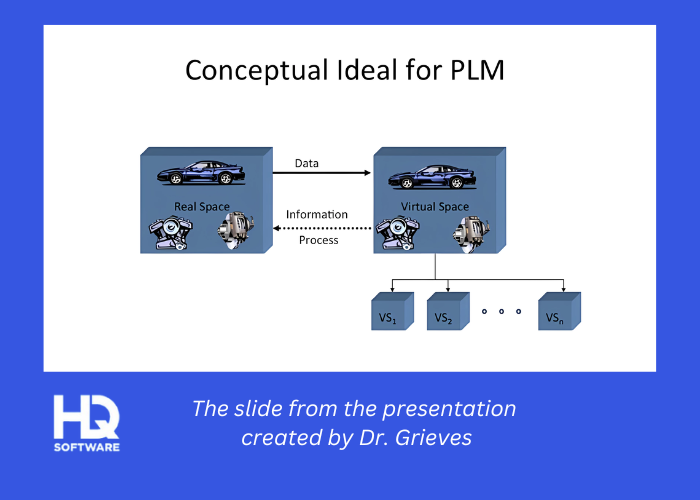
2000-2010: During this period, Computer Aided Design (CAD) systems began to develop and more powerful computers appeared. As a result, the first simple digital models began to be created. They were mostly static 3D models with limited functionality, used for visualization and design. Such twins contained information about the geometry of the object and its basic physical properties, but did not have the ability to receive data from the real object in real time.
2010-2015: The rapid development of Internet of Things (IoT) technologies and sensor systems led to the emergence of dynamic models capable of reflecting changes in the real object through sensor data. At this stage, digital twins began to transform from static models into ‘living’ digital replicas capable of reflecting the current state of physical objects. Companies began to use them to monitor production processes and equipment, reducing maintenance costs and unplanned downtime.
From 2015 to the present: The integration of Artificial Intelligence (AI), Machine Learning (ML) and Big Data analytics has brought digital twins to a new level. Today’s digital twins not only reflect the current state of objects, but are also capable of analyzing historical data, predicting future behaviour and automatically suggesting optimal solutions.
Need a custom software solution? We’re ready to help!Hymux Technologies has a team of skilled professionals ready to tackle the project. Ask me!
Victoria Rokash
Business Development Manager

How Do Digital Twins Work?
The work of digital twins can be broken down into a few simple steps. Let’s briefly describe each of them:
- Data collection: Various sensors are installed on a real object (for example, production equipment) that continuously measure key parameters: temperature, pressure, vibration, speed, energy consumption and other indicators. The more sensors used and the more accurate they are, the more complete the digital twin will be.
- Information transfer: Data from the sensors is transferred to the digital system via IoT. This happens almost instantaneously, ensuring that the information is up-to-date in real time.
- Creating a virtual model: Engineers develop a 3D computer model of an object that exactly matches its physical characteristics. This model includes information about materials, physical properties, features of functioning and other important aspects. The model can be further enhanced through AR/VR technologies to provide immersive interaction experiences.
- Data integration with the model: The information from the sensors constantly updates the virtual model. For example, if the bearing temperature rises in the real machine, this is immediately displayed in the digital twin.
- Analyzing and predicting: ML and AI algorithms analyze incoming data, comparing it with embedded norms and historical performance. The system can detect anomalies, predict possible breakdowns and recommend optimal operating modes.
- Feedback: Based on the conclusions drawn by the digital twin, decisions can be made about necessary actions: preventive maintenance, changes in operating modes or even automatic control of certain processes. In advanced systems, the digital twin can make adjustments to the equipment itself through the automatic control system.
4 Types of Digital Twins
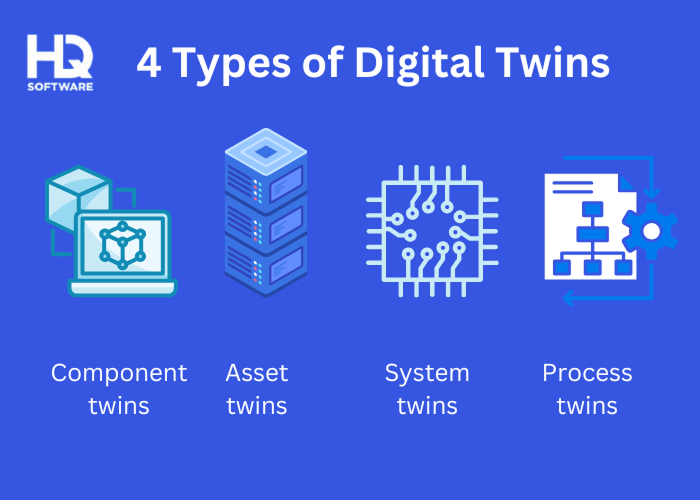
Depending on the level of complexity and scale of modelled objects, there are different types of digital twins. Each of them solves its own tasks and has its own peculiarities of application.
Component twins
Component twins are also called part twins. They are digital replicas of individual parts or assemblies of equipment. This type of digital twin monitors the condition of specific components such as bearings, motors, valves, pumps, etc. It also collects information about temperature, vibration, wear and other parameters of an individual part.
The main task of component twins is to monitor the performance of a specific part and predict possible failures. For example, a digital twin of a bearing can warn of excessive vibration and recommend replacement before failure occurs.
Asset twins
Asset twins simulate entire devices or pieces of equipment consisting of multiple components. These can be machines, turbines, cars, robots or any other complex technical device. Asset twins integrate information from all components of a device and analyze their interaction. They take into account not only the state of individual parts but also how these parts work together.
The main value of these twins lies in optimizing the performance of the entire device. They help to find the best operating modes, balance the performance of the equipment, and plan maintenance.
System twins
System twins simulate the interaction of multiple assets working together as a single system. This can be a production line, a building network, a power plant or an entire factory. These twins analyze not only the condition of each individual asset but also how they work together, including the material and information flows between them. They take into account complex interdependencies and help optimize the operation of the entire system as a whole.
System twins are particularly valuable for improving overall production efficiency. They help to identify bottlenecks, optimize logistics, reduce downtime and increase system throughput.
Process twins
Process twins focus not on physical devices but on the business processes and workflows of an organization. This type of digital twin integrates data not only from equipment but also from enterprise information systems — Enterprise Resource Planning (ERP), Customer Relationship Management (CRM), and others. Process twins model the flow of materials, information and resources throughout the organization.
The key function of such twins is to optimize business processes and support strategic decision-making. They help managers simulate various development scenarios, assess the impact of changes on the business and select optimal strategies.
Considering custom software?Hymux Technologies’s team of experts can design and develop the perfect solution for your business. Let’s discuss it
Dmitry Tihonovich
Business Development Manager

Digital Twin Examples
The past decade has seen a major leap in the development and application of digital twins. This technology is being adopted and successfully used by companies across a wide range of industries and sizes. Let’s look at specific examples of digital twins and the benefits they bring to business and society.
Healthcare
The cost of digital twins in healthcare was valued at around $1.6 billion in 2023. Experts expect significant growth in 2028, when the value of the market will exceed $21.1 billion. The phenomenal year-on-year growth indicates that digital twin technology is an important aspect of providing best practices in healthcare, benefiting medical organizations and improving patient care.
As an example, let’s talk about The Living Heart Project, a digital twin of the human heart. The initiative, launched by Dassault Systemes in 2013, brought together cardiovascular researchers, practicing cardiologists, scientists, medical device developers and regulatory agencies. To work on the digital twin, they used the 3DExperience platform, which can simulate the consumer experience even before the physical product is created and interact with partners in a single digital environment.
The data obtained from patients and research was combined on the platform into a digital model. It allows for simulating circulatory processes, calculating the efficacy of different treatment options and choosing the most suitable one.
Automotive industry
The automotive industry is investing heavily in digital twin technology. It helps engineers to create a virtual image of a car that includes various components — appearance, software and electronics — as well as to simulate the physical behaviour of the final model.
This allows manufacturers to recreate and pre-test each stage of development to identify potential problems and failures before actual production begins. Digital twin technology saves valuable time and money spent on testing and overproduction.
Among car manufacturers, the American company Tesla is the most active in using digital twin technology. Each of its cars is connected to its personal digital twin. It transmits to the company a huge array of data about the cars, which are analyzed by Artificial Intelligence. This allows the company to constantly monitor its products, improve the services offered and increase the quality of cars. Because Tesla cars have computers with specialized software, many mechanical problems can be fixed by simply downloading software updates wirelessly in real time.
Power-generation equipment
With the increasing share of renewable energy sources, digital twins allow for balancing supply and demand by simulating different generation and consumption patterns.
For example, Harbin Turbine Co. in China has implemented digital twin technology to improve turbine design and manufacturing. Using Siemens NX software and Teamcenter PLM, the company has been able to optimize design processes, reduce errors and meet international standards.
General Electric is one of the pioneers and leaders in the use of digital twin technology for power generation equipment. The company has developed the Predix platform specifically to create digital twins for industrial equipment, including wind turbines and gas-fired power plants.
Logistics
In logistics, the digital twin can be used for the following tasks:
- studying the behaviour of the supply chain;
- identifying bottlenecks;
- tracking risks and testing the chain’s resilience to emergencies;
- transport planning;
- inventory optimization;
- analyzing financial flows and customer service costs, etc.
The logistics market is in dire need of tools that can solve the above challenges. Therefore, businesses are ready to invest in digital twin technology that helps improve the safety and efficiency of logistics operations.
For example, Strauss and Givaudan have created digital twins of the dairy supply chain using IoT tools and a platform from Siemens. The system allows for not only tracking deliveries but also sharing information with suppliers, government agencies and consumers.
Meanwhile, global logistics giant DHL has implemented a full digital model of one of its warehouses in Singapore. This is one of the world’s largest warehouse complexes, which is managed based on real-time data fed into the system.
Manufacturing
By creating virtual replicas of factory floors, equipment and processes, manufacturers can visualize and optimize different workflows and operating scenarios before implementing changes in the physical environment.
For example, Siemens Numerical Control in China produces manufacturing systems, drives and motors. To reduce facility costs, they consolidated 3 factories into one using digital twins, allowing them to better optimize space and reduce the amount of waste produced in these facilities.
Meanwhile, the Siemens Electronics factory in Amberg has implemented the ‘smart factory’ concept using digital twins and automated monitoring systems. Thanks to the high level of digitalization, the company has achieved record levels of product quality (up to 99.998%) and minimized downtime.
Urban planning
A digital twin of a city can effectively model the development of the urban area, the operation of housing and communal services, transport, security, and the impact of climate and environmental conditions on the city. Such a virtual model makes it possible to manage all systems in accordance with the adopted development strategy and forecast the consequences of proposed changes.
According to the consulting company ABI Research, the number of digital twins and city models worldwide will exceed 500 by 2025. The largest project so far is Virtual Singapore, which cost $73 million.
To help make better use of Singapore’s scarcity of land and to figure out which areas are most at risk from flooding, GPS Lands Singapore created a detailed digital twin of the entire city. This three-dimensional model contains information about buildings, roads, parks and other city infrastructure. The authorities use it for urban planning, emergency modelling and traffic flow optimization. It has helped reduce traffic congestion by 8% and, along with that, reduced air pollution.
Digital Twin Benefits
Digital twin technology offers significant benefits in all areas of the economy and life, regardless of industry.
Reducing equipment downtime
Digital twins allow organizations to develop, test and adjust product designs or operational processes without disrupting existing supply chains and workflows.
Let’s take the following example: a manufacturer wants to test whether changing a certain set of settings on a production line will improve its performance. Instead of stopping the line, the manufacturer can conduct an experiment using performance and system status data collected by sensors embedded in the equipment and create a virtual replica to conduct the test.
Saving resources and reducing costs
In any industry, digital twins help optimize the use of resources: time, energy, materials and finance. The technology identifies inefficient processes and suggests ways to improve them. For example, in the urban sector, digital twins can help reduce energy consumption in buildings, and in healthcare, they can reduce the cost of treatment through more personalized care.
Speeding up innovation
Digital twins significantly reduce development time for new products and services. Instead of lengthy and costly physical testing, much of the testing is done in a virtual environment. This allows innovations in everything from manufacturing to financial services to be brought to market faster.
Adaptability to change
In our rapidly changing world, it is important to be able to react quickly to new conditions. Digital twins make organizations more adaptable by enabling them to quickly model and assess the impact of an external change — be it a pandemic, an economic crisis or new technological trend.
Create a Digital Twin With Hymux Technologies
Hymux Technologies’s experience in creating digital twins is perfectly illustrated by a project for a US company that works with equipment analytics systems. Our team improved the client’s existing system by integrating machine learning algorithms that predict possible breakdowns and determine the remaining time until failure.
The resulting system analyzes industrial machines in real time, measuring their efficiency and identifying problems before they occur. The implementation resulted in a significant 63.8% reduction in machine downtime and a 36% increase in automation.
This project demonstrates how digital twins not only collect data, but also allow companies to prevent problems in advance, bringing tangible economic benefits.
If you are interested in digital twin technology or still have questions, please contact us. Our experts will review your enquiry and help you find the best solution for your business.

Lead Software Engineer
An experienced developer with a passion for IoT. Having participated in more than 20 Internet of Things projects, shares tips and tricks on connected software development.


Contents:
Did you like the article?
Subscribe for more!
Related Articles
View All
Kick Off With Your Project Today
We are open to seeing your business needs and determining the best solution. Complete this form, and receive a free personalized proposal from your dedicated manager.

Sergei Vardomatski
Founder