Imagine a construction site: the noise of machinery, dozens of workers and tons of materials. Any wrong move, any underestimated danger can cost lives. Construction accidents remain one of the leading causes of workplace injuries and deaths. They represent not only a human tragedy but also enormous financial loss, project delays, and damage to company reputations.
Traditional safety training methods often prove insufficient. Lectures and oral instructions don’t always convey the full gravity of the risks. Workers learn on a real-world site, where the cost of error is too high.
This is where Virtual Reality (VR) comes into play. A technology once associated with games can now literally save lives. VR allows workers to experience realistic, hazardous scenarios without the slightest threat to their health. Safety training develops skills that cannot be reinforced in the classroom and helps them act correctly in critical moments.
In this article, we’ll dive deeper into how VR training is transforming construction safety and why it may become the future standard for protecting workers.
Common Health and Safety Risks on a Construction Site
Construction sites are inherently hazardous environments, and without proper precautions, workers face significant risks of injury or even death. Some of the most common construction safety hazards include:
Falls from height – Working at elevation is one of the leading causes of serious injuries and fatalities. Improper ladder use, lack of guardrails, or failure to regularly inspect scaffolding and elevated workstations all contribute to dangerous falls.
Electrical hazards – Damaged insulation, faulty wiring, or improper use of electrical equipment can expose workers to severe shocks, burns, or even fires.
Falling objects and materials – Heavy tools, equipment, and building materials can fall unexpectedly if not properly stored or secured. Such incidents often lead to head injuries or fractures among workers and bystanders.
Chemical and biological exposures – Hazardous substances such as paints, adhesives, and solvents may cause burns, respiratory problems, or skin irritation if handled incorrectly. In addition, construction sites can harbor biological risks like mold or pest infestations, which threaten long-term worker health.
Accident Statistics in Construction
Unfortunately, the construction industry remains the most dangerous field of work in many countries. Statistics bear this out:
According to Workyard, construction accounts for approximately 19-20% of all fatal workplace injuries in the private sector in the USA.
In 2023, 5,283 workers died across all industries, with approximately 1,075 fatalities in construction alone.
One of the most common causes of fatalities is falls, accounting for approximately 37-39% of all fatalities at construction sites.
Overall, the fatal occupational injury rate among construction and mining workers increased from 12.3 deaths per 100,000 workers in 2021 to 13.0 in 2022, decreasing slightly to 12.9 in 2023.
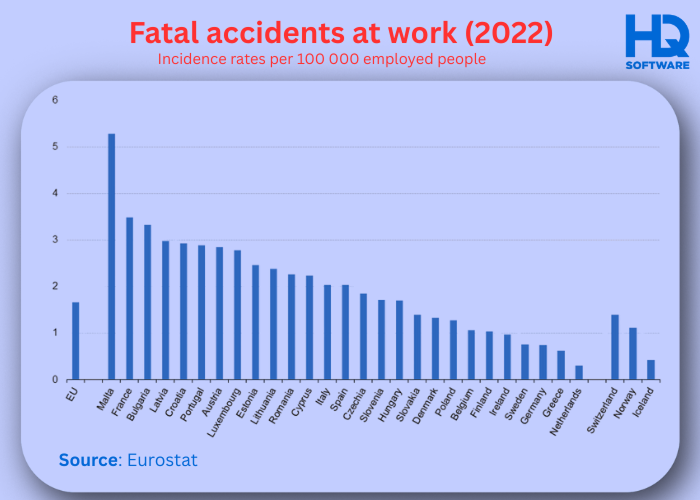
According to Eurostat, in 2022, there were 3,286 fatal workplace accidents in the EU, of which 22.9% (754 cases) occurred in construction. This means that one in four workplace fatalities in the EU was construction-related.
In 2022, there were 2,961 accidents per 100,000 workers in construction in the EU, the highest rate of any industry.
VR Benefits for Construction Safety Training
Virtual Reality technologies are actively being used for training personnel in safety precautions and practicing construction processes. Workers can receive advance instructions and practice installing complex structures in a safe virtual environment. This is especially important when working at heights, with heavy equipment, or in confined spaces, where the cost of error is extremely high.
What are the main advantages of VR safety training?
Reduced training costs and time – Virtual simulations reduce the cost of renting facilities, equipment, and instructors, and speed up the training process without compromising quality.
Individualized training – Each employee can complete training at their own pace. This is critical, as rushing to learn safety rules can cost lives.
Immersion in real-world risks – VR can simulate any hazardous situation: falls from heights, improper tool handling, or equipment accidents. This allows workers to practice correct actions in conditions that are close to reality, but without the risk to health.
Improved retention and practical skills – Visual and interactive elements of VR training help improve information retention and reinforce skills, which is difficult to achieve in a traditional classroom or with paper instructions.
Analysis and progress monitoring – VR systems often provide reports on employee performance, identify weaknesses, and help tailor future safety training.
Thus, VR training transforms construction safety into an interactive and safe process, allowing workers to practice real-life scenarios without risking their lives. Investment in such technologies not only saves time and resources but also truly protects the health and safety of employees.
Considering custom software?
Hymux Technologies’s team of experts can design and develop the perfect solution for your business. Let’s discuss it
Advantages of VR Over Traditional Training Methods
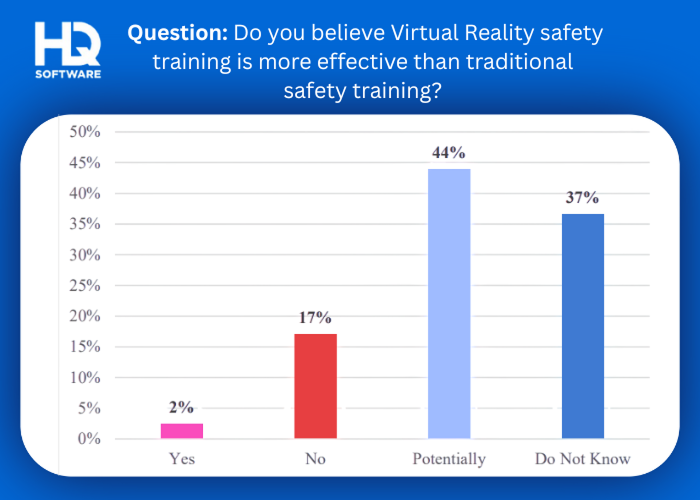
Various studies show that awareness and understanding of VR technology in the construction industry remain limited. For instance, in one survey conducted among construction workers, respondents were asked whether they believed that Virtual Reality safety training is more effective than traditional safety training. Interestingly, 81% of participants chose the options “Potentially” or “Do Not Know,” which may indicate a general lack of knowledge or experience with VR technology and its advantages over conventional methods.
Despite the rapid development of VR training, traditional safety training methods are still more generally used in the construction industry. Each employer is free to choose the approach that best suits their needs. However, as a company that has been developing VR solutions for many years and observing their effectiveness, we are confident that VR safety training should be considered, as it offers a number of tangible advantages over traditional methods.
To better understand the differences, please refer to the following table:
Criteria
VR Training
Traditional Training Methods
Cost efficiency
Reduces costs for physical materials, trainers, and travel
Often requires renting equipment, venues, and hiring multiple instructors
Training time
Faster learning process, can be completed in shorter sessions
Takes longer due to classroom setup and physical exercises
Customization
Highly customizable training scenarios based on specific needs
Limited customization, relies on generic safety procedures
Realism
Provides immersive, real-life simulations of dangerous situations
Limited to theoretical knowledge and video demonstrations
Safety
No risk to the worker; training takes place in a safe virtual environment
Potential real-world risks when practicing on-site or with actual equipment
Engagement
High engagement through interactive and gamified training
Less engaging, often passive (lectures, handbooks, videos)
Retention of knowledge
Increased retention due to its interactive and immersive nature
Lower retention rates, as it relies on lectures and reading materials
Real-time feedback
Immediate feedback on actions and decisions made during training
Feedback is often delayed or only provided after completion
Accessibility
Available anytime, anywhere with proper equipment
Dependent on schedules, location, and physical resources
Scalability
Easily scalable across large organizations, with consistent quality
Scaling requires substantial investment in trainers and materials
Applications of Virtual Reality in Construction Safety Training
Virtual Reality allows construction company employees to practice their skills in conditions that are as close to real life as possible, but without risk to life and health. Below are the main scenarios where VR training has proven its effectiveness.
Scenario #1: Working at Height
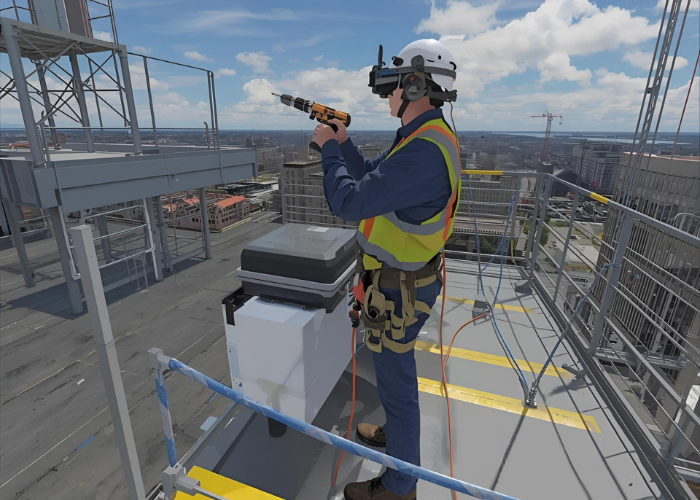
In this scenario, employees perform typical tasks associated with working at height, such as drilling, securing structures, and moving heavy materials. At the same time, they must comply with safety protocols: wearing a safety harness, checking the stability of the scaffolding, and ensuring that the equipment is correctly secured. Unexpected situations may arise during the simulation, such as loss of balance or a shaky platform. The training helps the employee learn to react quickly and prevent falls, forming stable habits of safe behavior.
Scenario #2: Operating Heavy Machinery
Crane, excavator, and loader operators are trained in a virtual environment where they can safely practice handling equipment in challenging conditions: limited space, poor visibility, and the presence of other workers nearby. The system records every action and warns of possible errors, such as exceeding the permissible boom radius or incorrect load attachment. This approach allows operators to safely master operating techniques without the risk of damaging equipment or causing injuries on a real site.
VR allows construction company employees to practice their skills in conditions that are as close to real life as possible.
Scenario #3: Electrical Hazards and Fire Safety
In this VR simulation, workers encounter dangerous situations: exposed wires, power surges, short circuits. They must correctly assess the risk, turn off the power, use personal protective equipment, and choose a safe evacuation route. Another part of the VR training simulates a fire on site: participants learn how to use fire extinguishers, act in smoky conditions, and organize the evacuation of colleagues. VR helps develop not only technical skills but also stress resistance in emergency situations.
Scenario #4: Emergency Response and Evacuation
This scenario simulates various emergency situations: fire, structural collapse, gas leak, or injury to a colleague. Employees must quickly decide whether to activate the alarm, administer first aid, or evacuate via a safe route. Some versions of the simulation allow them to practice teamwork—how the group should coordinate their actions during an evacuation. This experience builds confidence and readiness to act without panicking in a critical moment.
These scenarios demonstrate only some of the applications of Virtual Reality in construction safety training. In practice, the number of scenarios could be significantly expanded. It all depends on the specifics of the construction work, the level of employee training required, and the company’s objectives.
VR technologies allow the Hymux Technologies team to create customized training programs adapted to the real conditions of a particular enterprise, from installing metal structures to eliminating emergency situations.
How Can Hymux Technologies Help You Incorporate VR Into Your Construction Safety Program?
At Hymux Technologies, we’ve developed VR training solutions for multiple industries where safety is just as critical as it is in construction. Our experience shows that immersive technologies can significantly improve risk awareness, reduce accidents, and optimize training costs — no matter the field.
One of the most relevant examples is a VR training program for a major U.S. beverage manufacturer. The VR solution enables line operators to practice bottling processes safely, follow PPE protocols, and respond to emergency situations within a fully simulated production environment. By recreating potentially hazardous scenarios without disrupting real operations, the company improved its employees’ safety preparedness and minimized risks during training.
Building on this experience, Hymux Technologies helps construction companies integrate VR into their safety training programs step by step — from idea to fully functional training systems. Our approach ensures that each solution is tailored to the company’s unique processes, risks, and safety goals.
Need a custom software solution? We’re ready to help!
Hymux Technologies has a team of skilled professionals ready to tackle the project. Ask me!
Key Stages of VR Implementation for Construction Safety Training
Needs analysis and goal setting: We start by identifying the specific safety challenges your company faces. It might be working at heights, handling heavy machinery, or emergency response. Together, we define measurable goals such as reducing incident rates, cutting training time, or improving compliance.
Concept development and prototyping: Our team creates a Proof of Concept (PoC) or prototype that demonstrates how VR can address your training needs. This phase allows stakeholders to experience the technology firsthand and evaluate its potential before full-scale development.
Content design and development: We build immersive and interactive training modules based on real construction site scenarios. This includes simulations for hazard recognition, fall protection, PPE usage, and evacuation procedures.
Integration and testing: Once developed, the VR solution is integrated into your existing training infrastructure, including Learning Management Systems (LMS) or internal safety programs. We conduct user testing and make sure the experience is intuitive, realistic, and effective.
Deployment and continuous support: After deployment, we provide technical support, performance analytics, and periodic updates to keep the training relevant and aligned with changing safety regulations and company needs.
Challenges and Limitations of Implementing VR in the Construction Industry
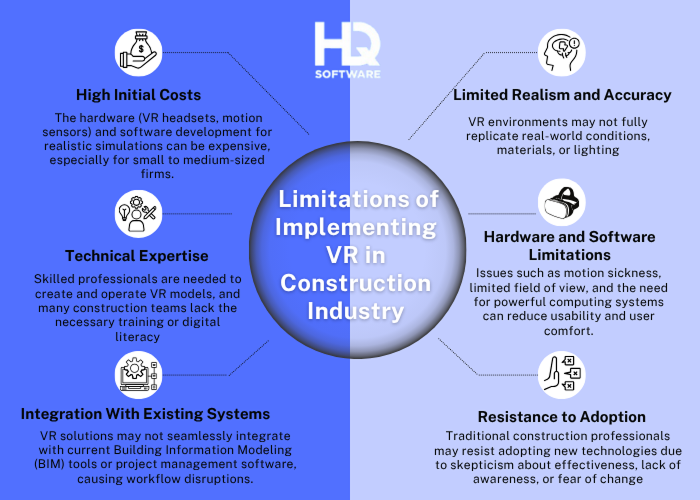
Every technology has advantages and disadvantages, and VR training is no exception. Despite the impressive capabilities of Virtual Reality in teaching safety techniques on construction sites, it is important to note its limitations and potential difficulties.
First, the cost of equipment and software can be significant. High-quality VR headsets, motion sensors, and custom applications require a serious investment, which can be a barrier for small and medium-sized construction companies. For example, implementing VR training for a team of 50 people can require tens of thousands of dollars for equipment and content development. For companies with limited budgets, this is a serious burden.
Another problem is the need for specialized equipment and available space. Employees need access to VR headsets, compatible computers, and enough space to safely interact with the simulation. Providing such conditions on an active construction site can be difficult and is not always possible.
Furthermore, simulations do not always fully correspond to reality. Despite the high degree of immersion, VR safety training cannot yet convey all the factors that may affect a real environment—such as loud noise, heat, gusts of wind, or uneven surfaces. For example, VR training can teach the correct use of a safety harness, but it cannot recreate the stress experienced by a worker at a height of 30 meters in strong winds.
Finally, training effectiveness can vary. Virtual Reality is excellent for practicing specific procedures and actions in emergency situations but may be less effective for learning general safety principles or developing critical thinking skills. In addition, some employees may find traditional face-to-face training or working with written materials more comfortable than digital immersion.
The Future of Virtual Reality in Construction Safety Training
Predicting the future is no easy task, but in the case of VR, it’s possible to make reasonable assumptions. We’re already seeing how rapidly Virtual Reality is being applied in various industries and how it is changing the approach to safety training. These trends give us an idea of how VR could transform the field of construction safety in the coming years.
Integration With Artificial Intelligence (AI)
In the future, VR training will be actively combined with AI, which will be able to analyze employee behavior during training and adapt scenarios to their level of knowledge and skills. For example, if an employee makes a mistake while working at height, the system will automatically offer an additional exercise to reinforce safe practices. This approach makes training more personalized and effective, reducing the likelihood of mistakes being repeated in the real world.
Collaborative Virtual Training
Collaborative VR technologies will enable entire teams to undergo training simultaneously, even when they’re located in different places. This improves teamwork skills, helps teams rehearse joint actions in emergency situations, and promotes a culture of safety at all levels of the company. For example, a team can practice fire evacuation together, working out the correct sequence of actions and coordination between participants.
Analytics and Monitoring
Connecting VR to analytics systems allows construction companies to collect detailed data on the actions of each employee: which steps were performed correctly, where mistakes were made, and how much time it took to complete the task. Based on this data, training modules can be adjusted and the effectiveness of training can be evaluated on an individual level. This approach provides objective feedback, allowing companies to identify their employees’ weaknesses and improve overall safety on site.
More Affordable Solutions
With the development of VR technologies, equipment is becoming more affordable and easier to use. Meanwhile, training modules are becoming faster to develop and easier to scale to growing needs. Therefore, even small construction companies will be able to implement interactive training programs that were previously only available to large corporations. This will make it possible to create safer work sites, reduce the number of incidents, and speed up the training of new employees.
Conclusion
Some of our predictions may come true in the near future, while others will take a little longer. But one thing is certain: VR training will become increasingly popular because it brings tangible benefits to both businesses and employees. Virtual Reality is not only about efficiency and cost reduction, but above all about saving lives and increasing safety on construction sites.
At Hymux Technologies, we are proud to contribute to this future by creating VR solutions that help companies reduce incidents and improve safety culture.
If you are ready to implement VR safety training in your company, please contact us. We will be happy to help you make your workplaces safer.
A developer with extensive expertise in AR/VR, very ingrained into the topic of Mixed Reality development. Shares his knowledge and the results of many years of work.
VR training excels at reducing accidents caused by human error. It improves hazard recognition, encourages proper use of personal protective equipment, and teaches emergency response skills. Workers gain hands-on experience in high-risk situations without danger. Over time, this leads to better situational awareness, faster decision-making, and a measurable decrease in injuries on construction sites.
What Scenarios Should We Include First?
Start with the scenarios that represent the highest risks on your sites. Working at heights, operating heavy machinery, and emergency response situations are often top priorities. By focusing on critical hazards first, VR training provides immediate safety benefits and builds worker confidence. Additional scenarios can then be added as experience and comfort with the system grow.
What VR Headsets Do We Need, and How Much Space Is Required?
For most construction safety training, standalone headsets like Meta Quest are sufficient. They are easy to use, portable, and affordable. Each user typically needs a safe area of about 2–3 meters in all directions. The setup can be scaled with multiple headsets, making it possible to train small groups or entire teams efficiently.
What Does VR Training Cost to Start and to Scale Across Projects?
Initial VR training costs vary depending on content complexity and hardware. A small pilot can be implemented with a modest budget, demonstrating the benefits quickly. Scaling across multiple projects adds cost for additional headsets and custom scenarios. Over time, VR reduces overall training expenses by lowering downtime, minimizing on-site risks, and increasing efficiency.
We are open to seeing your business needs and determining the best solution. Complete this form, and receive a free personalized proposal from your dedicated manager.