Table of contents:
Benefits for Cruise Lines of Using AR and VR
Applications for Guest Entertainment
Custom AR/VR Development for Cruise Lines by Hymux Technologies

Ever wished navigating a massive cruise ship felt as easy as following a friendly guide, or dreamed of exploring exotic destinations from your cabin? For cruise lines, meeting these passenger desires is a constant challenge.
Enter Augmented Reality (AR) and Virtual Reality (VR). AR can provide intuitive navigation and interactive onboard discovery. VR offers breathtaking pre-trip destination previews and engaging virtual entertainment.In this article we’ll outline the insights we’ve gained from building VR- and AR‑based training solutions and describe why they’re useful for cruise lines.
In this article, we’ll dive deeper into how VR training is transforming construction safety and why it may become the future standard for protecting workers.
Benefits for Cruise Lines of Using AR and VR
Applications for Guest Entertainment
Custom AR/VR Development for Cruise Lines by Hymux Technologies
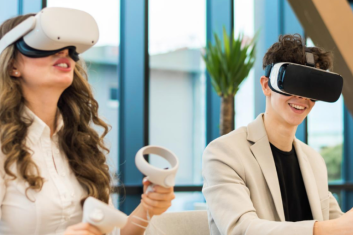
Cruise lines use Augmented Reality and Virtual Reality technology to enhance every aspect of the passenger experience. AR adds digital information to what you see through your phone or tablet. VR creates completely immersive digital worlds through special headsets, where passengers can “step” onto a virtual deck, explore a destination before docking, or practice emergency drills without any real‑world risk.
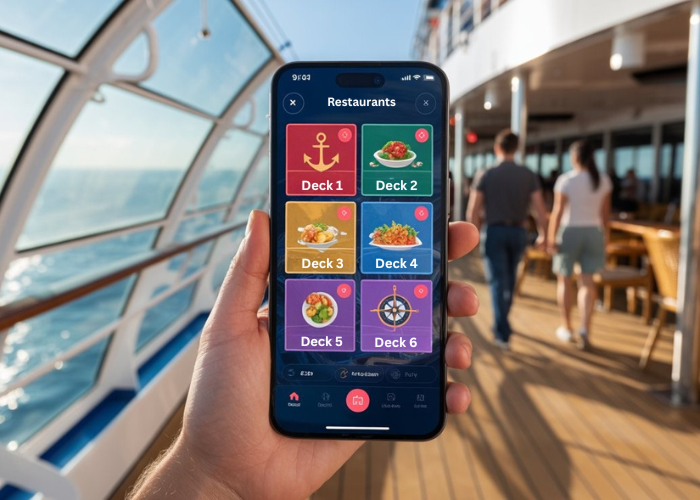
Because these technologies blend the physical ship with digital experiences, they offer a host of practical advantages for both guests and crew:
The benefits of AR and VR on cruise lines go far beyond convenience; they improve the entire guest experience. So, let’s explore how these technologies create unforgettable entertainment for passengers.
Need a custom software solution? We’re ready to help!Hymux Technologies has a team of skilled professionals ready to tackle the project. Ask me!
Victoria Rokash
Business Development Manager
The numbers tell an exciting story: VR and AR in tourism has grown from a $2.9 billion investment to an expected $16.7 billion in just nine years. This rapid expansion shows that cruise companies see huge potential in these technologies.
Here are some of the practical applications driving this growth.
Guests can use AR to explore the cruise ship like never before. By pointing their phone or tablet at various areas, they can see:
The overlay shows where the nearest bar is, what the menu looks like, or how a particular attraction works. This lets passengers discover the ship’s features on their own without needing a guide. So, they can easily navigate the ship, discover hidden gems and plan their day without getting lost.
For instance, MSC Cruises offers a VR catalog that allows passengers to explore ships and cabins virtually, improving engagement and customer experience. Every passenger interaction with VR features, such as accessing ship deck plans, provides cruise lines with valuable, direct customer data.
Before a shore stop, passengers can slip on a VR headset or scan a QR code to be transported to a lifelike 360° preview of the destination. They can walk through a historic site, dive into a coral reef, or stroll a bustling market. This preview builds excitement and helps to plan activities. This makes the upcoming excursion feel real before they even step off the vessel.
Cruise lines turn onboard fun into a game by adding:
Guests might hunt for virtual clues hidden around the ship, earn points for visiting certain venues, or compete in themed mini‑games. The playful competition encourages exploration and keeps passengers engaged throughout the voyage. Such games often reward participants with discounts, souvenirs, or exclusive experiences.
For example, Royal Caribbean’s Zone Zero creates a dedicated VR playground featuring exclusive adventures like Swashbuckler, where guests embark on a 12-minute steampunk pirate journey filled with epic battles and treasure hunts. The zone also features VR-enhanced escape rooms that challenge teams to solve puzzles in immersive virtual environments.
Crucially, the value of VR and AR isn’t limited to the guest experience. It also presents powerful opportunities for the companies operating these ships.
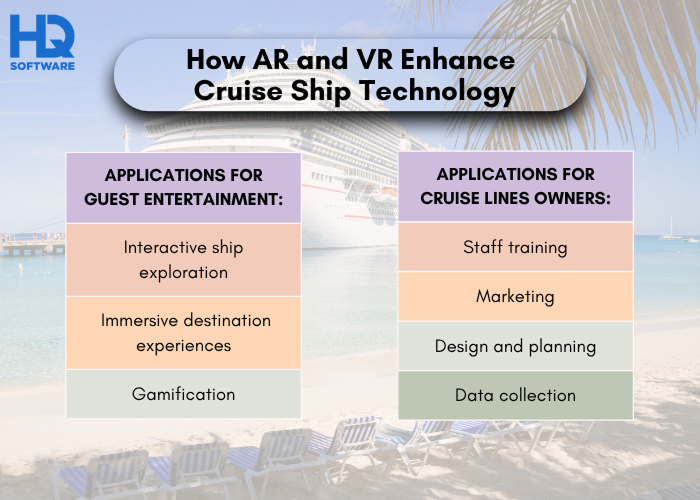
Cruise companies use immersive technologies to train teams better, boost safety, and attract more bookings with smart marketing, ultimately increasing profits. The applications with the biggest impact include:
AR and VR help cruise staff train faster and safer. Crew members can practice emergency drills such as fires or evacuations in virtual simulations without real danger. They can also learn customer service skills through interactive scenarios, like handling guest complaints or managing crowds. This makes training more effective and risk-free, ensuring staff are prepared for any situation on board.
Here is one bright example. Norwegian Cruise Line uses 360° virtual training to prepare their crew members more effectively. Through immersive experiences, crew members practice everything from evacuation procedures to handling difficult passenger situations.
AR and VR make cruise marketing more exciting and immersive. Potential passengers can take virtual tours of ships and cabins before booking, seeing every detail as if they were there. Interactive ads let users explore destinations in 3D or even “step onboard” a cruise ship from home. Social media filters and AR games can boost engagement and shares, making marketing campaigns more memorable and effective.
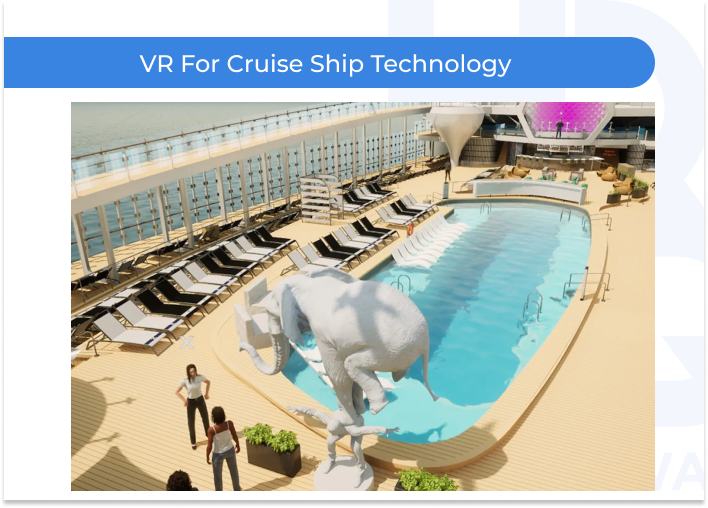
Before a new vessel is built, designers can use VR technology to walk through the ship’s layout, test passenger flow, and spot design flaws early. Architects can experiment with cabin sizes, restaurant placements, or pool locations in a virtual model, saving time and money by avoiding costly changes during construction and ensuring a smoother, more enjoyable onboard experience.
On the passenger side, Celebrity Cruises has pioneered virtual ship previews by building a Metaverse version of Celebrity Beyond, their latest luxury liner, giving potential cruisers an immersive preview experience before they book.
AR wayfinding apps and VR experiences can capture how passengers interact with ship features: what routes they take, which attractions they linger at, and how long they stay in each area. This anonymized data helps cruise lines understand guest preferences, optimize staffing, improve crowd management, and tailor future itineraries and onboard services to better meet traveler expectations.
Success stories from leading cruise lines prove that AR/VR investment delivers real results, inspiring more companies to explore these technologies.
Watch a short video to see how we can help you.
At Hymux Technologies, we turn the promise of AR and VR into practical, revenue‑driving tools for cruise operators. Our end‑to‑end service model means you get a single partner that handles strategy, design, development, and integration. So, you can focus on sailing while we build the digital experiences that keep guests and crew engaged.
Why сhoose Hymux Technologies?
Considering custom software?Hymux Technologies’s team of experts can design and develop the perfect solution for your business. Let’s discuss it
Dmitry Tihonovich
Business Development Manager
While AR and VR are reshaping the cruise experience, they aren’t without hurdles. Below we explore some of the key limitations faced in applying these technologies aboard a large vessel and how they can be addressed.
On a moving vessel, Wi‑Fi and cellular signals can be spotty, especially when the ship is far from shore. AR overlays that need to download 3D models or VR experiences that stream high‑resolution video may lag or fail to load, frustrating users.
How to overcome it: Pre‑load the most used assets onto the ship’s local server or onto passengers’ devices before they set sail, and use lightweight, compressed models that run offline. A small onboard mesh‑network can then deliver the content quickly without relying on external internet.
Both AR and VR technologies require a clear area to move safely. On crowded decks or cabins, passengers may bump into furniture, railings, or other guests, creating safety hazards.
How to overcome it: Design experiences that are seated or stationary. For instance, virtual tours viewed while seated, or AR way‑finding that works from a standing position without requiring large movements. Clearly mark safe zones on the ship and provide on‑screen warnings when users approach the edge of the designated area.
Cruise itineraries change frequently, and a one‑size‑fits‑all AR and VR library can quickly become outdated. This might be, for example, a shore excursion that’s no longer offered. Passengers may also speak different languages, making generic content less useful.
How to overcome it: Use a cloud‑based content‑management system that lets the ship’s operations team push updates in real time: new AR markers, updated destination previews, or multilingual overlays. So, the digital layer always matches the current schedule and guest demographics.
In conclusion, Augmented Reality and Virtual Reality are vital tools actively engaging with the cruise industry. From guiding passengers effortlessly around vast ships and offering thrilling entertainment, to providing invaluable training for crew and generating crucial customer insights, AR and VR are proving indispensable. As these technologies continue to evolve, they promise even more personalized experiences, setting a new standard for the future of cruising.
Contact us to discuss how we can tailor AR and VR solutions for your fleet, to turn every voyage into a safer, more engaging, and data‑driven experience.
AR/VR Expert
A developer with extensive expertise in AR/VR, very ingrained into the topic of Mixed Reality development. Shares his knowledge and the results of many years of work.


Subscribe for more!
We are open to seeing your business needs and determining the best solution. Complete this form, and receive a free personalized proposal from your dedicated manager.

Sergei Vardomatski
Founder