As a software development company that specializes in Virtual Reality (VR) and Augmented Reality (AR) solutions, we frequently encounter the same questions from small business owners: “Is VR training really viable for my business?” “Can we afford it?” “Will it actually deliver results?”
These are valid concerns. While Virtual Reality has improved training programs for large corporations, small businesses face unique challenges such as tighter budgets, smaller teams, and limited resources for experimentation with emerging technologies.
Drawing from years of developing numerous VR solutions across various industries, we understand both the potential and the practical limitations of this technology. We’ve witnessed firsthand which implementations succeed and which fail, what drives genuine ROI, and where small businesses can realistically benefit.
This guide addresses your most pressing questions about VR training for small businesses. We’ll explore practical use cases, implementation strategies, and how to determine if VR training aligns with your specific needs.
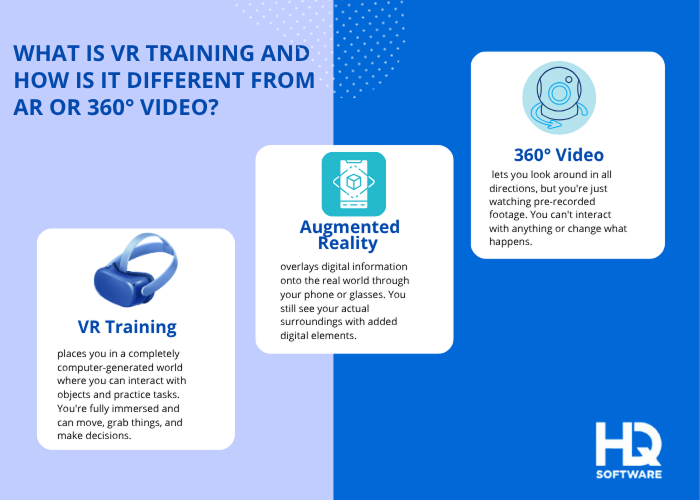
What Is VR Training and How Is It Different From AR or 360° Video?
Before diving deeper, let’s break down the basics. Understanding some key concepts will help us explore how VR technology truly stands out. So, the difference is:
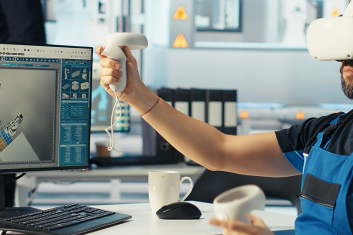
VR training places you in a completely computer-generated world where you can interact with objects and practice tasks. You’re fully immersed and can move, grab things, and make decisions.
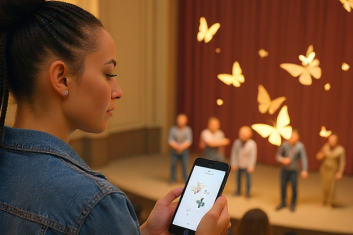
Augmented reality overlays digital information onto the real world through your phone or glasses. You still see your actual surroundings with added digital elements, like repair instructions floating over real equipment.
360° video lets you look around in all directions, but you’re just watching pre-recorded footage. You can’t interact with anything or change what happens. It’s like sitting in the middle of a movie.
The key difference:VR technology is interactive and computer-generated, AR enhances reality, and 360° video is passive observation. For training, VR offers hands-on practice, AR provides real-time guidance, and 360° video gives immersive viewing experiences.
Benefits of VR Training for Small Businesses
VR training offers small businesses surprising advantages that go beyond the technology’s “wow factor.” Here’s how it can genuinely improve your training programs.
Risk-Free Practice
Employees can make mistakes and learn from dangerous or costly scenarios without real-world consequences. No one gets hurt, and no equipment gets damaged during training This is a major plus for smaller teams that can’t afford downtime.
Reduced Material Costs
Small businesses often operate on tight budgets, and VR eliminates the need for costly physical materials, products, or equipment for every training session. One VR scenario can be repeated infinitely without wear and tear, saving money on replacements and maintenance.
Consistent Training Quality
With limited resources, small businesses may rely on whoever is available to do training, leading to inconsistent instruction. With VR, every employee receives identical instruction regardless of which trainer is available. This eliminates variability and ensures everyone learns the same procedures correctly.
Train Anytime and Anywhere
Employees can practice at their convenience without booking equipment and facilities. This flexibility reduces scheduling conflicts and downtime. For small businesses with lean staffing, this means they don’t have to pull multiple people away from work simultaneously or shut down operations for training sessions.
Improved Knowledge Retention
Small companies can’t afford constant retraining, so better retention means employees get it right the first time and need fewer follow-up sessions.Hands-on, immersive learning is more memorable than reading manuals or watching videos. Studies show people retain up to 75% of what they practice versus 10% of what they read.
Measurable Results
VR systems track performance metrics automatically, showing business owners exactly where their employees struggle or excel. This data helps refine both training content and individual coaching. Small businesses need to justify every dollar spent. So, concrete metrics prove your training investment is working and show exactly where to focus improvement efforts.
As we see, VR training offers small businesses a powerful way to enhance learning and development without breaking the bank.
Need a custom software solution? We’re ready to help!
Hymux Technologies has a team of skilled professionals ready to tackle the project. Ask me!
Now, let’s address the question on everyone’s mind.
Is VR Right for Your Small Business?
Despite all the advantages of VR training, it isn’t right for every small business. But it might be perfect for yours.
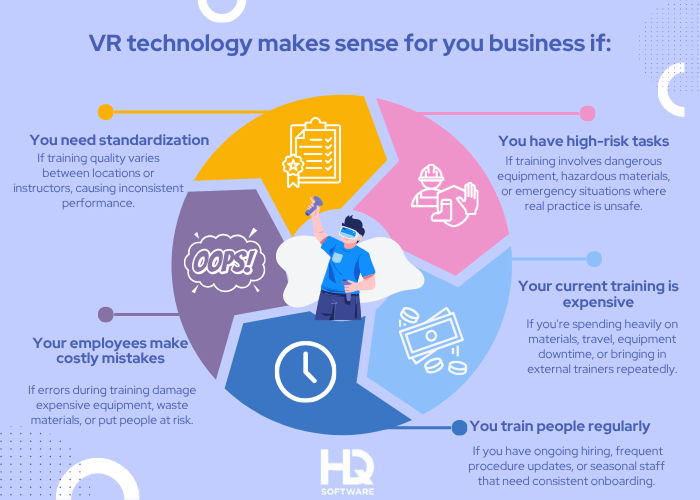
VR technology makes sense for your business if:
You have high-risk tasks. If training involves dangerous equipment, hazardous materials, or emergency situations where real practice is unsafe.
Your current training is expensive. If you’re spending heavily on materials, travel, equipment downtime, or bringing in external trainers repeatedly.
You train people regularly. If you have ongoing hiring, frequent procedure updates, or seasonal staff that need consistent onboarding.
Your employees make costly mistakes. If errors during training damage expensive equipment, waste materials, or put people at risk.
You need standardization. If training quality varies between locations or instructors, causing inconsistent performance.
VR training works best when you need repeatable, hands-on practice for physical or high-stakes scenarios. So, identify your most expensive or challenging training problem, and if VR solves that, it’s worth considering.
Applications of VR Training in Various Industries
Next, we’ll explore specific industries that are getting the best results, showcasing VR training programs we’ve developed at Hymux Technologies.
Manufacturing and Industrial Operations
VR training helps factory workers learn how to operate machinery safely without risking injury or damaging expensive equipment. Employees can practice assembly line procedures, equipment maintenance, and troubleshooting in a virtual factory environment. This is especially valuable for training on dangerous machinery such as forklifts, industrial presses, or robotic systems where mistakes could cause serious injuries or costly downtime.
Since traditional training methods were time-consuming and risky, a manufacturing company teamed up with Hymux Technologies to build VR training to handle complex machinery and safety procedures. Its aim was to help line operators master bottling tasks and follow safety protocols in the company’s bottling facility. The resulting solution allowed workers to practice complex procedures in a virtual environment, mimicking real-world conditions.
Outcomes included a 2.5 times reduction in training time, 73% reduction in training costs, and higher employee engagement. This quick turnaround demonstrated VR’s potential to streamline training and improve productivity in manufacturing.
Retail and Customer Service
Retail businesses use VR to train employees on customer interactions, handling difficult situations, and store procedures. Staff can practice dealing with angry customers, manage busy sales periods, or learn new point-of-sale systems in a stress-free environment. This builds confidence before employees face real customers and improves service quality.
For example, a small boutique can train new employees on handling returns and exchanges, upselling complementary items, or managing multiple customers during peak hours. All this is possible without the pressure of real sales on the line. This boosts employee capabilities and reduces mistakes during actual transactions.
Healthcare and Medical Training
Medical facilities train staff on patient care procedures, emergency response, and medical equipment operation through VR. For example, nurses can practice administering injections, caregivers can learn proper patient handling techniques, and dental assistants can familiarize themselves with procedures without involving real patients. This improves skills while maintaining patient safety and privacy.
At Hymux Technologies, we’ve created our own product called Bodyscope: a VR application that allows students and other medical professionals to explore and interact with CT and MRI scans in a virtual environment. Beyond standard viewing and rotation capabilities, the application provides powerful analysis tools:
Scaling models up or down to examine body parts in granular detail;
Filtering CT and MRI images by tissue density to highlight specific anatomical structures;
Slicing through models at any angle to eliminate visual obstructions;
Measuring anatomical features using multiple measurement tool options;
Controlling virtual lighting to improve structural visibility.
Construction and Trades
Construction companies use VR to teach workers about job site safety, equipment operation, and building techniques. Workers can identify hazards, practice operating heavy machinery, or learn proper installation procedures before stepping onto an actual construction site. This reduces accidents and helps new workers become productive faster.
For instance, a small electrical contracting company can train apprentices on identifying electrical hazards, proper lockout/tagout procedures, and working safely around live circuits. In VR, the company can teach its employees without any risk of electrocution or costly mistakes on a client’s property. This reduces accidents and helps new workers become productive faster.
Automotive and Repair Services
Auto shops and dealerships use VR to train mechanics on vehicle diagnostics, repair procedures, and new technologies. Technicians can disassemble virtual engines, practice complex repairs, or learn about electric vehicle systems without needing the actual vehicles or parts. This keeps training costs down while building expertise on various makes and models.
At Hymux Technologies, we’ve developed VR training programs that build practical skills needed for entry-level positions in engineering, mechanics, and similar fields. Spanning industries from truck and aircraft maintenance to electrical systems, these realistic VR scenarios enable trainees to tackle complex tasks and build critical job skills.
We’ve made everyday actions like using a screwdriver, taking measurements, or operating a car jack feel incredibly lifelike, helping trainees develop proper techniques and muscle memory. The data demonstrates clear success: VR training achieved 84% engagement rates and 67% knowledge retention among participants.
Hospitality and Food Service
The hospitality industry faces constant challenges with high staff turnover and the need to maintain consistent service quality across all shifts.So,restaurants and hotels train staff on food preparation, kitchen safety, customer service scenarios, and emergency procedures using VR.
Warehousing and Logistics
Warehouse operations train workers on equipment handling, inventory systems, and safety protocols through VR. The immersive environment allows workers to practice and master these essential procedures without risk. Employees can practice operating pallet jacks, learn warehouse layout and organization, or experience emergency evacuation procedures. This reduces workplace accidents and gets new hires productive quickly without disrupting actual operations.
For example, a small eCommerce fulfillment center could simulate a busy shipping day.It can let new employees practice using pallet jacks, locate items in the warehouse, and respond to fire alarms without risking damage to inventory or delaying orders.
Real Estate and Property Management
Real estate professionals use VR to train agents on property features, client interaction skills, and virtual property tours. This training method provides a realistic simulation of client interactions and property walkthroughs. It ensures agents are prepared and confident before engaging with actual clients or listings.
A small independent real estate agency, for instance, can use VR to train new agents on conducting showings for different property types from condos to single-family homes. Agents can practice how to highlight key features, answer common questions about fees or utility costs, and handle buyer objections about price or location. This prepares them to answer client questions confidently and conduct more effective showings.
From Pilot to Scale: Hymux Technologies for VR Training
With Hymux Technologies, you get a partner committed to turning your VR training vision into reality. Here’s how we support your idea from initial concept to full VR project development:
Consultation and needs assessment. We evaluate your specific training challenges and determine if VR is the right fit for you. You’ll get honest advice on whether VR makes business sense for your situation.
Hardware selection and setup. We recommend the right headsets and equipment for your budget and needs, then help you get everything configured. You won’t waste money on inappropriate or overpriced technology.
PoC and MVP development. We can create a small-scale prototype to test your VR training idea before full investment. This lets you experience the solution firsthand and gather feedback from actual users.
Custom VR training content. We build tailored training scenarios that match your exact procedures, equipment, and workflows. Everything reflects your real work environment and challenges.
Learning management system integration. We connect your VR training with your existing training platforms to track progress and results. All your training data lives in one place for easy reporting.
Performance analytics and reporting integration. We build dashboards showing exactly how trainees perform, where they struggle, and training ROI. You get measurable data to prove training effectiveness.
When you’re ready to expand, we help deploy training across multiple locations or departments. We ensure consistent quality as your program grows.
Andrey Kazakevich
Head of Production
at Hymux Technologies
The real payoff of building VR for a small business is delivering an asymmetric advantage. A focused application can give a 15-person team the geographical reach and operational efficiency of an organization ten times their size.
Check out this quick video to see our VR capabilities.
How to Implement VR Training for Your Small Business
To successfully adopt VR training, you need more than just headsets. You need a clear plan. Therefore, we’ve created a roadmap that breaks the process into actionable steps:
Step 1: Identify your training challenge. Pinpoint your most expensive or problematic training need. Look for tasks that are dangerous, costly to practice, or require frequent repetition. This is where VR will deliver the biggest return.
Step 2: Set clear goals. Define what success looks like. Do you want to reduce accidents by 30%? Cut training time in half? Improve test scores? Having specific, measurable targets helps you evaluate if VR is working.
Step 3: Start small with a pilot project. Don’t roll out VR company-wide immediately. Pick one specific training scenario and a small group of employees to test it. This lets you work out problems without major investment.
Step 4: Choose the right equipment. For most small businesses, start with affordable standalone headsets like Meta Quest. Avoid expensive, complicated setups until you’ve proven VR works for your needs.
Step 5: Develop content. Decide whether to buy off-the-shelf training software or build custom content. Off-the-shelf is faster and cheaper if available; custom development fits your exact needs but costs more.
Step 6: Refine and scale. Based on pilot results, adjust your approach. If it’s working, gradually expand to more employees and training scenarios. If not, figure out why before investing further.
Step 7: Integrate with existing training. VR works best alongside other methods. Combine it with classroom instruction, hands-on practice, and mentoring for a complete training program.
Budget and Cost Breakdown
Here’s the financial reality: VR training requires initial investment, but most businesses see positive ROI within the first year through compounding savings.
So, understanding those costs helps you plan effectively. Here’s a simple breakdown:
Hardware: VR headsets (for example, Meta Quest 2) range from $300 to $1,000+ per unit, depending on quality and quantity.
Software: Custom solutions can range from $10,000 to $50,000+.
Content development: Creating custom training modules cost $5,000–30,000+, depending on complexity.
Training and support: Budget for employee training and ongoing technical support, typically $1,000–5,000.
While upfront costs may seem high, long-term savings from reduced training expenses, fewer errors, and improved productivity make VR training a smart investment for many small businesses.
Organizations using VR as part of their training mix have cut annual expenses significantly, eliminating costs for printed manuals, training facilities, and instructor travel. These direct savings are substantial, but the financial benefits go much deeper.
How to Measure the Impact of VR Training
Measuring VR training effectiveness doesn’t require complicated analytics. Focus on these practical metrics:
Engagement rates. Track how actively employees participate in VR training sessions.
Skill Improvement. Test employees before and after training to see how much their skills have improved.
Time savings. Compare how much faster VR training is compared to traditional methods.
Error reduction. Measure if there are fewer mistakes on the job after VR training.
Cost savings. Calculate how much money you’ve saved on materials, travel, or instructor fees.
Employee feedback. Ask trainees how they feel about the VR experience and what they’ve learned.
Retention rates. Check if employees remember more after VR training compared to other methods.
You don’t need to track everything at once. Pick 2-3 metrics that matter most to your business goal. If safety is your priority, track incident rates. If it’s cost, track training expenses. Measure consistently over time to see real trends.
Now let’s get to the bottom line. Virtual Reality training gives small businesses a smart and affordable way to teach employees new skills. Instead of using expensive equipment or risking mistakes in real life, staff can learn by practicing in a safe, virtual space. It’s flexible, engaging, and helps people remember what they learn better. As technology becomes more accessible, VR training is quickly becoming a powerful tool for small companies to grow and stay competitive.
Contact us to explore how immersive VR training can improve your team’s learning experience.
A developer with extensive expertise in AR/VR, very ingrained into the topic of Mixed Reality development. Shares his knowledge and the results of many years of work.
What Are The Most Common Small-Business Use Cases for VR Training?
VR training is widely used in small businesses for safety training, skill development, and customer service simulations. Common use cases include employee onboarding, equipment operation training, and emergency response drills. It’s also used in retail for sales training, in healthcare for procedural practice, and in hospitality for guest interaction scenarios.
Is VR Training Cost-Effective for Small Businesses With Limited Budgets?
VR training requires some upfront investment in hardware and software. However, costs are decreasing with standalone headsets and subscription-based platforms. It also becomes cost-effective when replacing expensive hands-on training, reducing equipment damage, minimizing travel costs, or preventing workplace accidents through realistic safety training.
Can We Combine VR With Other Training Forms?
Yes, VR can be combined with other training forms, such as classroom learning, eLearning, and hands-on practice, to create blended learning experiences. This hybrid approach enhances engagement, reinforces knowledge, and caters to diverse learning styles. Integrating VR with traditional methods maximizes effectiveness, ensuring comprehensive skill development and better knowledge retention for trainees.
Which Headset Should We Buy First for Training Purposes?
For training purposes, the Meta Quest 2 is a popular choice due to its affordability, ease of use, and robust performance. It offers wireless convenience, a wide range of training apps, and sufficient power for most VR training needs, making it an ideal entry point for small businesses exploring VR training.
We are open to seeing your business needs and determining the best solution. Complete this form, and receive a free personalized proposal from your dedicated manager.