The rise of Artificial Intelligence (AI) has triggered intense debate across nearly every professional sector. But perhaps nowhere is the discussion more polarized than in consulting. People mostly argue about two things: Either AI will completely replace human consultants, or AI will make experts even more important than before. However, both views overlook the complex truth: consulting isn’t going away. AI is simply changing its basic structure, forcing companies to rethink how they operate.
At Hymux Technologies, we’re passionate about building intelligent software powered by AI and Machine Learning (ML). Through our work with clients across industries, we’ve witnessed firsthand how AI is reshaping the consulting sector. In this article, we’ll share our insights on how AI is disrupting traditional consulting models, moving the industry beyond its historical reliance on exhaustive manual analysis. We’ll also highlight the critical areas where we believe consultants must adapt and grow to remain competitive.
For years, most junior consultants did research, data work and analysis, while a small group of seniors handled strategy and client relationships. This structure ensured the profitability of the industry and defined the essence of consulting. But AI is upending this model. Generative AI, predictive tools and automated research can now do most junior-level work. Let’s break this down in more detail.
How AI Is Already Automating the Consulting Lifecycle
AI is already automating a lot of the regular work that consultants do for every project. Here’s how that works:
At the start of a project, consultants used to spend days digging up market data, client stats or old reports. Now AI can gather all that info in hours, and even point out the most important details right away.
Junior consultants spent weeks making spreadsheets, running financial forecasts, or looking for patterns in data. AI can do all that work in minutes instead.
When it’s time to draft a report or presentation, AI can turn the analyzed data into a clear first draft. Consultants just tweak that draft instead of writing everything from scratch.
Even after the project wraps up, AI can check how well the client’s new plan is working by monitoring their data, and flag small problems early so consultants don’t have to check every detail by hand.
Curious how AI can transform consulting workflows?
Explore our projects to see how we’ve helped firms automate tasks, accelerate insights, and scale expertise.
First, let’s define the terms. An AI is a system that can handle full multi-step tasks on its own, instead of just answering single questions. For example, a basic AI might only pull a client’s competitor’s sales data, but an AI agent could find that data, compare it to the client’s numbers, and write a summary automatically.
AI agents have quickly gone from experiments to common tools for many consulting firms. But most big firms don’t use public AI tools. Instead, they build their own proprietary (firm-owned) AI platforms. These custom platforms are loaded with the firm’s unique expertise such as decades of past client work, standard analysis methods, and deep industry knowledge.
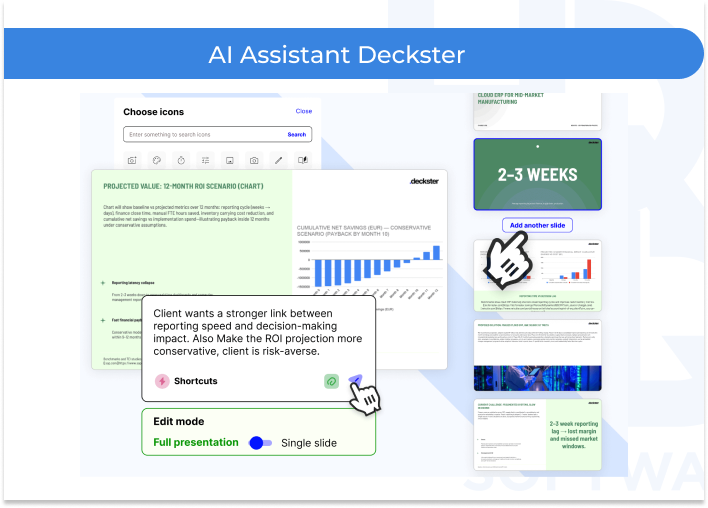
For example, over 72% of McKinsey’s employees now use its proprietary AI assistant Lilli, which cuts the time they spend on research and synthesizing findings by roughly 30%. Boston Consulting Group uses Deckster, a tool that creates presentation decks in minutes, while Bain has rolled out Sage, an AI copilot trained on the firm’s own internal intellectual property.
Even with powerful AI tools there are some core parts of consulting that AI still cannot replace. This depends entirely on human judgment, empathy, and real-world relationship sense. Here, in our opinion, are the biggest ones:
Building and keeping long-term trusted client relationships. Clients don’t trust consultants for fast reports or data analysis. They trust them for showing up through tough times, remembering details like past team layoffs, and knowing when to push for better strategy or back off. AI can’t build that kind of trust or long-term loyalty.
Making judgment calls on messy, ambiguous problems. Most high-stakes consulting choices aren’t straightforward. For example, a client might have to pick between a strategy that boosts quick profits but risks losing loyal customers, or a slower plan that protects their brand. AI can gather all the relevant data, but it can’t weigh unmeasurable factors like employee reactions or what customers truly value.
Creating completely new, untested strategies. AI is good at using old data and existing patterns to make suggestions. But if a client wants to try something totally new for their industry like a factory switching to full circular operations? AI has no past data to work from. Only human consultants can connect unrelated ideas, imagine new options, and bet on unproven strategies.
Spending hours on repetitive research and reporting?
We can build custom AI solutions for consulting that automate data gathering, analysis, and report creation.
Strategic Positioning for Consulting Leaders on the Market
With AI making expert advice cheap and easy to find, consulting firms are losing their competitive edge. So, leaders must shift from simply offering answers to helping clients actually get the job done. Drawing on our AI expertise, here is how to win against tech giants and smaller, faster rivals.
From “Knowledge Broker” to Reliable Partner
Consulting firms used to make money by selling “knowledge”—research, data analysis, and expert advice. However, AI can now do this work instantly and cheaply. Since clients can use AI to find their own answers, they no longer want to pay high fees just for information.
To survive, consultants must stop being just advisors and become partners who help get the work done. Instead of charging by the hour for slide decks, they should charge for successful results. Their new focus must be on the things AI cannot do: handling office politics, managing complex changes, and making sure AI tools are actually adopted by the client’s employees.
Competing With Hyperscalers and Boutiques
Big consulting firms are under attack from two directions. On one side, tech giants (like Microsoft) and software companies are building “consulting” features directly into their products, allowing clients to fix business problems without hiring humans.
On the other side, small specialized firms (boutiques) are using AI to do the same high-quality work as the big firms, but with fewer people and lower costs. To win, traditional consulting leaders need to offer what software and small shops cannot: big-picture judgment, safety and ethics checks, and the ability to manage complicated projects that span many different areas of a business.
Andrey Kazakevich
Head of Production
at Hymux Technologies
When we create AI tools for consulting firms, we make sure the AI can actually take action on its own. I mean AI can pull the right answers from your firm’s past projects and slides, work with live data, and keep every client’s information 100% separate and safe. Basically, it feels like giving every consultant a super-smart, always-on teammate who already knows your company inside out.
The result is consultants who spend 60-80% less time on research and slide-building and 100% more time on client relationships and creative strategy. Today a consulting company that isn’t embedding AI at this level simply won’t stay competitive.
What Are the Next-Gen Business Models With Platforms and Outcomes
For many years, the most dangerous phrase in consulting was “What’s your hourly rate?” Today, it’s “That’s not scalable.” The leaders who get this are abandoning timesheets to build value-creation engines. In this section, we’ll describe how.
When AI Kills the Timesheet
AI is so fast and efficient that charging by the hour (the timesheet or the billable hour)no longer makes sense. Many routine tasks such as analyzing data, spotting trends, making slides, and drafting reports can now be done by AI in seconds, saving junior consultants hundreds of hours.
Since AI does the work instantly, clients won’t pay high fees just for time spent. They’ll pay for the real value: the firm’s expertise, special tools, and AI-powered systems that make it all possible. Consulting firms will have to stop selling “hours” and start selling results instead.
Value-Based, Success-Fee and Subscription Models
Because clients don’t want to pay for hours anymore, consulting firms are changing how they charge. Instead of billing by the hour, they now focus on what clients gain:
Value-based pricing: Charge based on results (e.g. a percentage of money saved or earned for the client).
Success fees: Part of the payment depends on hitting specific goals, so the firm risks losing money if it doesn’t deliver.
AI also lets firms offer subscription models, where clients pay regularly for tools, updates, and ongoing advice. This turns one-time projects into long-term partnerships, giving firms steady income instead of unpredictable project fees.
Productized Consulting and AI-Native Offerings
The future of AI consulting is about turning expertise into ready-made tech tools. Instead of building custom solutions every time, firms create standardized AI-powered software. For instance, apps for supply chain problems or digital strategy checks.
These tools let consultants help hundreds of clients at once without hiring more staff. Firms make money not just by charging for hours, but by selling these tools repeatedly. This cuts costs and lets them focus less on manual advice and more on scaling their tech.
Routine processes slowing down your consultants?
Hymux Technologies can build custom AI solutions for consulting that automate workflows and repetitive tasks, letting your team deliver faster, smarter, and more efficiently.
Talent, Skills and Culture in AI-first Consulting Firms
The rapid evolution of AI consulting necessitates a complete overhaul in how talent is acquired, developed, and retained. Our analysis points to three core priorities.
Changing Hiring Patterns
Consulting firms are changing who they hire. Before they used to pick fresh graduates with basic business skills, but now AI does most of the easy tasks. For instance, work with data or making slides. So, firms now need more specialists such as data experts, software builders, and product managers to create and use AI tools.
Good consultants today also need new skills: curiosity about many topics, interpersonal skills, and the ability to pick the right questions for AI to solve. Deep industry knowledge and strong relationships still matter most.
Reskilling and AI Literacy at Scale
Current consultants need to learn AI skills quickly to stay relevant. Firms are offering training for everyone from new hires to bosses on how to use AI tools, read AI results, and work with their company’s special AI systems. This training goes beyond just “how to click buttons” and covers things, including:
Using AI ethically;
Managing data safely;
Writing good prompts (questions for AI) to get useful answers.
You may ask what is the goal? The answer is to make consultants comfortable using AI at every step of their work, treating it like a trusted teammate.
From Hero Analysts to Collaborative Man–Machine Teams
The old idea of a “hero analyst” (one person doing all the data work) is gone. Now, teams of professionals and AI work together:
AI handles boring tasks such as collecting data, basic analysis, and drafting reports;
Humans focus on strategy, talking to clients, guiding change, and making tough decisions.
The goal is combining human creativity with AI speed to get better results. Consultants now act like “AI coaches,” making sure the human side with empathy, client relationships, and custom advice stays at the heart of what the firm offers.
How to Run an AI-Augmented Firm
This is about changing the fundamental way a company works to make AI a core part of its daily operations. Let’s see how.
Building the AI Delivery Backbone
To run an AI-augmented firm, you need a strong “delivery backbone” that makes AI tools reliable and easy to use every day. This means having the right technical platforms, processes, and teams in place. So, AI models can be built, tested, and rolled out smoothly across the business.
It includes standard ways to connect AI to your existing systems, clear roles for who owns and maintains AI solutions, and repeatable methods for updating models over time. A good AI backbone turns experiments into scalable consulting services that employees can trust and use in their normal workflows.
Risk, Data, and Quality Control
AI only works well when you manage risk, data, and quality in a disciplined way:
Risk control means checking that AI outputs are safe, fair, compliant with laws, and aligned with company policies.
Data control means knowing where your data comes from, how it is cleaned, who can access it, and how it is protected.
Quality control means regularly testing AI models, measuring their accuracy and impact, and fixing issues quickly when performance drops. Together, these controls make sure AI is not just powerful, but also trustworthy, secure, and fit for real-world use.
To make these new strategies successful, you need custom-built AI tools that truly augment your consultants. Because implementing these solutions requires specialized technical knowledge, many firms seek help.
How Hymux Technologies Can Help You Build Custom AI Solutions for Consulting
At Hymux Technologies, we help consulting firms turn AI from a buzzword into practical tools that support everyday work. We combine technical expertise with an understanding of consulting workflows to build solutions your teams will actually use. Below are key ways we can support you in designing custom AI solutions for your practice:
AI strategy and use-case discovery. We help you identify where AI can bring the most value to your consulting practice, from research and analysis to client delivery. Together, we define a clear roadmap for building and rolling out AI solutions that fit your business model.
Custom AI copilots for consultants. We build AI assistants that help consultants research, analyze documents, create summaries, and draft reports or slide content faster. These tools plug into your existing workflows so teams can use them with minimal change.
Knowledge management and enterprise search. We create AI-powered search over your past projects, proposals, and reports so consultants can find relevant insights in seconds. This turns your project history into a living knowledge base your teams can reuse.
Data engineering and system integration. We connect AI solutions to your current tools such as CRMs, document systems, and collaboration platforms. Our team sets up secure data pipelines so AI models always work with clean, up-to-date information.
Predictive analytics and decision support. We build models that forecast trends, estimate impact, and support scenario planning for your clients. These tools help your consultants back recommendations with data-driven insights.
Workflow and process automation. We automate repetitive tasks like data entry, meeting notes, and basic reporting so consultants can focus on higher-value work. AI workflows are tailored to your specific processes, not generic templates.
We start our work with small, testable AI prototypes that prove value quickly for your teams or your clients. Once validated, we harden and scale these solutions for broader use across the firm. So, at the end you’ll get a perfect solution.
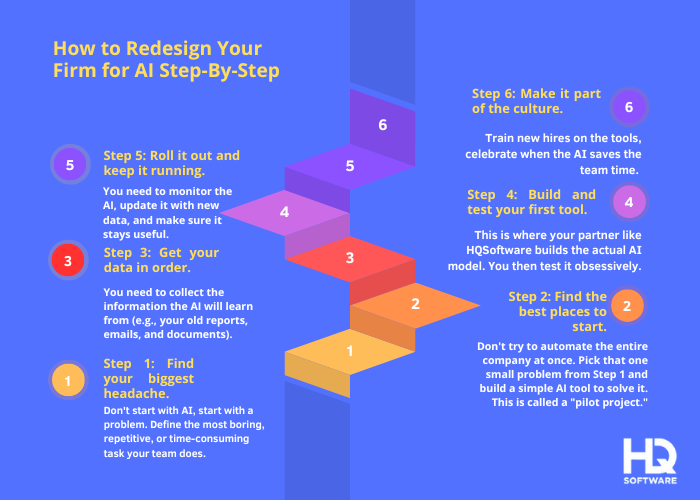
How to Redesign Your Firm for AI Step-By-Step
Over the past three years, we’ve guided numerous firms through this journey, and the ones that follow this structured sequence move faster, waste less money, and pull ahead of their competition. Here’s how we recommend it:
Step 1: Find your biggest headache. Don’t start with AI, start with a problem. Define the most boring, repetitive, or time-consuming task your team does. Maybe it’s writing weekly reports or searching for old project files. Pick one big pain point to solve first.
Step 2: Find the best places to start. Don’t try to automate the entire company at once. Pick that one small problem from Step 1 and build a simple AI tool to solve it. This is called a “pilot project.” Its goal is to get a quick win to prove the idea works and get everyone excited.
Step 3: Get your data in order. AI runs on data. You need to collect the information the AI will learn from (e.g., your old reports, emails, and documents). Make sure this data is clean and organized. Garbage data in means garbage answers out.
Step 4: Build and test your first tool. This is where your partner like Hymux Technologies builds the actual AI model. You then test it obsessively. Does it give the right answers? Is it fast? Is it safe? We fix the bugs until it works reliably for that one small task.
Step 5: Roll it out and keep it running. Once the tool is great, roll it out to the whole team. But the work isn’t over. You need to monitor the AI, update it with new data, and make sure it stays useful. An AI is like a garden; it needs constant tending.
Step 6: Make it part of the culture. The final step is to make using AI normal. Train new hires on the tools, celebrate when the AI saves the team time, and always look for the next headache to solve. This is how you become a truly AI-powered firm.
To sum up, for decades, a consulting firm’s edge came from its people. Today, that edge is defined by how well a firm augments its people with technology. The ultimate augmentation is a custom AI trained on your own intellectual property, creating a scalable, 24/7 expert that makes every consultant faster, smarter, and more impactful.
Contact us to know more about how we help you develop your next AI project.
Harvard Business School “Navigating the Jagged Technological Frontier: Field Experimental Evidence of the Effects of AI on Knowledge Worker Productivity and Quality” https://www.hbs.edu/faculty/Pages/item.aspx?num=64700
An experienced developer with a passion for IoT. Having participated in more than 20 Internet of Things projects, shares tips and tricks on connected software development.
How Is AI Changing the Traditional Business Model of Consulting Firms?
AI automates routine tasks such as data analysis and reporting, reducing reliance on billable hours. Consulting firms now adopt value-based or subscription pricing, offer AI implementation consulting services, and focus on strategic insights. Enhanced analytics enable personalized solutions that allow consultants to prioritize high-value advice.
Will AI Replace Human Consultants or Just Augment Their Work?
AI will augment, not replace, human consultants. It automates data analysis and routine tasks, freeing experts for strategic thinking, client relationships, and complex problem-solving. Human judgment, ethics, and emotional intelligence remain essential, ensuring AI enhances consulting roles rather than eliminating them in the industry.
What Parts of a Consulting Project Can Be Automated With AI Today?
AI automates:
data collection;
statistical analysis;
report drafting;
predictive modeling;
market trend analysis;
process automation (RPA), and
dashboard creation.
It streamlines routine tasks, enabling consultants to prioritize strategic planning, client relationship management, and high-level decision-making that demand human expertise and critical thinking. Ensuring accuracy and ethical oversight remains vital.
How Does AI Impact Pricing and Fee Structures in Consulting?
AI shifts consulting pricing from billable hours to value-based, fixed-fee, or subscription models. Automation cuts project time, enabling lower-cost standardized offerings. Outcome-based fees (linked to KPIs like savings) rise, as AI’s precise predictions allow measurable results. Firms also use tiered pricing for advanced analytics access, enhancing client flexibility and ROI focus now.
What New Roles and Skills Do Consulting Firms Need in an AI-First Environment?
Firms need new roles like AI ethicists, prompt engineers, and data architects. Crucial skills include AI literacy, algorithmic auditing, and high emotional intelligence. Consultants must shift from data crunching to strategic oversight, managing the human-AI interface to ensure accuracy, drive adoption, and navigate complex ethical compliance.
We are open to seeing your business needs and determining the best solution. Complete this form, and receive a free personalized proposal from your dedicated manager.