The use of Artificial Intelligence (AI) in manufacturing is becoming the new standard. Modern technologies are transforming production processes, automating routine operations, reducing downtime, and improving quality control. AI is particularly impressive in the field of predictive maintenance, an approach that allows potential equipment failures to be predicted before they occur.
In this article, we will take a detailed look at how AI-based predictive maintenance helps reduce downtime and increase production efficiency, as well as the benefits it brings to the modern manufacturing industry.
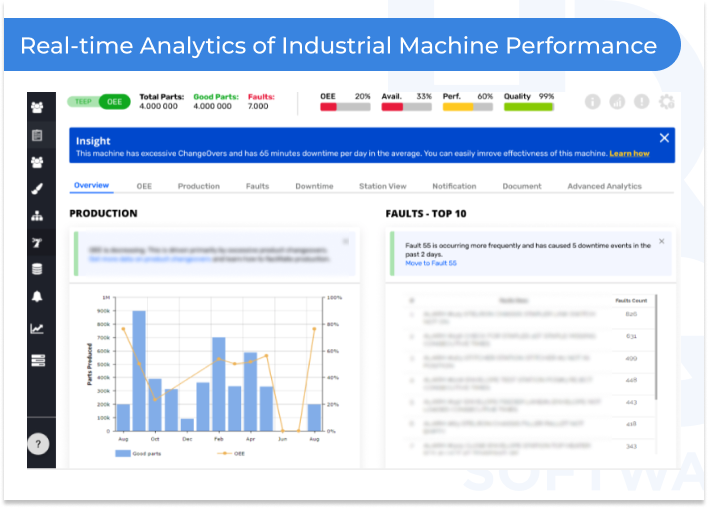
Predictive maintenance is based on collecting and analyzing real-time data from sensors and industrial Internet of Things (IIoT) devices. This data may include temperature, vibration, pressure, load, wear level, and other parameters that reflect the condition of the equipment.
Artificial Intelligence algorithms, including Machine Learning (ML) and anomaly detection models, process the information and identify hidden patterns that may indicate an impending failure or performance degradation.
In practice, AI models can predict when a specific component is likely to fail and recommend the optimal time for replacement. This enables companies to schedule maintenance before an emergency occurs, minimizing unplanned downtime and avoiding costly repairs. Beyond forecasting failures, AI also helps determine the remaining useful life of components, automate maintenance planning, and improve overall equipment reliability.
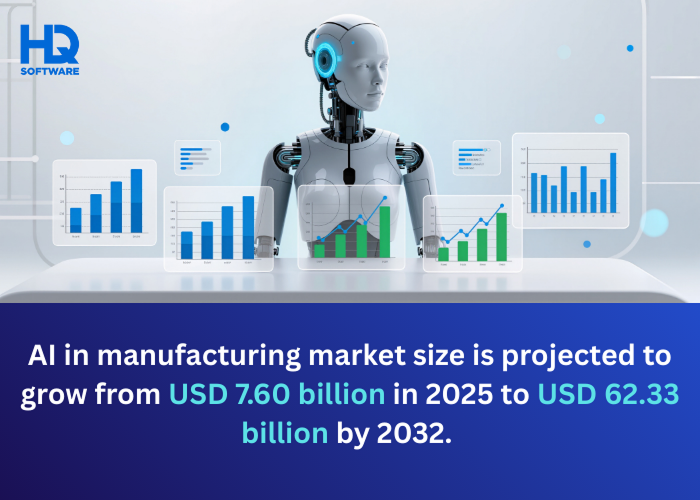
According to a report by Fortune Business Insights, the global market for AI in manufacturing is projected to grow from USD 7.60 billion in 2025 to USD 62.33 billion by 2032. The average annual growth rate will be 35.1%. This rapid expansion confirms that AI-driven predictive maintenance will continue to gain momentum across the manufacturing industry.
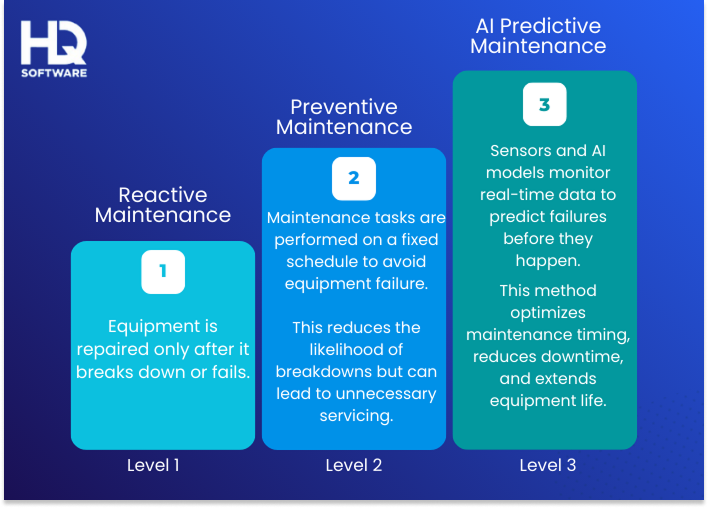
AI Predictive Maintenance vs Preventive Maintenance vs Reactive Maintenance
Undoubtedly, AI-driven predictive maintenance has emerged as a more advanced and efficient approach. However, many companies still rely on reactive or preventive maintenance — either repairing machinery after a breakdown or servicing it at predetermined intervals.
In manufacturing, maintenance strategies vary depending on business goals, budget constraints, and the overall level of operational maturity. The table below highlights the key differences between them.
Criterion
Reactive Maintenance
Preventive Maintenance
AI Predictive Maintenance
Approach
Fix equipment only after it breaks
Perform maintenance at scheduled intervals
Predict failures before they occur based on real-time data
Data usage
None
Low (basic logs, schedules)
High (IoT sensors, performance data, ML models)
Downtime risk
Highest — unexpected breakdowns
Moderate — planned stops, but issues may arise between intervals
Lowest — failures are predicted early
Maintenance cost
Unpredictable and often high
Stable but may include unnecessary servicing
Optimized — maintenance occurs exactly when needed
Impact on equipment lifespan
Shorter due to late intervention
Improved but not individualized
Maximized — early detection reduces wear and tear
Operational efficiency
Low
Medium
High
Required technology
Minimal
Basic scheduling tools
Advanced sensors, AI/ML analytics
Best for
Low-budget operations, non-critical assets
Organizations with predictable workloads
Modern factories aiming for high uptime and automation
Overall, while reactive and preventive maintenance still play a role in many manufacturing operations, they cannot match the precision, efficiency, and long-term value delivered by AI-driven predictive maintenance.
Want to see AI predictive maintenance in action?
Explore our case studies to discover how manufacturers reduce downtime, extend equipment lifespan, and boost operational efficiency with AI.
Benefits of AI Predictive Maintenance for Manufacturers
Why are many modern enterprises choosing to move from preventive or reactive maintenance to predictive maintenance? The answer lies in the clear advantages this transition delivers. Let’s take a closer look at the key benefits that make predictive maintenance a smarter and more efficient strategy for manufacturers.
Decrease in Unscheduled Downtime
Unscheduled downtime can be extremely costly for manufacturers. It leads to lost production, missed deadlines, reduced revenue, and damaged customer relationships. Predictive maintenance in manufacturing significantly reduces the incidence of such problems by identifying potential equipment failures before they occur. By responding to early warnings, companies can schedule repairs at planned times rather than stopping work unexpectedly. Some studies show that predictive maintenance can reduce unplanned downtime by up to 50%, improving overall operational efficiency.
Reduction in Infrastructure Failures
Predictive maintenance helps prevent not only machine breakdowns but also larger infrastructure failures, such as damage to production lines or critical utilities. By continuously monitoring the health of equipment and systems, AI algorithms can detect anomalies that might otherwise escalate into major failures. This proactive approach reduces repair costs, minimizes the risk of catastrophic failures, and extends the life of infrastructure components.
Improved Workplace Safety
Faulty or poorly maintained equipment poses serious risks to employees, with sudden breakdowns potentially leading to accidents, injuries, or even fatalities. Predictive maintenance enhances workplace safety by keeping machinery in optimal condition and addressing issues before they escalate.
In fact, some sources report impressive results: companies that have implemented AI-based predictive maintenance have experienced up to a 75% reduction in workplace incidents, thanks to early warnings and timely repairs.
Extended Equipment Lifespan
Early detection of issues in machines and systems can significantly increase the lifespan of industrial equipment. According to industry reports, predictive maintenance solutions can extend asset lifetime by up to 30% compared to traditional maintenance approaches, thanks to early detection of wear and tear and prevention of severe breakdowns.
Another key advantage is the ability to automatically calculate metrics such as Mean Time Between Failures (MTBF). This helps manufacturers determine the most cost‑effective moment to service or replace equipment, avoiding unnecessary or premature maintenance and reducing overall lifecycle costs.
Energy Efficiency Optimization
Inefficient or faulty equipment often consumes excess energy, increasing operating costs and environmental impact. AI-driven predictive maintenance ensures maximum equipment efficiency by addressing issues such as friction, misalignment, or wear before they impair performance. Companies implementing predictive maintenance report energy savings of 10–20%, as well as reduced emissions and more sustainable operations. Optimizing energy consumption not only reduces costs, but also aligns with corporate sustainability goals.
Tired of unplanned equipment downtime?
Our AI predictive maintenance solutions detect potential failures early and keep your production running smoothly.
How Hymux Technologies Can Help You Build Custom AI Solutions for Manufacturing
Hymux Technologies has extensive experience in developing AI solutions across various industries, including manufacturing. This hands-on expertise gives us a deep understanding of common challenges and how to address them effectively.
The Hymux Technologies team applied two Machine Learning approaches for predictive maintenance. The classification model predicts the likelihood of equipment failure in the near future, while the regression model estimates how much time remains before the next failure.
To power these models, time series data from sensors was collected and processed. Missing or incomplete information was enriched and transformed to ensure accurate predictions. Using this approach, the client could detect potential issues early, prevent unplanned downtime, and automate several manual processes, significantly improving operational efficiency.
Having seen how predictive maintenance can be implemented in practice, it’s important to understand the key AI technologies that make these solutions possible.
AI Technologies Used for Predictive Maintenance
AI relies on a combination of advanced technologies that work together to analyze equipment data, detect anomalies, and predict failures before they happen. Below are the key AI technologies that power modern predictive maintenance solutions and enable manufacturers to achieve higher reliability and efficiency.
Technology
What It Does
How It Supports Predictive Maintenance
Machine Learning
Learns patterns from historical and real-time data
Analyzes complex, high-volume datasets such as vibration spectra or imagery
Improves accuracy for complex equipment and non-linear failure patterns
Anomaly detection algorithms
Identify deviations from normal operating conditions
Detect early signs of malfunction before they become critical
Time series analysis
Examines sensor data over time to identify trends
Helps forecast future failures and performance degradation
Computer Vision
Uses cameras and image processing to inspect equipment
Detects surface defects, wear, leaks, or misalignment
Natural Language Processing
Processes maintenance logs and technician notes
Extracts insights from textual data to improve diagnostic accuracy
Edge AI
Runs AI models directly on local devices and sensors
Enables real-time analytics with low latency and reduced cloud dependency
IoT platforms & sensors
Collect operational and environmental data continuously
Provide the raw data needed for AI-based predictions
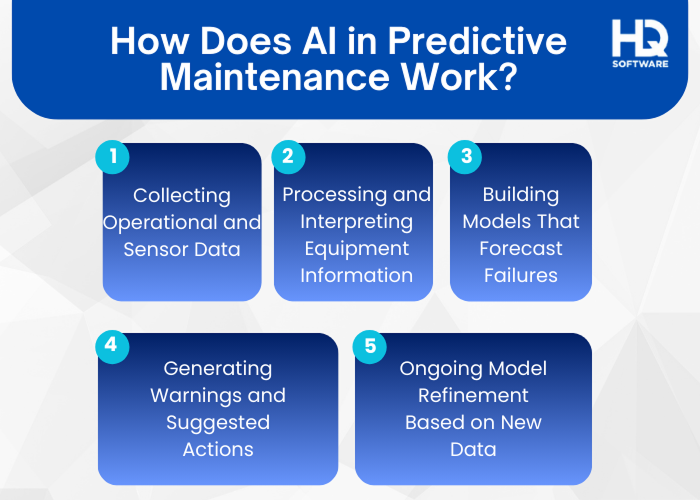
How Does AI in Predictive Maintenance Work?
Predictive maintenance is a complex system that relies on several interrelated components for effective functioning and consists of several stages.
1. Collecting Operational and Sensor Data
First, sensors must be placed on critical equipment components to monitor their condition and performance. These sensors capture real-time data such as temperature, vibration, pressure, load, and power consumption.
In addition to sensor readings, operational data from Programmable Logic Controllers (PLCs), SCADA systems, and IoT platforms can also be integrated. Together, these data streams create a comprehensive picture of how the equipment behaves under different conditions, forming the foundation for accurate AI-driven predictions.
2. Processing and Interpreting Equipment Information
With a constant flow of sensor data, effective storage, filtering, and preprocessing become essential. Large volumes of information are typically handled using cloud platforms or edge computing systems that ensure fast and scalable data processing. Before analysis, the data is cleaned, normalized, and enriched to remove noise, fill gaps, and align values across different sources.
Once prepared, the data is analyzed using advanced AI and ML models. These algorithms evaluate both historical and real-time patterns, identify anomalies, and detect subtle deviations in equipment behavior that may indicate early signs of failure.
3. Building Models That Forecast Failures
At this stage, ML models are developed to predict the condition of equipment and the likelihood of its failure. Various approaches are used, ranging from classification, which determines the risk of imminent failure, to regression, which estimates the remaining time before failure. The models are trained on historical data and identified anomalies, enabling them to accurately predict potential malfunctions long before they occur.
4. Generating Warnings and Suggested Actions
When the model detects deviations in equipment behavior or predicts a probable failure, the system automatically generates notifications. Alerts can contain not only information about the problem but also recommendations for action: perform diagnostics, replace a component, or perform preventive maintenance. This helps technicians make timely decisions and plan repairs without stopping production.
5. Ongoing Model Refinement Based on New Data
After implementation, the system continues to learn. Each new equipment cycle, each maintenance operation, and each recorded failure provides additional data to improve the model. This approach allows algorithms to adapt to changing operating conditions, improve forecast accuracy, and ensure more reliable production processes.
AI-Based Predictive Maintenance Examples Across Industry
Siemens
At Siemens’ smart factories, AI and IoT technologies are deeply integrated into daily operations. Sensors continuously collect data on equipment performance, while digital twins simulate machinery behavior under different conditions. By analyzing this data with advanced Machine Learning algorithms, Siemens can predict potential failures before they occur. This proactive approach has not only significantly reduced unplanned downtime but also optimized maintenance schedules, resulting in lower operational costs and higher production efficiency.
General Electric
General Electric uses predictive analytics and IoT monitoring across its industrial facilities to tackle one of manufacturing’s biggest challenges: unexpected equipment failures. By continuously analyzing sensor data, GE can detect early signs of wear and tear, anticipate failures, and schedule maintenance in advance. This system has allowed the company to cut maintenance costs, maximize equipment uptime, and showcase the benefits of scaling AI solutions across large, complex industrial operations.
Rockwell Automation
Rockwell Automation launched its AI-powered Asset Risk Predictor (ARP) to help manufacturers combine maintenance data with AI for predictive insights. The system integrates sensor data, machine recipes, and operational conditions to detect anomalies, anticipate potential failures, and plan maintenance more precisely. According to Rockwell, integrating ARP into production environments can deliver measurable results in just a few days, improving overall equipment effectiveness (OEE) and reducing downtime.
Spending too much on maintenance and repairs?
We implement AI-driven predictive maintenance to schedule repairs only when needed, cutting costs and improving efficiency.
Limitations of AI-Powered Predictive Maintenance in Manufacturing
Predictive maintenance in manufacturing offers companies significant opportunities to improve their production processes, but businesses may encounter certain obstacles when implementing it. Understanding these limitations and applying best practices can help businesses achieve better results. Key aspects include:
Investment in technology and infrastructure: Implementing predictive maintenance requires upfront investment in sensors, connectivity, and analytics tools. While this can be costly, the investment often pays off through reduced downtime and increased operational efficiency.
Data analysis and management:AI-driven predictive maintenance relies on large volumes of accurate, high-quality historical and real-time data. Inconsistent or incomplete data is one of the most common barriers, making robust data collection and processing systems essential.
Training and adaptation of specialists: The transition to a predictive maintenance model involves training employees to work with new technologies. This enables them to use new tools effectively and increase productivity.
Integration with existing systems: Integrating predictive maintenance with legacy machinery can be challenging. In many cases, older equipment can be retrofitted with modern sensors, but compatibility varies. Successful integration ensures a smoother transition and greater optimization of production processes.
While these limitations may seem challenging, many of them can be effectively overcome by partnering with experienced technology providers. Companies like Hymux Technologies help manufacturers navigate integration issues, implement robust AI models, and ensure smooth adoption across teams. With the right expertise, predictive maintenance in manufacturing becomes a powerful driver of operational excellence.
If you’re looking to implement AI-powered predictive maintenance or explore how these solutions can be tailored to your manufacturing needs, contact us today. Our team will be happy to discuss your challenges and help you move toward smarter, more efficient operations.
An experienced developer with a passion for IoT. Having participated in more than 20 Internet of Things projects, shares tips and tricks on connected software development.
What Are the Key Benefits of Implementing AI-Based Predictive Maintenance?
AI-based predictive maintenance helps manufacturers reduce unplanned downtime, extend equipment lifespan, and cut repair costs by detecting issues early. It also improves production efficiency and resource allocation through real-time monitoring and accurate failure predictions. As a result, businesses achieve higher reliability, safety, and more stable operational performance.
Which Industries Benefit Most From Implementing AI-Driven Predictive Maintenance?
AI-driven predictive maintenance is valuable across industries where equipment reliability is critical. Manufacturing, automotive, aviation, oil and gas, and energy sectors gain the most due to high equipment loads and strict safety requirements. By predicting failures in advance, companies minimize downtime, reduce costs, and ensure continuous, efficient operations.
How Does AI Predictive Maintenance Differ From Traditional Scheduled Maintenance?
AI-based predictive maintenance relies on real-time data and Machine Learning models to determine the exact moment equipment needs servicing. Traditional maintenance follows fixed schedules regardless of actual equipment condition. As a result, AI enables more accurate, cost-effective, and timely interventions. It helps to reduce unnecessary repairs and prevent unexpected breakdowns.
How to Implement AI-Powered Predictive Maintenance
To implement AI-powered predictive maintenance, companies start by equipping machines with sensors to collect operational data. This data is then processed and analyzed using Machine Learning algorithms that identify patterns and predict failures. The final steps include integrating the system with existing processes, training staff, and refining models for continuous improvement.
We are open to seeing your business needs and determining the best solution. Complete this form, and receive a free personalized proposal from your dedicated manager.