The modern healthcare system operates amid growing structural challenges: uneven distribution of funding, a shortage of qualified medical personnel, a high administrative burden on doctors, and limited patient access to quality medical care. These factors directly affect the quality and timely delivery of medical services, making the search for effective solutions critically important.
In this context, Artificial Intelligence (AI) technologies, in particular AI agents and virtual health assistants, are seen as one of the key tools for optimizing clinical and operational processes, reducing the burden on medical staff, and improving interaction with patients.
The purpose of this article is to examine what AI virtual assistants in healthcare are, how they differ from traditional chatbots, and to analyze their key advantages and limitations in practical application.
AI virtual assistants in healthcare are AI-driven software systems designed to support or automate clinical, administrative, and patient-facing tasks within healthcare workflows. Using technologies such as natural language processing (NLP), Machine Learning (ML), and large language models (LLM), these assistants can interpret user inputs, access relevant medical information, and execute predefined actions with limited human intervention.
Unlike traditional rule-based healthcare software, AI virtual assistants are capable of adapting to context, processing unstructured data such as free-text or voice input, and continuously improving their performance based on interaction data. In practice, they are commonly used for patient triage, appointment scheduling, clinical documentation support, medication adherence reminders, and patient communication. While these systems may autonomously perform operational tasks, actual clinical decision-making typically remains under the supervision of healthcare professionals.
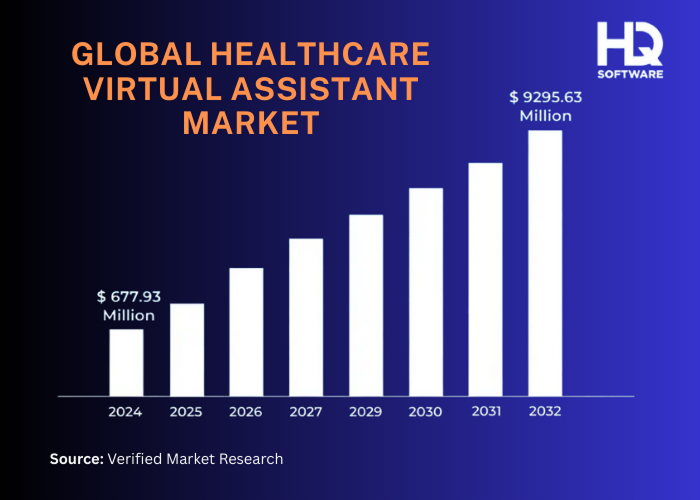
AI virtual assistants are being adopted rapidly. According to Verified Market Research, the market in global healthcare virtual assistants was valued at USD 677.93 million in 2024 and is projected to reach USD 9,295.63 million by 2032, reflecting growing demand for scalable digital solutions that address workforce shortages and operational inefficiencies in healthcare.
Curious how AI improves healthcare workflows?
Explore our case studies to see how AI virtual assistants boost efficiency and patient care in real healthcare settings.
AI Virtual Assistants vs. Classic Medical Chatbots
Non-technical audiences often conflate AI virtual assistants with traditional medical chatbots. While both systems are designed to interact with users through conversational interfaces, their underlying capabilities and practical value differ significantly.
Classic medical chatbots typically rely on predefined scripts and decision trees. They are effective for handling simple, repetitive queries on topics such as clinic opening hours, location details, or physician schedules. However, these systems struggle when user input deviates from expected patterns, limiting their usefulness in more complex or ambiguous situations.
AI-powered virtual assistants, by contrast, employ advanced NLP and ML techniques to interpret intent, context, and relevant clinical signals within user messages. Rather than following fixed scripts, they can analyze unstructured input, identify key symptoms or risk indicators, and dynamically determine appropriate next steps.
For example, when a patient reports experiencing nighttime dizziness alongside elevated blood glucose levels, an AI virtual assistant may recognize potential risk factors and suggest timely medical follow-up or escalate the case to a healthcare professional.
The table below summarizes the main differences between chatbots and virtual assistants in healthcare.
Criterion
Classic Medical Chatbots
AI Virtual Assistants in Healthcare
Underlying technology
Rule-based logic and predefined scripts
Machine Learning, NLP, large language models
Understanding of user intent
Limited to keywords and expected inputs
Context-aware interpretation of unstructured input
Adaptability and learning
Static behavior after deployment
Adaptive behavior with continuous improvement
Handling of complex medical queries
Low (fails outside predefined scenarios)
High (can analyze multi-symptom or ambiguous inputs)
Role in healthcare workflows
Informational support only
Operational and clinical support with human oversight
Types of AI Virtual Assistants in Healthcare Industry
Virtual assistants in healthcare perform a variety of functions. Each type helps in its own way. Here is a brief overview of the most common ones.
1. Virtual Assistants for Physicians and Nurses
These AI virtual assistants are primarily deployed in hospital and clinical settings and are typically integrated with electronic health record (EHR) systems. They support healthcare professionals by converting voice dictation into structured clinical documentation, retrieving patient medical histories, and highlighting relevant laboratory results or abnormal findings in real time. By automating routine documentation tasks, such systems significantly reduce the administrative burden on clinical staff.
Beyond documentation, AI virtual assistants can also function as clinical decision support tools. By continuously analyzing patient data streams, they may identify patterns, flag potential risk factors, and suggest evidence-based considerations for further evaluation. Importantly, these systems are designed to support rather than replace clinician judgment, enabling faster, more informed, and potentially safer clinical decision-making.
2. Virtual Medical Assistants for Round-the-Clock Patient Interaction
These AI-powered assistants are designed to provide continuous support and communication for patients outside clinical visits. They can:
Answer patient questions about symptoms, care instructions, or general health information;
Collect preliminary health information to prepare for clinician review;
Provide guidance on next steps or direct patients to appropriate care channels;
Offer reassurance, education, and engagement to improve the patient experience.
By focusing on constant availability and patient engagement, these assistants complement other AI systems without duplicating administrative or medication management functions.
3. Administrative Assistants
These AI virtual assistants are designed to support administrative and operational workflows in healthcare organizations. They handle routine tasks such as appointment scheduling, insurance verification, billing, and patient inquiries. By automating these processes, administrative assistants reduce manual workload, minimize scheduling errors, and allow staff to focus on higher-value tasks. Importantly, these systems integrate with EHRs and practice management software to ensure seamless coordination across departments.
Too much time spent on paperwork and routine calls?
We build AI virtual assistants that free your team from administrative overload and give them more time for patient care.
These virtual assistants are deployed in home care and telemedicine settings and provide continuous support to patients and healthcare providers:
They continuously gather patient information from wearable devices, home monitoring equipment, or patient-reported inputs.
They track long-term health conditions and monitor key indicators.
They flag abnormal readings or warning signs for timely intervention.
They support telemedicine visits by providing up-to-date patient data.
They improve adherence to care plans and promote proactive health management.
5. Medication Management Assistants
These virtual assistants in healthcare focus on improving medication adherence and therapy management for patients. They provide reminders to take medications, monitor patient compliance, alert patients and caregivers to potential drug interactions, and offer guidance for complex treatment schedules. By supporting patients in maintaining prescribed therapy regimens, medication management assistants reduce the risk of complications, improve health outcomes, and complement the work of healthcare providers in managing chronic or multi-drug treatments.
Benefits of AI-Powered Virtual Assistants for Patients
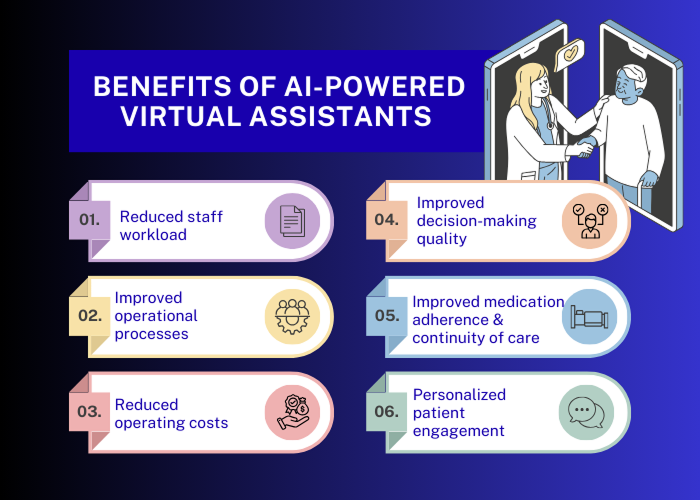
The introduction of AI virtual assistants in healthcare is accelerating rapidly because of their practical value for both sides of the equation. In the following sections, we’ll consider the key advantages of AI virtual assistants for both healthcare providers and patients, as their value is different for each.
24/7 Access to Medical Information and Support
AI virtual assistants provide patients with continuous access to healthcare-related information and guidance, regardless of time or location. Instead of waiting for office hours, patients can receive timely advice, symptom-related information, and recommendations on appropriate next steps, including when to seek urgent or emergency care. Immediate access to support helps reduce anxiety and may prevent condition deterioration.
Personalized Patient Engagement
AI virtual assistants tailor their information and recommendations according to individual patient profiles and health needs. For example, patients with chronic conditions may receive personalized lifestyle guidance, reminders, or educational content. This individualized approach promotes stronger patient engagement and supports more active participation in personal health management.
Simplified Access to Healthcare Services
By streamlining processes such as appointment scheduling, prescription refills, and insurance verification, AI virtual assistants reduce administrative barriers to care. Patients can request services in natural language, while the assistant coordinates availability and logistics, making access to care faster and more convenient.
Reduced Access Barriers for Underserved Populations
AI virtual assistants help make healthcare more accessible for patients who face barriers to traditional care. This includes people living in remote or rural areas, individuals with limited mobility, older adults, and patients with language or scheduling constraints.
By offering digital, always-available support and communication in multiple languages, virtual assistants reduce the need for in-person visits and simplify interactions with healthcare systems.
Improved Medication Adherence and Continuity of Care
Virtual assistants help patients follow prescribed treatment plans more consistently by providing timely reminders, clear instructions, and ongoing support between medical visits. They can explain how and when to take medications, clarify common questions, and alert patients if a dose is missed.
Worried your AI investment won’t deliver real clinical value?
We design secure, compliant, and scalable AI virtual assistants that solve real operational challenges and deliver measurable results.
Benefits of AI-Powered Virtual Assistants for Providers
Reducing the Administrative Burden on Staff
One of the most serious challenges for healthcare organizations remains the excess of administrative tasks—from filling out paperwork to processing patient requests. Virtual assistants in healthcare take on routine operations such as health record-keeping, data updates, and basic patient interactions. This allows doctors and nurses to spend less time on paperwork and more time on direct patient care.
Improving the Efficiency of Clinical and Operational Processes
AI virtual assistants help optimize day-to-day processes within healthcare organizations. They speed up data processing, simplify coordination between departments, and reduce errors associated with manual data entry. Thanks to more coordinated systems and staff, healthcare facilities can serve more patients without a proportional increase in workload or costs.
Reduced Operating Costs and More Efficient Use of Resources
Automating administrative processes allows healthcare organizations to reduce costs associated with manual data processing, call centers, and repetitive tasks. At the same time, AI virtual assistants help allocate resources more efficiently—staff time, appointments, equipment—which is especially important in organizations facing limited budgets and staff shortages.
Improving Decision-Making Quality
AI virtual assistants can analyze large amounts of medical data in real time and highlight important information that may be overlooked when specialists are busy. Acting as a clinical support tool, they help healthcare professionals navigate data more quickly, identify potential risks, and make more informed decisions. It is important to note that the final decision always rests with the doctor.
How to Implement an AI Virtual Assistant in Your Healthcare Practice
Successful implementation of an AI virtual assistant in a medical center requires more than selecting a technology vendor. It involves careful preparation, clear goal setting, and close alignment with clinical, administrative, and regulatory requirements. Below are the key steps healthcare organizations should consider when introducing AI virtual assistants into their practice.
1. Assess Organizational Readiness
As a healthcare facility manager or founder, the desire to implement an AI assistant is not enough. First and foremost, it’s important to assess how ready the organization is to use AI solutions. This includes analyzing the IT infrastructure, data quality, the level of process digitization, and the willingness of staff to work with new tools. This will help avoid a number of potential difficulties and future regrets.
At this stage, it’s also useful to determine which processes have already been digitized and where manual work remains, creating additional workload and the risk of errors.
2. Define Clear Use-Cases and Objectives
AI virtual assistants are most useful when applied to clearly defined tasks. Healthcare organizations need to determine which processes require optimization: clinical documentation, patient registration, chronic disease management, or administrative functions.
For example, if doctors spend a significant portion of their working time filling out medical documentation, the first step may be to implement a voice assistant to automatically create clinical records, rather than attempting to automate all processes at once.
3. Ensure Data Quality, Security, and Regulatory Compliance
The effectiveness of AI virtual assistants directly depends on the quality of the medical data they have access to. Healthcare organizations need to ensure that the data used by the assistant is accurate, up-to-date, and structured to avoid errors and incorrect recommendations.
An equally important aspect is the protection of patients’ personal data and compliance with information security requirements. When implementing AI virtual assistants in healthcare, it is absolutely necessary to take into account applicable regulatory requirements, such as HIPAA in the USA or GDPR in the European Union. Those requirements include controlling access to data, encrypting information, auditing system actions, and ensuring transparency in data processing.
Compliance with privacy and security requirements not only reduces legal and reputational risks, but also plays a key role in building trust in AI solutions among patients and medical staff.
4. Integrate With Existing Healthcare Systems
For AI virtual assistants to work effectively, the virtual assistant must be integrated with electronic health records and any scheduling or billing platforms. Smooth integration reduces duplication of work, minimizes errors, and ensures that the assistant becomes a natural extension of existing workflows rather than a standalone tool.
5. Train Staff and Manage Change
Introducing AI into healthcare practice inevitably changes how staff work. Proper training is essential to ensure that clinicians and administrative teams understand how to use the assistant, interpret its outputs, and recognize its limitations. Clear communication about the role of AI—as a support tool rather than a replacement—helps reduce resistance and fosters adoption.
6. Start With a Pilot and Scale Gradually
Based on our company’s experience, we believe that the best approach is to launch an AI virtual assistant as a pilot project. This allows teams to test the solution on a limited number of users, gather feedback, pinpoint potential problems and identify areas for improvement. Once proven effective, the virtual assistant can be refined and scaled across other departments or scenarios.
What Are the Limitations of AI Virtual Assistants in Healthcare?
Despite their growing adoption and clear benefits, AI virtual assistants in healthcare face several limitations that may slow or complicate their implementation. Understanding these challenges is essential for realistic expectations and responsible use of AI technologies in medical settings.
Limited Resources and Implementation Costs
Developing AI virtual assistants often requires significant financial and organizational resources. Healthcare providers must invest in software solutions, system integration, data preparation, cybersecurity measures, and staff training. For smaller clinics or underfunded healthcare institutions, these upfront costs and technical requirements can become a major barrier, limiting access to advanced AI technologies despite their long-term potential benefits.
Skepticism From Healthcare Professionals and Patients
Adopting AI virtual assistants is not only a technological challenge but also a cultural one. Some healthcare professionals express concerns about the reliability, transparency, and clinical safety of AI-driven recommendations.
Patients, in turn, may be hesitant to share sensitive health information with automated systems or may simply prefer human interaction, especially in emotionally sensitive situations. Survey data suggest that many patients are skeptical about the responsible use of AI in healthcare; in a US study, a majority of respondents reported low trust in their healthcare system’s ability to use AI tools safely and responsibly.
Risk of Errors and Unclear Accountability
Despite significant progress, AI virtual assistants are not immune to errors. Inaccurate data, biased training datasets, system limitations, or misinterpretation of patient inputs can lead to incorrect recommendations or missed warning signs. In healthcare, even minor errors may have serious consequences for patient safety.
From a practical standpoint, this raises the issue of clinical accountability. It remains unclear in many jurisdictions who bears responsibility for AI-related errors: the technology developer, the healthcare provider, or the institution deploying the system.
Legal, Ethical, and Regulatory Constraints
Healthcare is one of the most highly regulated industries, and the use of AI virtual assistants raises complex legal and ethical questions. These include compliance with data protection laws, data ownership, transparency of AI decision-making, and adherence to national and international healthcare regulations such as HIPAA or GDPR.
In many regions, regulatory frameworks for AI in healthcare are still evolving, creating uncertainty for providers and technology vendors. This regulatory complexity can slow adoption and requires careful governance to ensure patient safety and legal compliance.
Top 4 Use-Cases for AI Virtual Assistants in the Healthcare Sector
Drawing on real-world deployments and industry-recognized solutions, the following use-cases highlight some applications of AI virtual assistants in healthcare that will have the most impact. One example is based on Hymux Technologies’s experience in developing healthcare software and AI-driven solutions for medical organizations, while others represent widely adopted industry platforms. Together, these cases illustrate how AI virtual assistants can be successfully integrated into different healthcare workflows.
Patient Communication and Administrative Automation
Hymux Technologies developed an AI voice assistant for a mid-sized medical center to automate routine patient calls. The assistant manages scheduling, answers common questions, and directs complex cases to human staff when needed.
By providing 24/7 availability, it reduces staff workload, improves response times, and ensures patients can access information and services efficiently. This example shows how a single AI virtual assistant can serve as the first point of contact while supporting operational efficiency and patient care.
Symptom Assessment and Health Triage
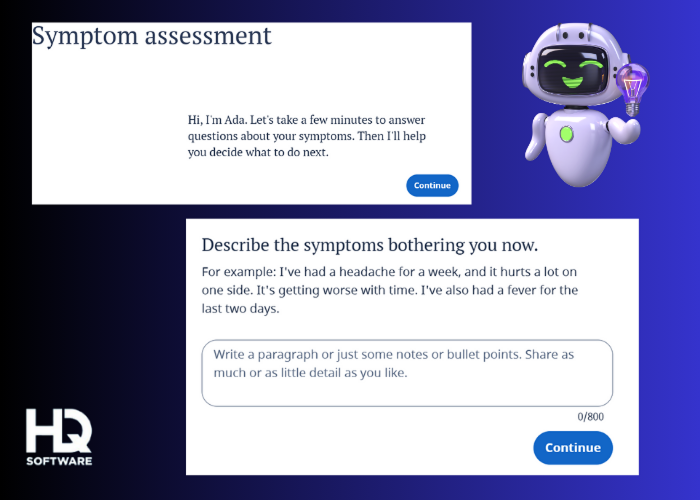
Ada Health is one of the best-known AI health assistants. It is based on the knowledge of real doctors and clinical research. Instead of simply entering “headache,” the user answers a series of clarifying questions: where exactly does it hurt, how long has it been going on, what preceded it, and is there a fever? The algorithm takes into account age, gender, and medical history and generates a list of possible causes, indicating the urgency of seeking professional help.
This approach helps distinguish between situations where “you can wait until morning” and cases where “it’s better to call an ambulance right now.” The system does not make diagnoses — it helps you understand how serious the situation is and which doctor you should see.
Everyday Medical Guidance and Self-Care Support
Dot™ by Healthily is an AI-powered virtual health assistant designed to provide medically verified health information and symptom navigation. It helps users interpret symptoms, understand potential next steps, and access reliable health guidance based on clinical standards.
This use case is particularly valuable for patients seeking reassurance, basic medical orientation, or guidance outside traditional clinical hours, reducing unnecessary visits while encouraging timely care when needed.
Clinical Documentation and Physician Workflow Support
Nuance Dragon Ambient eXperience (DAX) is an AI virtual assistant designed to support physicians by automating clinical documentation. The system listens to patient–doctor conversations and generates structured clinical notes directly within electronic health record systems.
This use-case addresses one of the most significant pain points in healthcare: excessive paperwork. By reducing time spent on documentation, AI assistants like Nuance DAX help clinicians focus more on patient care and reduce burnout.
Remote Monitoring & Medication Adherence
Florence is a conversational AI health assistant designed to support patients in managing their health routines. It helps users track medications, monitor symptoms, log health metrics, and receive reminders through chat-based interaction.
This AI virtual assistant can support chronic disease management and patient engagement through continuous, conversational support outside clinical settings.
Future Trends in AI Assistants for Healthcare
Artificial Intelligence has become one of the hottest topics in the healthcare industry, and experts agree that this trend will continue and intensify in 2026 and beyond. More and more medical institutions will implement AI-based virtual assistants in an effort to improve efficiency, quality of service, and accessibility of medical care.
However, widespread adoption does not guarantee automatic success. It is already apparent that a significant portion of AI implementation initiatives present limited clinical value or scalability issues. In healthcare, as in other industries, a recurring mistake is the “build it and they will come” approach, which focuses on technology rather than real clinical and operational challenges.
Against this backdrop, key trends are emerging that will shape the future of virtual assistants in healthcare:
Shift in focus from technological novelty to clinical value: Solutions will be evaluated based on their measurable impact on treatment outcomes, reduction of workload on medical staff, and improvement of patient interaction, rather than on the complexity of the models used.
Deep integration into clinical workflows: Virtual assistants in healthcare will cease to exist as isolated tools and become part of EHR, triage, scheduling, remote patient monitoring, and care coordination ecosystems.
Increased demands for data quality, security, and model explainability: Organizations and regulators will expect transparent algorithms that are resistant to data bias, as well as continuous monitoring of accuracy and risks.
Transition from experimental pilots to scalable and sustainable solutions: The market will gradually weed out projects that mimic historical data without the ability to reliably predict outcomes in real clinical settings.
If you are considering implementing AI virtual assistants in healthcare and want to ensure their real clinical value, scalability, and compliance with industry requirements, contact Hymux Technologies. Our team helps healthcare organizations design and implement AI solutions focused on real clinical and operational challenges, rather than short-term technology trends.
NIH/PubMed Central – Are Virtual Assistants Trustworthy for Medicare Information: An Examination of Accuracy and Reliability https://pubmed.ncbi.nlm.nih.gov/38832398/
An experienced developer with a passion for IoT. Having participated in more than 20 Internet of Things projects, shares tips and tricks on connected software development.
How Long Does It Take to Implement an AI Virtual Assistant in Healthcare?
Implementation timelines vary based on complexity and integration needs. A basic AI virtual assistant can be launched in 2–3 months. More advanced solutions that integrate with EHR systems, follow compliance requirements, and support clinical workflows typically take 4–6 months or longer.
What Technologies Power AI Virtual Assistants in Healthcare?
AI virtual assistants rely on natural language processing (NLP), Machine Learning, and speech recognition. They also use rules-based logic, APIs, and data integration layers to interact with clinical systems. In healthcare, these technologies are combined with security, compliance, and data governance frameworks.
Can AI Virtual Assistants Be Integrated With EHR and Hospital Systems?
Yes, most AI virtual assistants can integrate with EHRs and hospital systems through secure APIs and interoperability standards such as HL7 or FHIR. Successful integration requires careful planning to ensure data accuracy, workflow alignment, and compliance with healthcare regulations like HIPAA or GDPR.
Can AI Virtual Assistants Make Medical Decisions?
AI virtual assistants do not replace clinicians or make independent medical decisions. They support healthcare professionals by providing information, reminders, and preliminary insights. Final clinical decisions remain the responsibility of licensed medical staff, ensuring patient safety and regulatory compliance.
Can AI Virtual Assistants Reduce Administrative Workload in Healthcare?
Yes, AI virtual assistants help reduce operational and administrative workload in healthcare. They automate front-office tasks such as appointment scheduling, patient intake, reminders, and routine inquiries. By offloading these activities from staff, healthcare organizations free up clinical and administrative teams to focus on patient care and higher-value work.
Do AI Virtual Assistants Help Reduce Healthcare Costs?
AI virtual assistants can help lower costs by improving operational efficiency and reducing manual work. They decrease call center load, minimize no-shows, and streamline workflows. Over time, these improvements can lead to measurable savings without compromising quality of care.
We are open to seeing your business needs and determining the best solution. Complete this form, and receive a free personalized proposal from your dedicated manager.