For many businesses, keeping up with customer demand feels like a constant race against time. Long wait times, repetitive questions, and inconsistent service can frustrate customers and strain support teams.
That’s where Artificial Intelligence (AI) voice assistants help: they manage many everyday tasks 24/7, give quick and correct answers, and let human staff focus on problems needing personal care. By understanding natural speech and learning from each conversation, these smart tools improve response time and boost customer satisfaction.
Drawing on Hymux Technologies’s extensive experience in developing advanced AI solutions, including voice assistants for various industries, we possess a unique perspective on their power. In this article, we’ll explore what an AI voice assistant is, examine the different types available, and uncover the pivotal roles they play in elevating customer care.
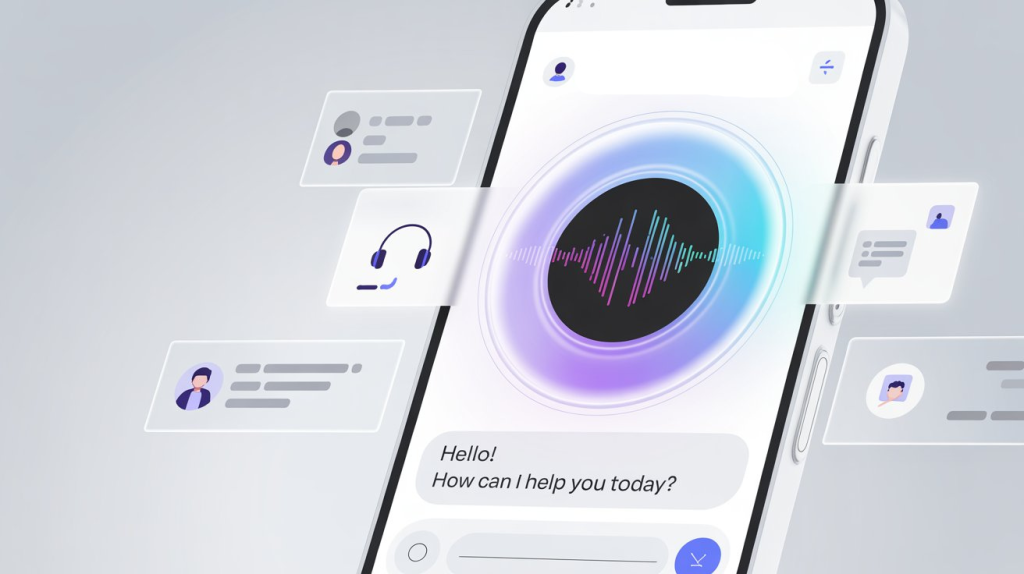
An AI voice assistant is a computer program that uses Artificial Intelligence to understand spoken words and answer questions or complete tasks for you. It serves as a helpful digital companion that you can talk to instead of typing on a keyboard or clicking a screen. It listens to your voice, figures out what you want, and responds or acts immediately.
To make this clearer, here’s a simple example. In customer service, an AI voice assistant works like a digital receptionist that can talk to customers over the phone or a smart speaker to solve problems without making them wait for a human agent. For instance, when a caller says, “I forgot my password,” the assistant guides them through a secure reset, cutting wait times and improving service flow.
Example of AI Voice Assistant
Types of AI Voice Assistants
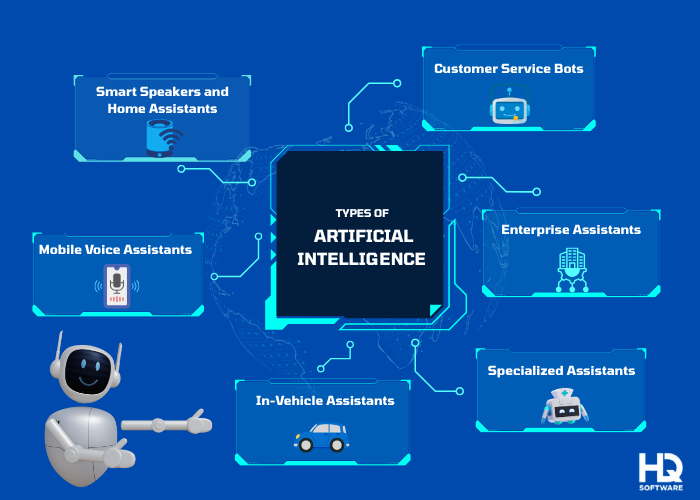
AI voice assistants generally fall into a few categories, tailored for different uses and scenarios. Typically these are:
Smart speakers and home assistants:AI assistants such as Amazon Alexa or Google Home help with daily tasks at home. For example, playing music, controlling lights, or setting reminders.
Customer service bots: Such helpers to answer common questions over the phone or online, like checking order status or account balances.
Mobile voice assistants: Siri or Google assistant on the phone let users send messages, get directions, or check schedules using voice.
Enterprise assistants: These tools help employees in businesses with internal tasks, including scheduling meetings, finding documents, or managing workflows.
In-vehicle assistants: Integrated into cars, they enable drivers to access navigation, make calls and control entertainment systems without taking their hands off the wheel.
Specialized assistants: A new type of assistants that are designed for specific fields such as healthcare (taking patient notes) or retail (helping shoppers find products).
Each type uses speech recognition and AI to understand and respond to voice commands in its own context. Now, let’s explore how these assistants can be deployed to uniquely enhance customer care.
The Role of AI in Improving Customer Care
Voice AI helps make customer service much faster and always available. It can quickly answer common questions using chatbots or automated phone systems, so customers get advice right away, any time of day.
It also helps human customer service agents. An AI assistant can give them quick access to customer information or suggest answers, so they can solve harder problems more efficiently. By handling the easy stuff, AI frees up human agents to focus on complex or sensitive issues. That could be de-escalating angry customers or navigating intricate technical troubleshooting.
As we’ve seen how AI helps make customer service better overall, it’s time to explore the specific ways it’s applied.
Unsure how AI can transform your customer care?
Explore our case studies to see how we’ve implemented AI voice assistants that reduce workload, speed responses, and improve customer experiences.
How Are Voice AI Assistants Used in Customer Service?
A recent McKinsey report reveals that 78% of organizations leverage AI in at least one business area, and customer service is a prime example of its highly effective adoption. This strong performance has made AI indispensable. But how do voice AI assistants contribute to customer service? We have an answer.
Answering Common Questions
AI voice assistants handle frequent customer inquiries such as store hours, order status, or return policies instantly and around the clock. This reduces call wait times and lets human agents focus on more complex issues.
Routing Calls to the Right Agent
If a problem needs human help, the voice assistant quickly figures out what kind of support is needed. It then connects the customer to the best-suited agent, saving time and improving first-call resolution.
Processing Orders and Payments
Customers can place orders or make payments using just their voice. The assistant securely takes details such as delivery addresses and payment info, making purchasing fast and hands-free. This is especially useful for busy users or in-car systems.
Guiding Through Troubleshooting
When something goes wrong, voice assistants walk users step-by-step through fixes using simple spoken instructions—for example, how to reset a router or troubleshoot an app error. It helps curb customer frustration and decreases the volume of incoming support calls.
Personalizing Customer Experiences
By recognizing voices or accessing past interactions, AI assistants greet customers by name. They also offer tailored recommendations or reminders. This makes service feel more personal and attentive.
Long customer wait times hurting satisfaction?
We design and build custom AI voice assistants that handle routine questions 24/7, so your team can focus on complex support issues.
To gain a clearer understanding of voice assistants and their business value, look at a real example we built at Hymux Technologies for one of our clients.
How Hymux Technologies Can Help You Get Started With AI Voice Assistants
Our customer, a medical center, faced a problem: they needed to handle a large number of routine patient calls that were overwhelming staff and wanted to offer round-the-clock service beyond regular office hours. At Hymux Technologies, we developed an AI voice assistant for the medical center that:
automatically handles inbound calls;
logs every interaction in the CRM;
helps patients book or cancel appointments;
provides answers to common health questions;
transfers to a human agent when necessary; and
sends patients medication reminders by speaking naturally.
Behind the scenes, the AI assistant integrates securely with the clinic’s systems to protect privacy while reducing staff workload. It understands voice commands, checks schedules in real time, and provides personalized responses based on patient data.
Thanks to the AI voice assistant, our client saw a 60–70% drop in operator workload and achieved an average response speed three times faster than before. Patients can interact with it 24/7, whether calling in or using a smart device, improving overall satisfaction.
For more examples of our innovative AI solutions, please explore our portfolio.
If you are looking for similar solutions, here’s how we can help:
Custom strategy and feasibility study: Our experts will assess your specific business needs, identify key pain points in your customer service, and determine exactly where an AI voice assistant can deliver the most value for your operations. We help you define clear goals and map out a practical roadmap.
Tailored AI voice assistant development: With our deep expertise in AI, we build custom voice assistants perfectly suited to your unique requirements. Whether you need a simple bot for FAQs or a complex conversational AI for intricate tasks, we ensure your solution integrates seamlessly with your existing systems and speaks your brand’s language.
Integration with existing systems: We specialize in integrating your new AI voice assistant with your current CRM, databases, and other platforms. This ensures the assistant has access to the information it needs and can perform tasks across your entire digital ecosystem.
Ongoing optimization: AI is not a “set it and forget it” solution. We provide continuous monitoring and updates to ensure your voice assistant evolves with your business needs.
Key Features to Look For in a Voice AI for Customer Service
Successfully integrating a voice AI assistant means selecting a tool that genuinely meets your needs. To avoid common pitfalls and ensure your investment pays off, it’s important to know which features are non-negotiable. You may use the list below to check the must‑have features.
Accurate Speech Recognition and Understanding
It must clearly hear what customers say, even with different accents or background noise. It also needs to understand the meaning behind their words, not just the individual words, to provide truly helpful responses.
Natural Conversation Flow
The voice assistant shouldn’t sound like a robot reading a script. It should be able to hold a conversation that feels natural, respond appropriately and remember context from earlier in the chat.
Providing 24/7 Support
Unlike human teams, voice AI never sleeps. So, AI assistants should always be available to help customers at any hour. They will ensure support is there when they need it, even if it’s midnight or a holiday.
Multilingual Support
A voice assistant should be able to speak the languages your customers do. Multilingual support not only broadens your reach but also improves service for a diverse customer base. The ability to communicate in various languages broadens reach and improves service for a wide range of customers.
Robust Security & Privacy
Since it handles customer information, the voice assistant must have security features. It needs to protect sensitive data and comply with all privacy regulations. Ensuring high-level encryption and data masking prevents costly breaches and builds the essential trust necessary for customers to share their information comfortably.
Scalability and High Volume Handling
When customer calls or query volumes spike, the voice assistant needs to handle it without breaking a sweat. It should be able to manage hundreds or thousands of simultaneous conversations without slowing down or making customers wait.
Task Automation and Action Execution
Beyond just answering questions, the best assistants can do more complex tasks. These include common actions such as:
resetting passwords;
processing orders;
updating account details; or
scheduling appointments directly.
Continuous Learning and Improvement
An effective voice AI should get smarter over time. It needs to learn from every conversation, understanding new phrases and improving its responses, rather than staying static. It’s better to choose a platform with feedback tools, human review, and regular updates so the assistant keeps getting more accurate over time.
Knowing these essential features will help you identify a truly effective voice AI solution for customer service.
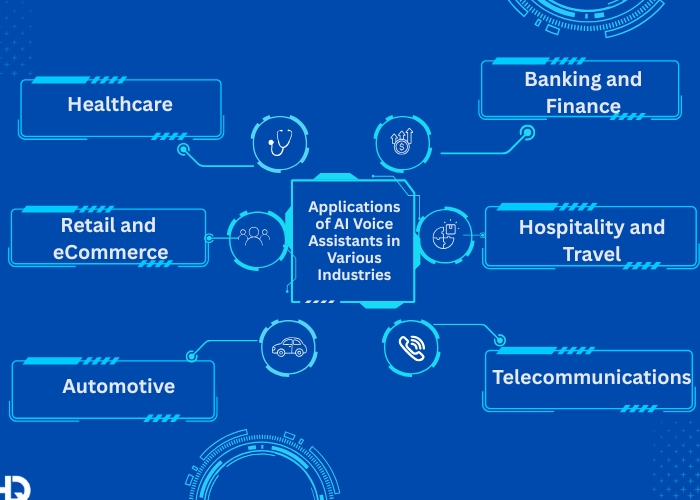
Applications of AI Voice Assistants in Various Industries
Now, let’s broaden our perspective and see how these powerful tools are being applied across diverse industries.
Healthcare
In clinics and hospitals, voice assistants schedule appointments and answer common health questions. A patient might say, “Reschedule my checkup,” and the assistant handles it automatically. This can reduce missed appointments and call volume for staff.
Banking and Finance
Voice AI in banking helps customers manage their money more easily and securely. People can:
ask about their account balance;
check recent transactions;
transfer funds between accounts; or
even get help with loan applications.
Voice AI provides quick, convenient access to financial information and services around the clock.
Retail and eCommerce
For shopping businesses, voice assistants make the buying experience smoother. Imagine asking your smart speaker, “Where’s my latest delivery?” and getting an instant update, or quickly reordering your favorite item by just speaking. Thus, AI assistants help customers find products, check stock availability, track orders, or even process simple returns.
Hospitality and Travel
In hotels, voice assistants serve as a virtual concierge, offering guests hands-free control over their stay. They handle requests from ordering room service to adjusting room settings or providing local information. Similarly, in the broader travel sector, these assistants simplify journeys by managing flight details and reservations. It makes trips less stressful and more enjoyable.
Automotive and Transportation
In-car voice assistants help drivers navigate, make calls, send messages, and even control music hands-free. For instance, saying, “Find the nearest gas station” gives turn-by-turn directions without taking eyes off the road, boosting safety and convenience.
Telecommunications
Phone and internet companies use voice AI to handle customer questions and manage account needs quickly. These smart assistants solve common problems without needing a human, which makes getting help much faster and reduces long wait times.
Struggling to route calls efficiently?
Our team can create AI voice assistants that intelligently direct customers to the right agent, reducing wait times and improving first-call resolution.
How to Overcome Challenges in AI Voice Assistant Integration
Seeing how widely AI voice assistants are used, it’s clear they offer huge benefits. However, implementing them smoothly into your existing systems can present its own set of challenges:
Complex system integration: Connecting voice assistants to existing tools like CRMs or scheduling systems can be tricky. At Hymux Technologies, we recommend using flexible APIs and conducting a full tech audit upfront to ensure smooth, secure connections from day one.
Limited understanding of accents or phrasing: If the assistant doesn’t understand different ways people speak, users get frustrated. Our developers overcome this by training models on diverse voice samples and continuously improving accuracy through real-user feedback and updates.
User resistance or low adoption: Employees or customers may hesitate to use new technology. We involve teams early, provide simple training, and design intuitive, helpful interactions that build trust and encourage everyday use.
Data privacy and security risks: Handling sensitive customer data requires strong protection. We address this by building assistants with end-to-end encryption, strict access controls, and compliance with regulations.
Conclusion
AI voice assistants are useful tools that are truly changing how we help customers. They automatically handle easy jobs, give quick answers, and let human staff focus on harder problems. This solves big business challenges and makes customers much happier.
Integrating these assistants into your system can be challenging. However, with careful planning, ongoing training, and a reliable partner like Hymux Technologies, you can enjoy all their benefits. Choosing AI voice assistants means investing in customer service that’s not just faster and cheaper, but also more personal, quicker to respond, and better focused on people.
Contact us to explore how Hymux Technologies can help you design and implement a custom AI voice assistant.
An experienced developer with a passion for IoT. Having participated in more than 20 Internet of Things projects, shares tips and tricks on connected software development.
AI affects customer service by automating routine inquiries and providing instant, personalized responses through chatbots. It significantly speeds up issue resolution and empowers human agents with intelligent tools. This leads to higher efficiency and a better customer experience, and allows businesses to analyze interactions for continuous improvement.
What Are the Disadvantages of AI in Customer Service?
In the field of customer service, AI can struggle with complex or nuanced requests, which can lead to customer frustration. It might lack empathy and the human touch essential for responding to sensitive issues. Over-reliance on AI can also create a perception of impersonal service and limit genuine problem-solving when pre-programmed responses fall short.
What Is the 30% Rule in AI?
The 30% rule in AI suggests that automation should handle about 70% of routine tasks, leaving 30% for human oversight and decision-making. This balance helps maintain accuracy, accountability, and the ability to manage exceptions where AI may lack context or judgment.
Can AI Replace Customer Service?
No. AI can’t fully replace customer service because it lacks human empathy, intuition, and the ability to handle complex and potentially emotional situations. Customers value personal connection and nuanced understanding—especially in sensitive or unique cases, where only a trained human agent can provide reassurance, build trust, and deliver truly tailored support.
We are open to seeing your business needs and determining the best solution. Complete this form, and receive a free personalized proposal from your dedicated manager.