Hymux Technologies keeps up with the latest Artificial Intelligence (AI) advancements, especially in the field of employee training. One exciting trend nowadays is the use of AI avatars — virtual characters created with the help of generative AI. Avatars simulate real-life scenarios and engage employees in interactive role-playing exercises. These “digital humans” help employees develop professional and soft skills, adapting to fast-changing business needs.
In this article, you’ll explore how your organization can implement AI avatars for employee training. And we’ll show you where such digital assistants deliver the most impact, their key benefits for your operations, and how to navigate the challenges of implementing them.
An AI avatar is a digital character created using generative AI technologies. It is not only able to speak in pre-recorded phrases but can “understand” the context, respond in real time and even show emotional signals, facial expressions and behavior close to humans. Avatars can be presented as 2D or 3D models, integrated into a web interface, mobile application or even used within a Virtual Reality (VR) context to maximize the immersive experience.
The main strength of an AI avatar lies in its ability to adapt. It can change behavior depending on a given scenario: be polite or irritated, calm or emotional, professional or distracted. This makes training feel realistic rather than formulaic, as employees encounter different customer behaviors.
How an AI avatar works:
Recognizes a user’s speech or text – Using Natural Language Processing (NLP) techniques, the system analyzes what the employee is saying and determines the meaning of what is being said.
Analyzes context and emotion – AI evaluates the user’s intonation, wording, and behavior to understand emotional state and intent.
Generates a real-time response – Based on Machine Learning (ML) and predefined scenarios, the avatar generates a response that fits the current situation.
Voices a cue with emotional coloring – The voice is synthesized with the right intonation to create realistic communication.
Displays facial expressions and gestures – Using computer animation or 3D graphics, the avatar “comes to life” and behaves like a real person.
Adapts behavior as the conversation progresses – If an employee reacts inappropriately or gets lost, the avatar can change its manner of communication.
Industries Benefiting from AI Avatar-Based Training
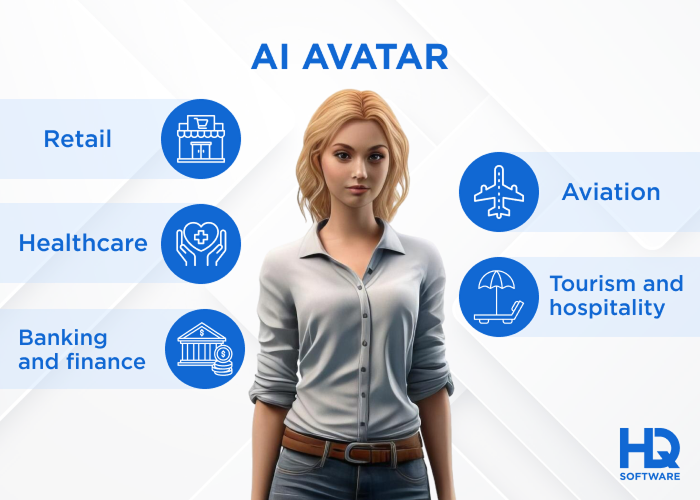
Companies from various industries have already started to implement training using AI avatars and have noted its effectiveness. These digital humans allow staff to practice their communication skills and solve non-standard situations in a safe and realistic environment. Thanks to their flexibility and adaptability, AI avatars can be easily customized for every industry, from aviation to finance.
Aviation
Aviation is one of the busiest and most dynamic industries, with employees working every day under high stress, dense passenger traffic and the need to respond quickly. According to IATA, more than 4.5 billion people used air transportation in 2023. This means that staff have to deal with a wide range of situations, from delays and overbookings to complex security issues.
AI avatars help to create interactive scenarios that are as close to reality as possible, where airport employees can practice communication skills, stress tolerance and conflict resolution without the risk of damaging the company’s reputation.
Let’s examine the two most common applications.
For check-in desk staff:
AI avatars can simulate diverse passenger behaviour and emotions scenarios. For example, a couple with small children and overweight luggage, or an annoyed passenger who insists on boarding immediately, or a customer who does not speak the local language. The scenarios teach check-in desk staff how to remain polite, follow procedures and find compromises within the airline’s rules.
For security:
AI avatars can represent passengers who are suspicious, refuse to be inspected, nervous or aggressive. This allows security staff to practice proper de-escalation, protocols and decision-making under stressful conditions, for instance when they have found prohibited items or need to call a supervisor.
This approach builds employee confidence and professionalism, helping airports maintain a high level of service and security during busy periods or in unexpected situations.
Retail
According to a report by Coherent Market Insights, the global consumer product and retail market was valued at $21.13 trillion in 2023 and is expected to surpass $34.44 trillion by 2030. This highlights the scale and importance of this industry to the economy and business.
In a highly competitive environment with ever-increasing customer expectations, quality of service has become a critical differentiator. Training programs powered by AI avatars allow retail employees to practice real-world customer interactions by simulating a wide range of shopper behaviors, from bargain hunters to impatient or indecisive customers. These roleplay scenarios help staff develop essential soft skills, such as empathy, persuasion, and problem-solving, in a safe environment.
Healthcare
Effective communication plays a key role not only in patient comfort but also in ensuring the safety of treatment. Even a small misunderstanding between medical staff and patient can lead to misdiagnosis, incorrect medication or reduced confidence in treatment. Digital avatars integrated with Artificial Intelligence can help to solve this problem. They allow medical professionals to practice their communication skills in a variety of scenarios.
For example, a doctor can “talk” to an avatar playing the role of an elderly patient who is hard of hearing, shy to ask clarifying questions, and misunderstands instructions. This simulation helps physicians learn how to explain information more clearly, ask the right questions, and be more attentive.
Tourism and hospitality
Tourism and hotel businesses are particularly sensitive to the quality of service. It is often the first impression and the speed of staff response that determines whether a guest will return to your hotel or use your travel services again. That’s why it’s important for staff to flexibly adapt to cultural differences, the emotional state of guests, and non-standard requests.
AI avatars make it possible to recreate realistic service situations. For instance, an AI human can “play” a tired foreign tourist with a poor command of the local language who is late for a tour and can’t find his reservation. The hotel employee should solve the problem tactfully and with understanding, taking into account the guest’s stress and possible language barriers.
This type of training teaches employees to act quickly, clearly and sensitively in different situations — whether it’s resolving conflicts or helping confused tourists.
Banking and finance
According to PwC research, 32% of customers stop doing business with financial institutions after just one negative experience, and nearly 60% will leave after several poor interactions.
This statistic underscores how critical it is to provide quality service and really listen to customers. If the service is poor, the bank has no chance of retaining customers, even if its products are competitive.
AI avatars can help bank employees significantly enhance their communication skills by simulating a wide range of customer scenarios. These include irritable or emotional clients, as well as individuals with different levels of financial literacy. Such simulations allow staff to practice explaining complex information clearly, handling difficult conversations with empathy, and building trust.
An AI avatar might simulate an elderly customer who is confused by online banking features and concerned about potential fraud. The employee needs to respond with patience, provide clear guidance, and offer reassurance. This helps develop real-world communication skills and customer sensitivity.
Need a custom software solution? We’re ready to help!
Hymux Technologies has a team of skilled professionals ready to tackle the project. Ask me!
To illustrate the real effectiveness of AI avatars in employee training, let’s look at how leading companies are already applying this technology.
1. AI avatars and Extended Reality
Scoot Airlines (a subsidiary of Singapore Airlines) employs AI and Extended Reality (XR) for immersive soft skills training. Their program includes digital replicas of work environments in 3D, helping employees prepare for dynamic passenger interactions such as handling unruly passengers.
In particular, trainees practice in a virtual Boeing 747, where they encounter challenging situations such as crying infants, passengers switching seats without permission, and intoxicated travelers. The training system features two AI components: virtual passengers that create realistic scenarios, and a virtual coach trained on Scoot’s service manuals and procedures. This AI coach evaluates trainee performance and offers feedback aligned with company policies and customer satisfaction goals, thereby accelerating training quality and operational readiness.
2. AI avatars for workforce training
The Chicago Transport Authority (CTA) implements AI avatars for workforce training, enhancing eLearning efficiency and reducing production time for training videos. CTA has access to over 140 AI avatars and a vast library of synthetic voices in 120 languages, ensuring that training materials are inclusive and engaging.
The CTA, using AI avatars, was able to shorten the training module cycle from several weeks to just a few minutes. This increased efficiency resulted in considerable cost savings and a more streamlined training process.
3. AI avatar to support employee communication and onboarding
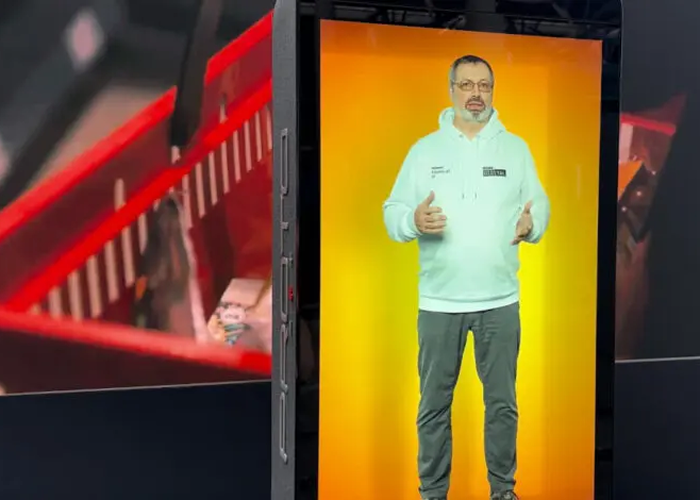
Rewe Group is piloting the use of hyper-realistic AI avatars to support employee communication and onboarding. Their avatar “goRobert,” a digital twin of a management member, answers new employees’ questions anonymously and realistically during face-to-face events and remotely via Microsoft Teams. This helps new hires get information on various topics, including personal concerns, without judgment.
AI avatar manager Robert answers questions
The Technologies Behind AI Avatars
AI avatars are comprehensive solutions that use advanced technologies to enhance employee training. In this section, we’ll look at the key technologies that make virtual trainers effective tools for developing employee skills.
Technology
Description
Generative AI
Creates realistic visuals, voices, and behavior patterns based on training data.
Natural Language Processing
Enables avatars to understand user input and respond with relevant, human-like dialogue.
Speech Synthesis
Converts text into natural-sounding speech with tone and emotion.
Speech Recognition
Identifies and processes users’ spoken input in real time.
Machine Learning
Continuously improves avatar performance based on feedback and data.
Emotion Recognition
Detects user emotions through voice or facial cues to adjust avatar responses.
3D Animation and Rendering
Delivers lifelike visuals, including facial expressions and gestures.
Integration with LMS/CRM
Allows seamless use of avatars within training platforms and customer systems.
Considering custom software?
Hymux Technologies’s team of experts can design and develop the perfect solution for your business. Let’s discuss it
At Hymux Technologies, we deliver AI avatar solutions tailored to your industry needs. Backed by solid experience in AI development services, we combine 3D artistry, AI/ML, and behavioral science to create avatars that don’t just talk but teach and master user experiences. Here’s what we provide for digital humans:
Custom AI avatar development: We design lifelike avatars with natural speech, emotions, and industry-specific knowledge that are perfect for training, customer service, or education.
Multilingual and voice-enabled avatars: We create avatars that speak various languages and understand accents, ensuring global accessibility.
VR/AR integration: With years of experience in VR/AR development services, our specialists can integrate AI avatars into immersive training environments. For instance, medical role-plays, airport customer service drills, etc.
AI-powered learning analytics. With AI avatars you can track your trainee performance with real-time feedback on tone, response time, and decision-making.
Integration with your current platforms and systems: We can seamlessly embed avatars into LMS, CRM, or custom apps for scalable training.
Partnering with Hymux Technologies for custom AI avatars means investing in tech that enhances education and training in various settings. These advanced digital characters will improve your trainees’ engagement and learning results beyond traditional methods.
But what other key advantages do AI avatars offer?
Andrey Kazakevich
Head of Production
at Hymux Technologies
As Head of Production, I see AI avatars as a vital operational tool, not just a training novelty. At Hymux Technologies, we are implementing them to create hyper-realistic practice environments that help master soft skills, reduce errors, and ensure peak performance.
Benefits of Using AI-based Avatars in Employee Training
The global Digital Human (AI Avatars) Market size was valued at USD 21.50 billion in 2023 and is projected to reach USD 454.75 billion by 2031, growing at a CAGR of 46.59% between 2024 and 2031. There are several reasons for this steep increase:
Realistic and risk-free practice. Trainees can interact with AI-powered personas — angry customers, distressed patients — in lifelike scenarios, with no real-world consequences.
On-demand training. AI avatars can be available 24/7, allowing employees to access training whenever and wherever they need it. This flexibility supports continuous learning in diverse work environments.
Personalized learning paths. AI avatars can be programmed to adapt to individual learning styles and provide customized feedback.
Enhanced engagement and retention. An interactive and dynamic presentation style helps capture employees’ attention and boosts retention of course material.
Data-driven insights. Integrated analytics track learner progress and performance. This data helps trainers refine content, address knowledge gaps, and improve overall training strategies.
Cost efficiency. By automating training sessions and reducing the need for live trainers, AI avatars can lower training expenses. They also minimize downtime since employees can access training at their convenience.
To sum up, the effectiveness of AI avatars in corporate training is clear, but as with any innovation, challenges remain.
Challenges in Implementing AI Avatars
Ensuring realism and user engagement
A key challenge in AI avatar implementation is achieving lifelike interactions that resonate with users. Avatars must exhibit natural speech patterns, believable emotions, and adaptive responses to maintain engagement. Poorly designed avatars can feel robotic or unresponsive, leading to frustration and reduced learning outcomes.
What we offer: We blend 3D artistry, behavioral science, and AI/ML to create lifelike avatars with natural speech, emotions, and adaptive interactions. This helps to keep users engaged.
Personalization and adaptability
Another major hurdle in AI avatar adoption is creating tailored experiences that adapt to individual user needs. Generic avatars often fail to address diverse learning places, cultural backgrounds, or role-specific requirements. This can lead to ineffective training.
What we offer: We leverage advanced ML algorithms to tailor the avatar’s interactions and responses based on each student’s performance and preferences. Continuous data analysis and updates ensure that the avatar remains effective and relevant to individual learning needs.
Technical complexity and integration
Organizations often struggle with compatibility issues, especially when merging avatars with legacy software, CRMs, or LMS. Deploying AI avatars at scale involves navigating a web of technical hurdles, from seamless API integrations with existing LMS/HR systems to ensuring real-time rendering across devices.
What we offer: we develop avatars that can seamlessly integrate with your LMS, CRM, or custom apps via APIs. We handle legacy system compatibility and provide 24/7 support for smooth deployment.
AI avatars are still a relatively new technology, but at Hymux Technologies, we see tremendous potential in their application for corporate training. By simulating realistic scenarios and delivering scalable, engaging learning experiences, AI avatars can help companies reduce training costs while improving employee readiness and performance. For organizations aiming to modernize their learning processes and stay ahead of the curve, AI-powered digital humans are a smart investment in the future.
If you want to take your corporate training to the next level, contact us. The Hymux Technologies team will be happy to explore your goals, offer expert guidance, and develop a custom AI avatar solution for your business.
An experienced developer with a passion for IoT. Having participated in more than 20 Internet of Things projects, shares tips and tricks on connected software development.
Can Generative AI Avatars Handle Multiple Languages?
Yes, generative AI avatars can handle multiple languages using natural language processing models. They can seamlessly switch between languages during conversations, maintain consistent personalities across different languages, and adapt cultural nuances appropriately. This multilingual capability makes them valuable in diverse learning environments.
Do Generative AI Avatars Require Constant Internet Access?
Not necessarily. Simple avatars can run locally on powerful devices, while complex ones often require cloud processing for real-time generation. Hybrid approaches exist where basic functions work offline but advanced features need the internet. The requirement depends on model complexity, device capabilities, and whether real-time AI processing happens locally or remotely.
How Quickly Can Employees Adapt to AI Avatar Training?
Employees can adapt to AI avatar training relatively quickly, often within a few sessions. The interactive and immersive nature of AI avatar training enhances learning and retention, facilitating swift adaptation. Success rates improve significantly when organizations provide proper support and address initial resistance through demonstration sessions.
How Long Does It Take to Develop an AI Avatar for Training?
Developing an AI avatar for training varies greatly. A simple avatar with basic interactions could take weeks. Complex, highly personalized avatars with advanced features like emotional expression and real-time adaptation can take a few months. Factors such as dataset size, development team size, and desired functionality significantly impact the timeline.
Can AI Avatars Adapt to Different Learning Styles?
Yes, AI avatars can personalize training by adjusting content delivery. This could be visual, auditory, or interactive content, based on employee preferences and performance. This enhances engagement and retention, making learning more effective for diverse learners.
Can an AI Avatar Help Teach Soft Skills or Empathy?
Yes. AI avatars simulate real workplace scenarios where employees practice listening, responding, and showing understanding. They give instant, unbiased feedback, helping learners improve tone, body language, and word choice. This makes them useful for building empathy and communication skills in a safe, judgment-free space before applying them with real people.
Can AI Avatars Serve as Virtual Lab Assistants?
Absolutely. AI avatars can guide employees through complex lab procedures, safety protocols, and troubleshooting. They demonstrate correct techniques, answer questions, and adapt to the learner’s pace. By simulating experiments or technical tasks, they reduce risks and costs, while ensuring learners gain hands-on experience in a controlled and repeatable environment.
What Roles Can AI Avatars Play in the Onboarding Process?
AI avatars can act as friendly guides for new hires. They introduce company culture, explain policies, and walk employees through workflows. Because they’re available anytime, avatars reduce HR workload and provide consistent onboarding. They also make the experience more engaging, helping employees feel welcomed, supported, and ready to succeed from day one.
How Can AI Avatars Help in Role-Play Training, Such as Negotiation or Leadership Exercises?
AI avatars can take on roles like clients, colleagues, or managers, allowing employees to practice critical scenarios. Learners can experiment with different approaches in negotiation, decision-making, or conflict resolution. The avatar’s adaptive responses create realistic challenges and prepare employees for high-stakes situations in a safe environment.
We are open to seeing your business needs and determining the best solution. Complete this form, and receive a free personalized proposal from your dedicated manager.