
With the rising popularity of AR, more businesses want to implement AR/VR development services and reap the benefits of AR apps. But how can you budget for AR development when you’re not sure what will affect Augmented Reality app development cost?
In this article we will sort out the following:
- General concepts of AR operation;
- Typical use cases of Augmented Reality apps;
- 3 types of AR apps;
- SDKs for building an AR app;
- Cost to develop AR app features;
- Factors influencing the cost to develop an Augmented Reality app.
And some bonus content: We’ll answer some frequently asked questions about building an AR app at the end of the article. Read on!
How Do AR Apps Work?
Augmented Reality is a technology that overlays digital content on a real-world image. The overlay may consist of graphic content of different kinds: 3D and 2D objects, masks with object and motion tracking, interactive objects such as buttons, and so on.
Usually, AR experiences include sound content as well.
Some simple points about how AR apps work:
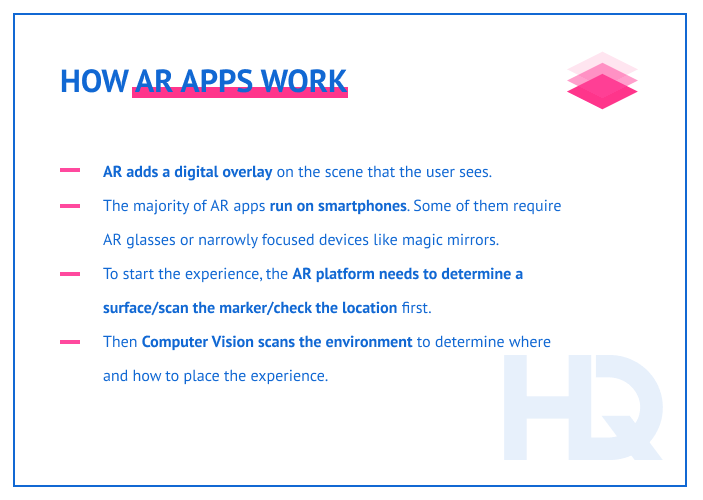
- AR adds a digital overlay on the scene that the user sees. The overlay includes 3D and/or 2D content.
- Most AR apps run on smartphones. Some require AR glasses or narrowly focused devices such as magic mirrors.
- To start the experience, the AR platform must determine a surface, scan a marker or check the location first.
- Computer Vision scans the environment to determine where and how to place the experience.
Thanks to the fact that most AR apps require only a smartphone to run, AR technologies are very affordable to both parties:
- Businesses that want to use AR content to attract new customers can advertise their products, and so on;
- Customers who want to try a new technology for entertainment or to interact with a brand on a new level, but don’t want to buy expensive hardware.
Brands take advantage of this affordability by building an AR app for smartphones. Let’s take a look at some successful AR platform use cases.
Use Cases for AR Apps
Many industries benefit from building an AR app, but some can completely change how their business operates by taking advantage of AR.
We will discuss these industries below.
Media and entertainment
Media and entertainment businesses are increasingly turning to Augmented Reality to deliver immersive experiences and stand out in a competitive landscape. The global AR market is expected to reach about $72.5 billion in 2025, with rapid expansion in gaming, social media, and interactive content creation, and forecasts suggest this could exceed more than $1 trillion by 2035. This growth is driven by rising adoption of AR games, AR-enhanced social content, and immersive entertainment experiences across platforms such as Instagram, TikTok, Snapchat, and dedicated AR apps.
5 Reasons to Implement AR in Media and Entertainment
How do modern businesses use AR to increase their revenues and outperform their industry competitors?

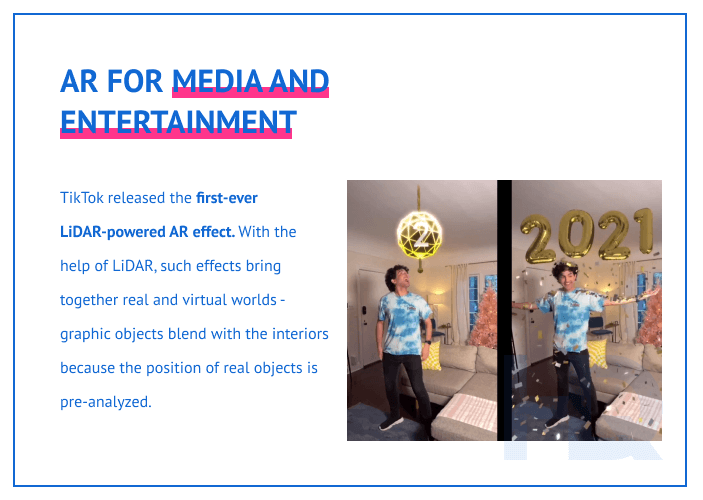
For example, TikTok released the first-ever LiDAR-powered AR effect. With the help of LiDAR, effects bring together real and virtual worlds; the position of real objects is pre-analyzed so that graphic objects blend smoothly with interiors.
Retail
Retail businesses benefit from the ability of AR platforms to overlay 3D and 2D content on particular objects from real life. We’re talking, for example, about fitting clothes on human bodies virtually.
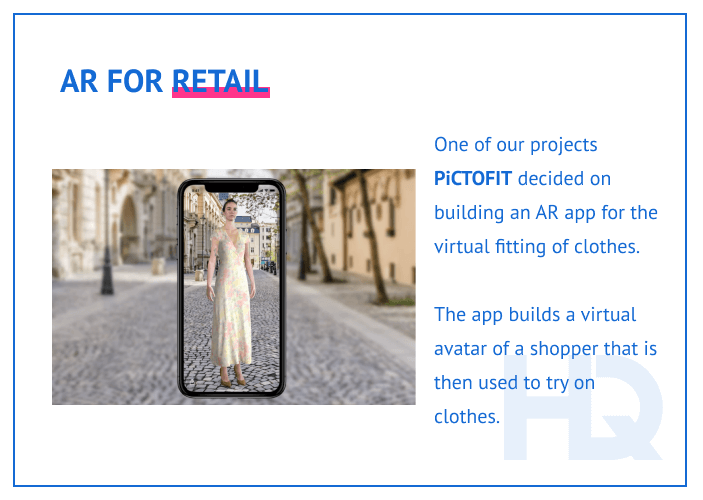
One of Hymux Technologies’s successful projects, PiCTOFIT, for example, has thrived on this concept. By building an AR app , the business gives shoppers the chance to create a virtual avatar who tries on the clothing.
The app has boosted sales by attracting customers who love the experience of seeing how they’ll look in the clothes right from their phone, before they buy.
Education
AR is great not only for entertainment but also for educational purposes. AR can be used to teach everyone from preschoolers to higher education students.
For example, there are tons of AR apps on the market with educational content on narrow topics that will be much more engaging for children than merely reading an article.
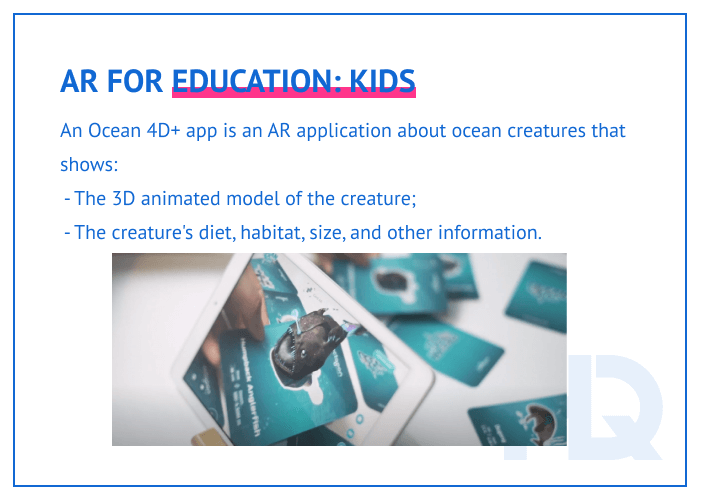
The Ocean 4D+ app is an AR application featuring ocean creatures that shows:
- A 3D animated model of the creature;
- The creature’s diet, habitat, size, and other information.
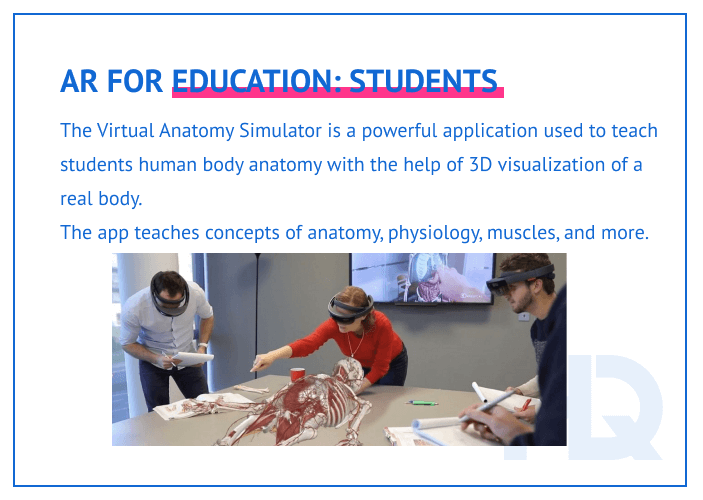
For more mature students, there are entirely AR-based educational programs used mostly in healthcare education.
The Virtual Anatomy Simulator is a powerful application used to teach students human body anatomy with the help of 3D visualization of a real body.
The app teaches concepts of anatomy, physiology, muscles, and more.
Healthcare
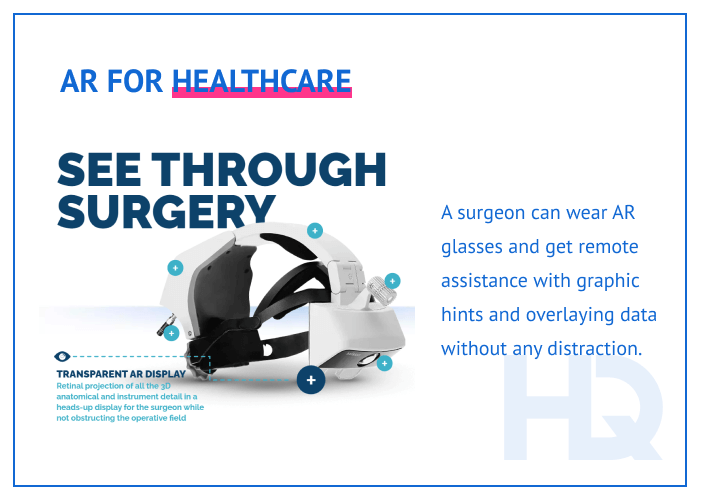
One of the most impressive ways AR is used for healthcare is hands-free surgical assistance.
A surgeon can wear AR glasses and get remote assistance with graphic hints and overlaying data without any distractions. See how Augmedics handles this — they have even built an AR head-mounted display for surgical purposes.
As you can see, each industry uses AR in a different way, but regardless of the field, this technology offers businesses numerous benefits.
Benefits of Augmented Reality App Development
In the table below we have described the features and benefits of AR applications for various industries.
| Industries | AR app development benefits |
| Media and entertainment | Customer engagement. As AR seamlessly connects elements of real and virtual worlds and allows interactions with both, users can actively engage with entertainment content and take part in activities instead of being passive observers.
Immersive experience. With interactive ads, games, and social media materials, businesses attract users’ attention, immerse them in content consumption, and create truly memorable experiences. Content diversification. By adding interactive virtual elements, companies can diversify their conventional static forms of content to enhance the customer experience. |
| Retail | Boosting sales. AR allows customers to virtually try on products before purchase, which enhances decision-making and reduces returns.
Improving the customer journey. The ability to interact with products, explore them in detail, and easily receive additional information about them makes shopping more engaging and enhances the customer experience. Increasing customer retention. Using AR, businesses can optimize every touchpoint with buyers, which, together with an interactive shopping experience, creates a positive brand image and encourages customers to make recurring purchases. Providing personalized content. AR apps collect data on shoppers’ behavior and preferences, which then enables personalized experiences and product recommendations that immerse customers in shopping and lead to increased sales. |
| Education | Interactive learning environment. Using AR apps, students can augment existing reality and interact with virtual objects, which engages them in the learning process.
Immersive learning. AR technology allows learners to gain practical skills in a safe virtual environment without having to buy or use expensive equipment. Enhanced memorization. Adding visuals and providing opportunities to interact with learning material helps students better understand the subject and, as a result, absorb it better. Accessibility. Students can use AR apps for learning whenever and wherever they want, which makes studying accessible for learners from various locations. |
| Healthcare | Improved training. AR technology helps medical students memorize information better, using 3D models instead of 2D images. Doctors, in turn, can improve their surgical performance on virtual patients.
Enhanced surgical efficiency. Using AR, surgeons can overlay scan results on the patient’s body, which helps them during surgery. It’s especially helpful for use with laparoscopic or minimally invasive surgeries. Advanced patient consultation. This is a win-win for both parties: doctors can better visualize patient data and even conduct remote consultations, while patients can better understand information related to their medical condition. |
The aforementioned benefits not only vary from industry to industry but also depend on the type of AR application that’s being used. So, when thinking about building an AR app, businesses must first decide which of the three types of AR is best suited to the project.
Types of AR apps
There are three types of AR platforms:
- Marker-based
- Markerless
- Geolocation-based
Let’s take a closer look at these choices.
Want to upgrade your business with an AR app?You have found your perfect partner here – Hymux Technologies is ready to develop a perfect AR app that will take your business to a new level.
Anna Halias
Business Development Manager,
Hymux Technologies

Marker-based AR platform
A marker-based AR app requires a visual trigger and some prior knowledge of the user’s environment to start the experience and place it correctly.
In simple words, a user needs to scan a marker — usually, it’s a 2D printed image — and when the AR app recognizes it, the experience starts.
This format suits businesses whose target is to offer a simple experience that will work correctly upon scanning a marker.
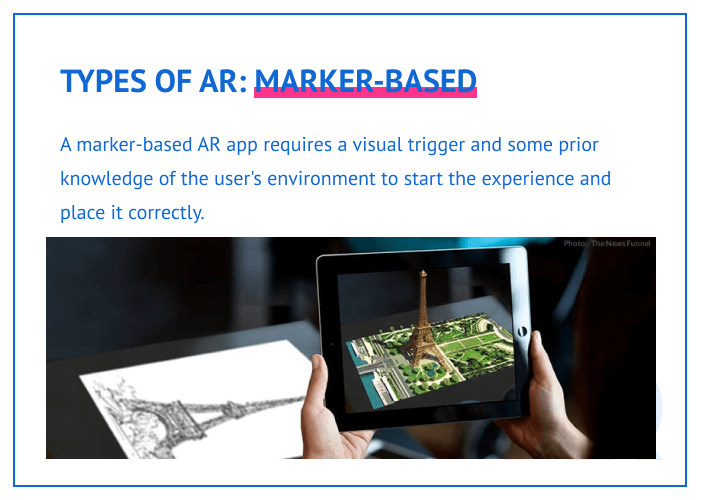
For example, the user scans a code on a business card and gets an AR experience that showcases information about the company via digital content. See how Hymux Technologies did this with its own business cards.
Markerless AR platform
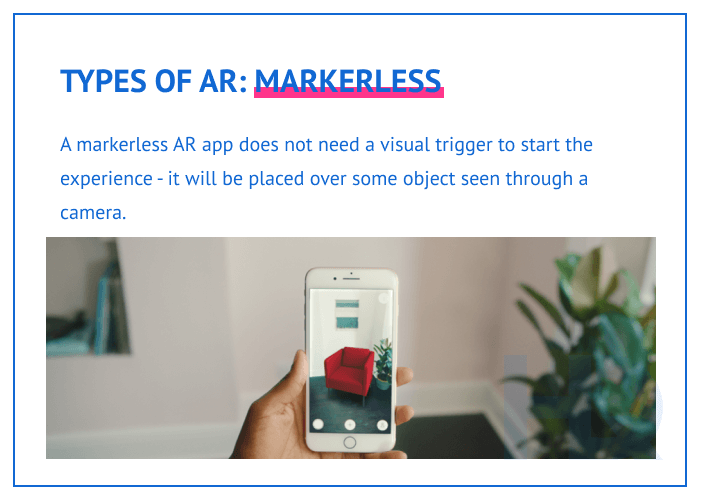
A markerless AR app does not need a visual trigger to start the experience. It will be placed over some object seen through a camera. Usually, this is a flat surface, like a floor or walls, a human’s face, etc.
This type of AR doesn’t need to scan the environment beforehand. It just uses the data from the camera and built-in sensors in the smartphone.
An AR face filter, or an app that places virtual furniture in your apartment, are good examples of this type. Check out the AR masks on Instagram or Ikea Place for reference.
Location-based AR platform
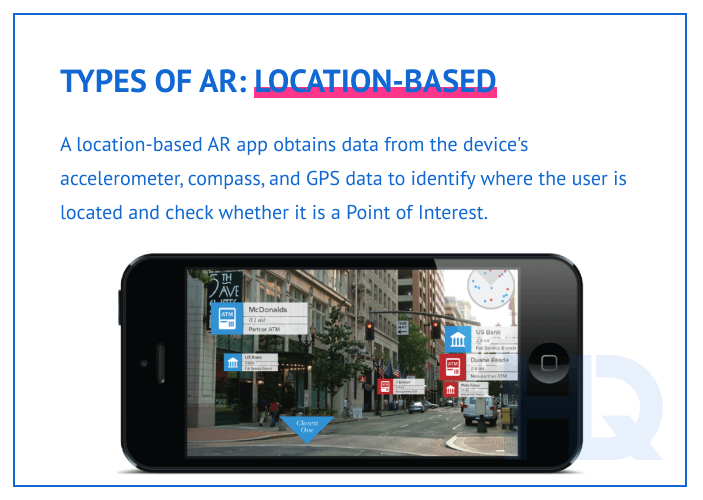
A location-based AR app obtains data from the device’s accelerometer, compass, and GPS data to identify where the user is located and check whether it is a Point of Interest.
When the location is identified and it is the right one for the experience, the AR app starts the experience. It doesn’t usually rely on flat surfaces.
The most famous example is Pokemon GO — an AR game that became a worldwide phenomenon, where the user must catch pokemon located in different places around a city.
To create an AR app of any type, developers use SDKs — software development kits. Let’s take a look at the most popular ones and compare them.
SDKs for AR Apps: Comparison Table
Let’s compare 4 of the most popular AR SDKs:
- ARCore. Google’s AR SDK for building AR apps of any kind.
- ARKit. Apple’s AR SDK is suitable for creating AR platforms of any type.
- Kudan AR. All-in-one lightweight SDK owned by Kudan.
- EasyAR. Another lightweight SDK for small to large businesses.
| ARCore | ARKit | Kudan | EasyAR | |
| Type | Free API | Free API | Free, commercial option available | Free, commercial option available |
| Unity 3D | + | + | + | + |
| Face tracking | + | + | Needs plugins | Needs plugins |
| Object tracking | + | + | + | + |
| Deployment platform | Android | iOS | Android/iOS | Android/iOS |
| Cloud recognition | – | – | + | + |
Next, let’s break down the AR development costs.
AR Apps Features and Development Cost
Let’s start with some typical development approaches:
- Building an MVP
- Building a Custom AR app
- Building a large enterprise-grade AR app
And some typical features:
- Marker-based AR
- Markerless AR
- Geolocation-based AR
From here we will analyze the Augmented Reality app development cost for these 6 options.
To calculate all further AR development costs, we’ll take an average developer rate of $35 per hour, which is common in countries such as Estonia and Estonian that boast high-quality development services.
Cost to develop an Augmented Reality app MVP
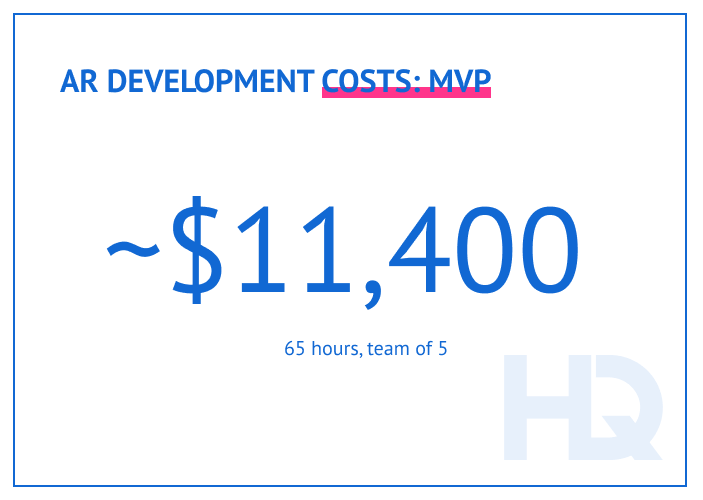
An AR MVP will help you test your idea and decide whether it is worth developing a whole AR platform. MVPs are generally lightweight, user-friendly, and carry few features: virtual models that users can rotate and zoom, and that might be it.
In this case, the whole process from designing and wireframing to development and publishing in app stores will take around 65 hours. With a small team of 2 developers, 1 tester, 1 designer, and 1 3D modeler, the AR app development costs will be up to $11,400.
Cost to develop a custom AR app
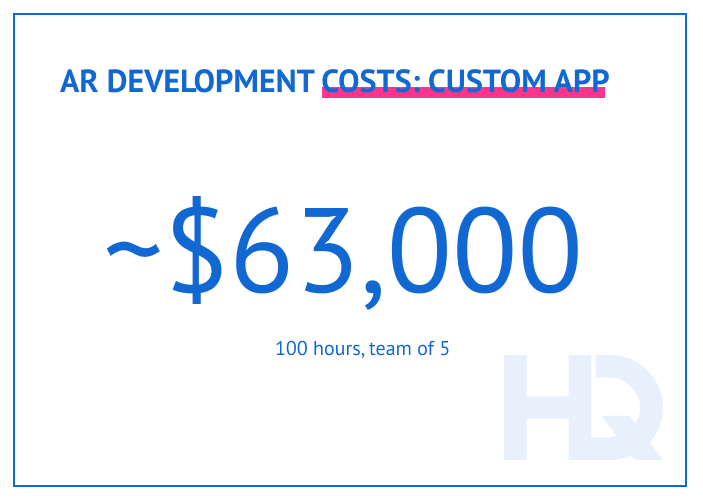
A custom AR application could include an unlimited number of features, but we will stop with a few of them.
A simple custom AR application will probably include the following features:
- Sign in and sign up for users;
- Catalog of AR content;
- Sharing options;
- Third-party APIs, plugins, etc.;
- Back-end features.
This set will take up to 100 hours, depending on the complexity of features. With the same team composition as was stated earlier, the AR app cost will be around $63,000.
Cost to develop an enterprise AR app
Enterprise AR applications simultaneously satisfy a number of potential business objectives. They may offer features for employee training, cooperative work, inventory tracking, and so on.
A standard set of features for this type of AR app will include:
- Sign in and sign up for users;
- Catalog of AR content;
- Recommendations based on data analysis;
- Sharing options;
- Recognition system;
- A number of 3D models.
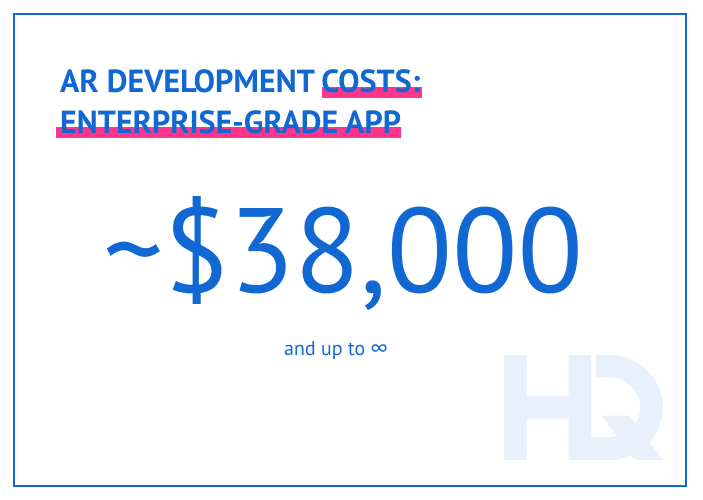
With publishing to app stores, building an AR app for enterprise takes a minimum of $38,000. At the upper end, the sky is the limit. The final AR app development price depends on the complexity of the project, number of features, and team composition.
Cost to develop a marker-based AR app
Marker-based AR apps need a visual code that triggers the AR experience. Typically such apps are simple and can be developed in a short time.
It can take around 100 hours to build an AR app and will cost around $3,000.
Cost to develop a markerless AR app
Markerless AR is a more complex technology that requires extra effort when building an AR app.
It typically takes up to 500 hours of development and design, and the cost of building an Augmented Reality app of this type starts at $10,000.
Cost to develop a geolocation-based AR app
Geolocation-based AR apps often require a cloud connection to download AR content from the server to show it to users. Such apps have more features, are more complex, and require a larger team.
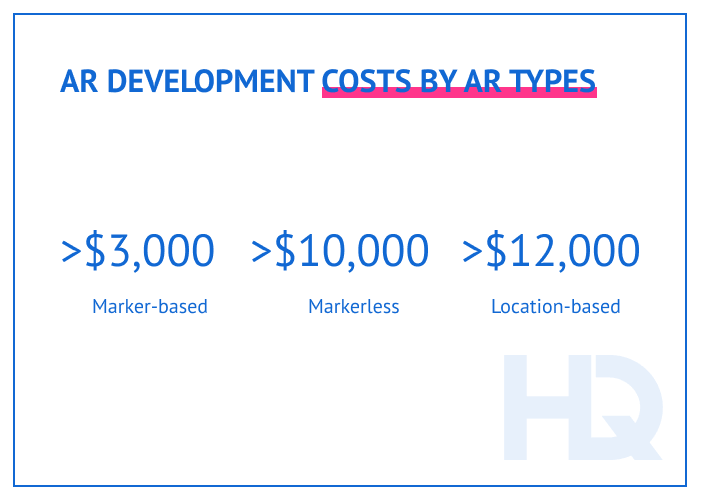
It takes more than 400 hours to build such an app. The AR app development cost will start at $12,000.
Note that all of these cost estimations are extremely approximate. To learn how much it will cost to develop an Augmented Reality app for your specific needs, contact us for a free estimate.
Factors Influencing the Cost of an AR App
We have partly described these costs already, but let’s dive in a little deeper
Team composition
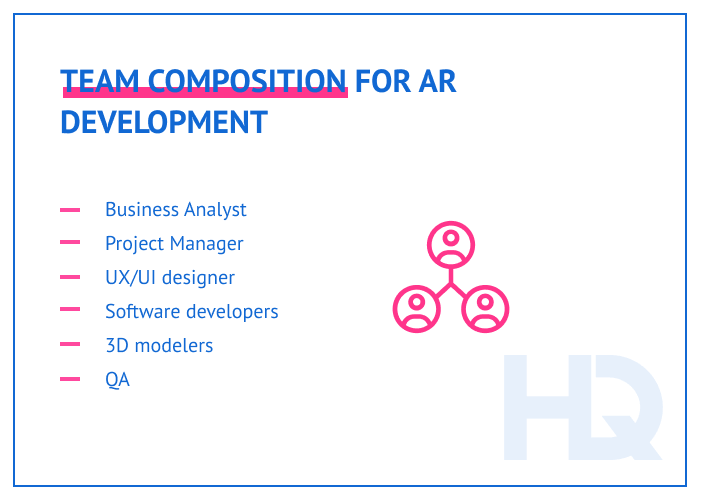
An AR development team can include the following specialists:
- Business Analyst
- Project Manager
- UX/UI designer
- Software developers
- 3D modelers
- QA
If you have to hire a complete team, or the project requires more than just two developers, it will cost more.
You can have a Project Manager, or a Business Analyst, or both, coming from your business, without needing to hire them from a vendor. This will save you some money but can complicate the development process.
Hourly rates
An hourly rate is the price a client pays for an hour of work of one specialist. Rates depend on the experience of a specialist, their position, and their location.
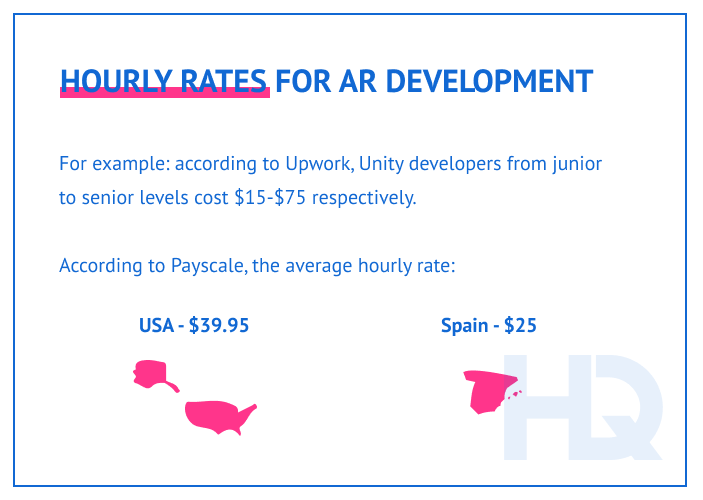
For example: according to Upwork, Unity developers from junior to senior levels cost $15-$75 respectively. According to Payscale, the average hourly rate in the USA is $39.55, and in Spain, it is around $25.
Project type
AR app development costs will differ drastically depending on the project type you choose.
Creating an AR app with only a few 3D models and a marker will take little time and, of course, cost less than building an enterprise-grade AR system.
Geolocation-based AR also costs more than other types of AR.
Number of features
Here, the rule is simple — the more features required, the higher the cost. Also, features take varying amounts of time to build.
Amount of 3D content
Creating 3D content for AR experiences is a whole separate issue. It takes time and money and often requires a whole bunch of developers working simultaneously.
Now that you know all the variables, let’s figure out what your AR app cost might be.
How Much Does It Cost to Develop an AR App?
Because there are so many factors affecting the AR app development price, we will try to create a rough estimate using the information already shared in this article.
For a complex AR app with, let’s say, several markers, social media sharing features, a content gallery, and so on, it will take more than 160 hours of development.
Here we will also add around 100 hours of Business Analysis, Project Management, 3D design, and QA work.
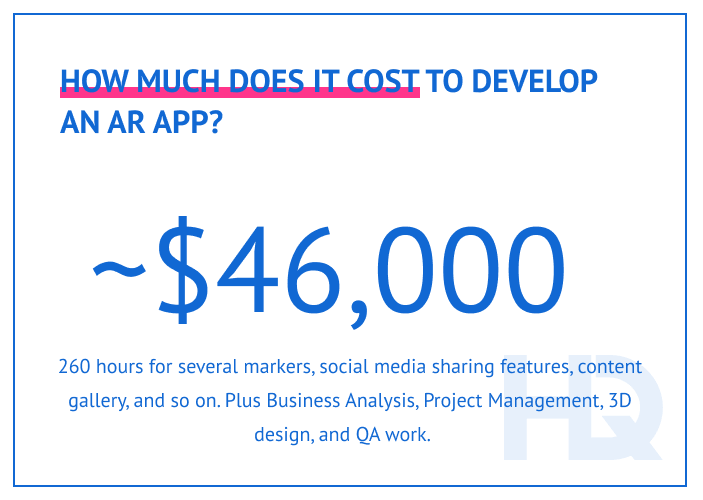
As a result, building an AR app will take around 260 hours, and the cost of app development with the aforementioned features will be around $46,000.
To determine an AR app development cost for your business, drop us a line — we will create a free personal estimate for you.
References
- Oregon LCF – Augmented Reality Principles And Practice https://lcf.oregon.gov/Download_PDFS/EIW27/505662/augmented-reality-principles-and-practice.pdf
- AREA (Augmented Reality for Enterprise Alliance) – Total Cost of Ownership of Enterprise Augmented Reality https://thearea.org/total-cost-ownership-enterprise-augmented-reality/
- GAO (U.S. Government Accountability Office) – Most Civilian Agencies Are Using or Plan to Use Augmented Reality, Virtual Reality, and More https://www.gao.gov/assets/gao-24-106665.pdf
- NSF (National Science Foundation) – A Study of the Hololens Application Store https://par.nsf.gov/servlets/purl/10406321

AR/VR Expert
A developer with extensive expertise in AR/VR, very ingrained into the topic of Mixed Reality development. Shares his knowledge and the results of many years of work.


Frequently Asked Questions
What are the AR & VR market size predictions?
Where is AR used?
How does Augmented Reality work?
How much time does it take to develop a basic AR app?
What benefits will I get from outsourcing AR app development to Estonia?
Is Augmented Reality expensive?
Related Posts
View All


We are open to seeing your business needs and determining the best solution. Complete this form, and receive a free personalized proposal from your dedicated manager.

Sergei Vardomatski
Founder