What’s the one thing stopping online shoppers from buying jewelry? The answer is uncertainty. Customers want to see, feel, and experience jewelry before purchasing, but online they’re left wondering: Will this ring fit? Does this necklace suit me? This doubt leads to abandoned carts, high return rates, and missed sales.
Augmented Reality (AR) eliminates the guesswork. With virtual try-on technology, shoppers can instantly visualize how your pieces look on them, from any device. AR enhances the shopping experience, builds trust, and turns browsers into loyal customers.
So, let’s discover how AR for jewelry can give you the competitive edge you need to thrive in 2025 and beyond.
AR solutions in the jewelry industry let customers virtually try on rings, necklaces, earrings, and more using their smartphone or tablet. Instead of guessing how a piece will look, shoppers can see it on themselves in real time, as though in a digital mirror.
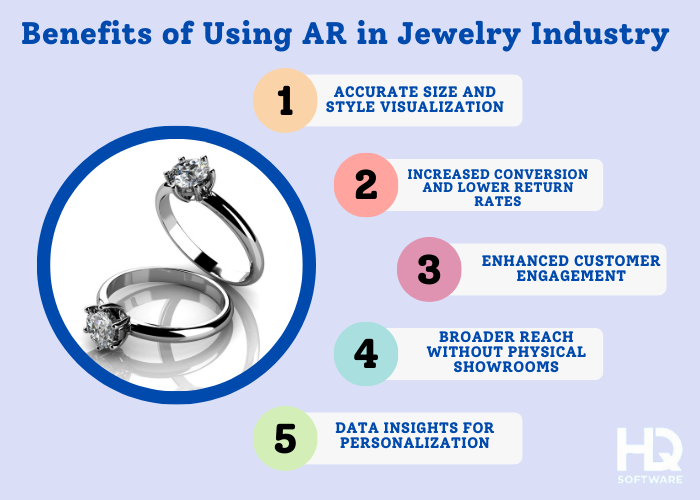
Thus, AR technology elevates the jewelry shopping experience from ordinary to extraordinary. Here’s is what benefits it offers:
Accurate size and style visualization.AR scales the jewelry to the user’s body, showing true proportions, metal finish, and stone sparkle. Shoppers can compare multiple options side‑by‑side, making it easier to select the perfect item.
Increased conversion and lower return rates. When buyers can preview items accurately, they are more likely to complete the purchase and less likely to be disappointed after delivery.
Enhanced customer engagement. Interactive AR experiences are fun and shareable, encouraging users to spend more time on the brand’s site or app and to spread the experience on social media.
Broader reach without physical showrooms. Brands can showcase their full catalog to shoppers anywhere, even in regions without a brick‑and‑mortar store. This expands market access while keeping overhead low.
Data insights for personalization.AR platforms track which pieces users try, how long they view them, and what customizations they select. Brands can use this data to tailor recommendations, marketing messages, and inventory planning.
Achieving these impressive results requires placing the technology directly into the hands of potential buyers. However, implementation strategies vary significantly depending on brand goals, target audience, and technical requirements.
How Jewelry Brands Integrate AR Try-Ons
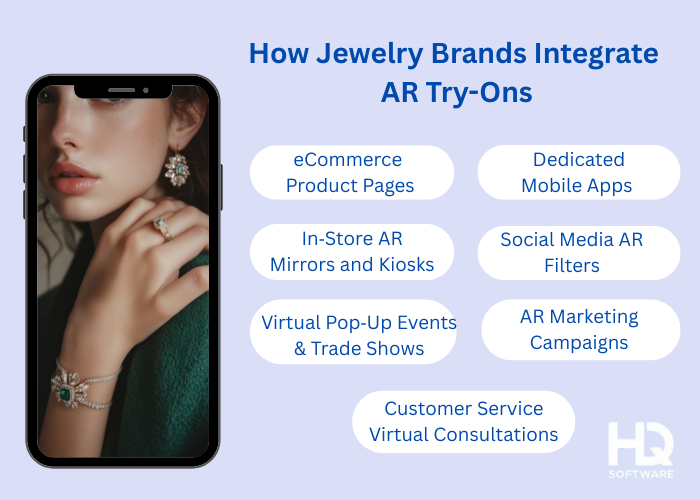
Jewelry brands are now actively using AR try-on technology, choosing different methods based on their customers and goals. These approaches vary from simple apps to advanced web tools, each with its own advantages. Knowing these key 7 options can help you pick the best fit for your audience.
1. eCommerce Product Pages
Online jewelry stores embed AR try‑on widgets directly into their product listings. Shoppers click a “Try on” button, point their phone or laptop camera at their hand or face, and see a realistic 3D model of a jewelry piece overlaid in real time. This instant visual confirmation reduces hesitation, cuts return rates, and turns a static catalog into an interactive sales floor.
2. Dedicated Mobile Apps
Many brands launch their own iOS/Android apps that include a full‑featured AR suite. The app can store a user’s size preferences, suggest complementary pieces, and even let customers experiment with different metal finishes or gemstone colors. Because the experience lives inside the brand’s app, it can push personalized offers and build a loyalty loop that a simple web widget cannot.
3. In‑Store AR Mirrors and Kiosks
Physical boutiques install smart mirrors or tabletop kiosks equipped with depth‑sensing cameras. Customers step in front of the mirror, select a piece on a touchscreen, and watch the jewelry appear on their reflection as they move. The mirror can also capture photos or videos for social sharing, creating a memorable “phygital” moment that drives foot traffic and word‑of‑mouth promotion.
4. Social Media AR Filters
Platforms such as Instagram, Snapchat, and TikTok offer AR lenses that brands can publish as branded filters. Users simply open the camera, select the filter, and instantly see a virtual piece of jewelry on themselves. Because the content lives where users already spend time, it fuels organic reach, encourages user‑generated content, and turns a casual scroll into a mini‑shopping experience.
5. Virtual Pop‑Up Events and Trade Shows
During online exhibitions or limited‑time virtual pop‑ups, brands host live AR sessions where attendees can try on collections from the comfort of their homes. Sharing a link or QR code gives instant access to an AR experience via any web browser. Brands can use this to showcase new items, get customer details, and generate buzz, bypassing the need for a physical showroom.
6. Augmented Reality Marketing Campaigns
Beyond direct sales, AR is used in storytelling ads: a short video might invite viewers to scan a printed postcard or billboard, launching an AR scene where the jewelry floats around a model or a historic setting. This immersive narrative deepens emotional connection, reinforces brand heritage, and often includes a call‑to‑action that routes users to a try‑on page.
7. Customer Service Virtual Consultations
Some luxury retailers integrate AR into their support channels. A sales associate can start a video call, share an AR overlay, and guide the customer through trying various pieces, adjusting sizes, or visualizing custom engravings in real time. This hybrid service blends the expertise of a personal shopper with the convenience of remote shopping, increasing conversion for high‑ticket items.
By letting shoppers see how a piece looks on them before they click “buy,” AR try‑ons turn visualization into confidence. A perfect example is a solution we built at Hymux Technologies.
Jewelry AR Try-On by Hymux Technologies
At Hymux Technologies, we developed a comprehensive AR jewelry try-on application for a luxury jewelry retailer that allows customers to virtually experience their entire collection through smartphones and tablets. The solution features advanced hand-tracking technology that accurately maps ring placement on fingers, while facial recognition enables precise positioning of earrings and necklaces.
Customers can browse through hundreds of jewelry pieces, adjust sizes, and switch between different metal and gemstone options. The app also includes a unique “mix and match” feature that lets clients try on multiple pieces simultaneously to create complete jewelry sets.
The platform integrates seamlessly with the retailer’s eCommerce system and social media channels, allowing customers to save their favorite combinations, share virtual try-on photos with friends, and make purchases directly through the app. In addition, advanced analytics provide the jewelry brand with valuable insights into customer preferences, most-tried items, and conversion patterns.
Explore our portfolio to see more of our AR/VR projects.
Need a custom software solution? We’re ready to help!
Hymux Technologies has a team of skilled professionals ready to tackle the project. Ask me!
Boosting Jewelry Sales Through Enhanced Customer Engagement
Many leading brands are already using AR to amplify their marketing, and the numbers speak for themselves. In 2023, the worldwide virtual try‑on market was worth about $9 billion. That’s expected to jump to roughly $46 billion by 2030, growing at an average of 26% each year from 2024 onward.
Based on these findings, the three most effective ways jewelry companies are using digital solutions to boost sales through deeper customer engagement are:
Social AR for discovery
Configurable designs
Remote storytelling
Social AR for Discovery
This means using Augmented Reality filters on social media apps such as Instagram or Snapchat. People can try on virtual jewelry, such as earrings or necklaces, just by pointing their phone camera. It’s a fun and easy way for customers to discover new pieces they might like without visiting a store, spreading the word about the brand organically.
Configurable Designs
This involves letting clients customize jewelry pieces using technology. Imagine being able to choose the metal color, the type of gemstone, or even engrave a special message, and then seeing exactly how it looks on your finger or neck through AR. This makes the shopping experience personal and exciting, allowing customers to create unique pieces that perfectly match their style.
Remote Storytelling
This is about using AR to share the unique story behind each piece of jewelry. For example, pointing a phone at a necklace could trigger an AR animation showing where the gemstones came from, who designed it, or the inspiration behind its creation. It helps customers connect emotionally with the jewelry and understand its value and craftsmanship, even if they can’t physically be at the store or meet the maker.
Boosting jewelry sales starts with deeper customer engagement, and AR makes it possible. With Hymux Technologies’s tailored AR app development, you can create immersive try-on experiences that captivate shoppers and drive conversions.
Developing an Augmented Reality Jewelry App With Hymux Technologies
While jewelry shopping still feels like guesswork, Hymux Technologies eliminates the uncertainty. We build AR applications that let customers see exactly how a piece ofjewelry looks on them before they buy, turning hesitant browsers into confident buyers.
Take a look at what we can offer:
Custom AR try-on solutions. We develop AR apps that allow customers to virtually try on rings, earrings, necklaces, and bracelets with photorealistic accuracy. Our advanced computer vision technology ensures precise fitting and natural movement tracking for an authentic virtual experience.
Cross-platform development. Our team builds AR jewelry apps that work seamlessly across iOS, Android, and web browsers, ensuring maximum reach for your customer base. We optimize performance for various device specifications.
3D jewelry modeling and digitization. We transform your physical jewelry catalog into high-quality 3D models with accurate materials, textures, and lighting properties. Our designers capture every detail, from gemstone brilliance to metal finishes, creating virtual pieces that look identical to their real counterparts.
Real-time customization features. We integrate dynamic configuration tools that let customers change metals, gemstones, sizes, and engravings while seeing instant visual updates. This helps drive higher-value purchases through customized designs.
Social media integration. Our AR solutions seamlessly connect with Instagram, Snapchat, and Facebook, enabling customers to share their virtual try-on experiences. These social features will expand your brand’s reach through organic content.
AI analytics. We implement comprehensive tracking systems that provide insights into customer preferences, popular products, and user behavior patterns. These analytics help jewelry brands optimize their inventory, marketing strategies, and product development based on real customer data.
We build AR jewelry apps on scalable cloud platforms that can handle traffic spikes during sales events and holiday seasons. Our infrastructure ensures fast loading times and smooth performance, regardless of user volume or geographic location.
Considering custom software?
Hymux Technologies’s team of experts can design and develop the perfect solution for your business. Let’s discuss it
Now let’s see real examples of what other popular brands can provide for their clients.
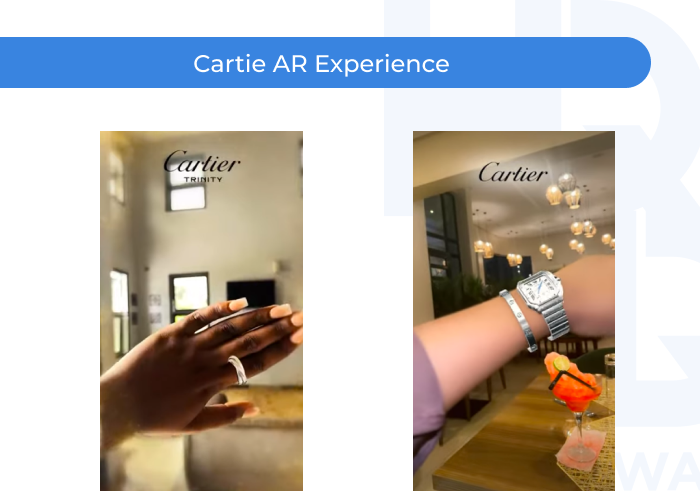
1. Cartier
Cartier teamed up with Snapchat to bring its iconic rings and watches to life through an AR Lens that lets users virtually try them on via their phone’s camera. For example, the experience overlays a realistic 3D model of each ring onto the viewer’s hand, automatically detecting finger position and adjusting scale, lighting and metal finish in real time.
Shoppers can swipe through the collection, switch between yellow, rose or white gold, and even view the stone’s sparkle from different angles. This makes the luxury brand’s high‑end pieces instantly accessible and interactive for a global audience.
2. Swarovski
Swarovski’s website lets shoppers try on jewelry in real time with AR, so they can see exactly how each piece looks before purchasing. The AR layer is built into the eCommerce platform, enabling a one‑click “add to cart” that bridges digital browsing with the tactile feel of crystal luxury. Customers can also schedule virtual consultations with sales associates, combining the convenience of online shopping with the personalized service of a boutique.
By scanning a hand or face, the app projects a realistic 3D model of necklaces, earrings, bracelets or watches, accurately rendering the brand’s signature sparkle, reflections and metal finishes. Customers can swipe through collections, change colors or stone styles, and see how each piece catches the light as they move, all without physically handling the items.
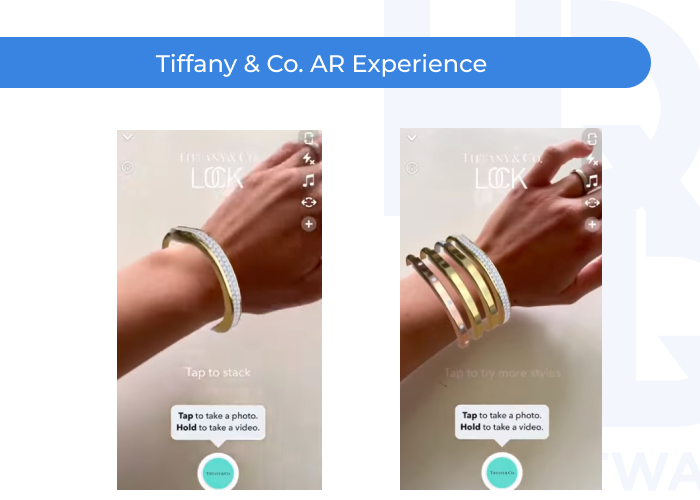
3. Tiffany & Co.
Tiffany & Co. uses Snap’s AR technology to turn luxury jewelry into interactive digital experiences, most notably with an AR mirror at the 2023 US Open. The mirror lets visitors see a diamond‑encrusted tennis racket, digital trophies and other Tiffany creations overlaid on their reflections, while Snap’s ray‑tracing renders the sparkle and metal finishes with photorealistic lighting. Users can pose, capture photos and share them via QR code, all without needing a phone or app.
The same platform also powers Tiffany’s earlier AR try‑on of the Lock bracelet and its London Saatchi Gallery exhibition, where shoppers could virtually wear yellow diamonds and explore walls of gems. Tiffany delivers a seamless, in‑store AR mirror that combines brand storytelling, product visualization and social sharing, expanding access to its luxury pieces while preserving the brand’s high‑end image.
4. Pandora
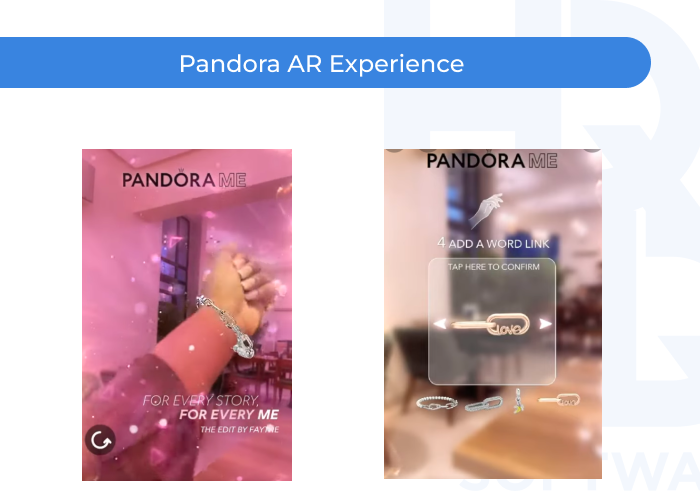
Pandora’s AR offering, called the Virtual Jewelry Box, lets shoppers try on rings, bracelets, charms and earrings by simply pointing their phone’s camera at a hand or wrist. Using markerless hand‑tracking, the app detects finger position and overlays a high‑resolution 3D model of the selected piece, complete with realistic metal‑shine and gemstone sparkle.
Customers can swipe through the entire Pandora catalog, mix‑and‑match charms on a virtual bracelet, and instantly switch between gold, silver or rose‑gold finishes. The experience is built on a lightweight WebAR framework, so it runs directly in mobile browsers without a download. Once a piece is tried on, shoppers can add it to their cart with one tap, turning a virtual try‑on into an immediate purchase.
5. Bulgari
Bulgari uses AR technology so shoppers can try on its famous Serpenti and B.zero1 jewelry, as well as luxury watches, right from their phone or an in‑store digital mirror.Using high-fidelity 3D modeling, Bulgari’s AR tools replicate the sparkle of gemstones, intricate metalwork, and ergonomic fit, ensuring a near-real experience.
The brand also integrates AR into social media campaigns (like Instagram filters) and virtual showrooms, enabling customers to explore limited-edition designs or customize jewelry before purchase. By merging Italian craftsmanship with digital innovation, Bulgari makes luxury more interactive while preserving its exclusive allure.
The success stories of those five AR‑savvy jewelers prove the concept works in the real world. The next step is to understand the hurdles and constraints that can stand in the way of wider adoption.
Challenges and Limitations for AR in the Jewelry Industry
For all its benefits, using AR in jewelry has its limitations. Here are the most common obstacles brands face and practical ways to address them.
Accurate Size and Sparkle Rendering
Small rings, delicate chains and glittering stones are hard for AR to display at the right scale and with realistic sparkle, so customers can’t tell if a piece really fits or shines.
Hymux Technologies solution: We create high‑precision 3D models with advanced material shaders and ray‑tracing, then calibrate the app to each device’s camera so the jewelry appears at true size and with lifelike sparkle every time.
Device Compatibility and Performance
Not all phones or browsers can handle heavy 3D assets, leading to lag, low‑resolution graphics, or the experience not loading at all.
Hymux Technologies solution: We build lightweight, adaptive AR bundles that automatically downgrade graphics on older devices while keeping the core try‑on functional, and we test across iOS, Android and major browsers to guarantee smooth performance everywhere.
Slow Loading and Glitches
Heavy AR apps can lag or crash, frustrating users and hurting sales. This performance drop often leads to abandoned sessions and a negative perception of the brand.
Hymux Technologies’s solution: We optimize AR for fast loading on any device, using lightweight tech that works seamlessly on websites, apps, and social media. Our approach includes asset compression, progressive streaming, and device‑specific fallback layers to guarantee a smooth, reliable experience for every visitor.
In conclusion, Augmented Reality has emerged as a force for the jewelry industry. By seamlessly integrating virtual try-on capabilities and compelling digital storytelling, AR empowers brands to bridge the gap between the online and physical worlds. This not only enhances customer engagement and confidence but also drives sales and fosters deeper connections.
Contact us to create a seamless, high-converting try-on experience tailored to your brand.
A developer with extensive expertise in AR/VR, very ingrained into the topic of Mixed Reality development. Shares his knowledge and the results of many years of work.
Which Jewelry Categories Work Best With AR (Rings, Earrings, Necklaces, Bracelets)?
Rings and earrings perform best in AR because they’re small, fit close to the face, and can be visualized accurately on a live video feed. Necklaces and bracelets work, but require more precise scaling and background detection. That makes them slightly less reliable for quick, realistic try-ons in online shopping contexts.
Do Shoppers Need a Special App or Does WebAR Work in the Browser?
Most WebAR experiences run directly in mobile or desktop browsers using JavaScript libraries such as 8th Wall or AR.js, so shoppers don’t need to install a separate app. Native apps are required only for higher‑resolution models, offline access, or advanced tracking. But for typical try‑ons, browser‑based AR is sufficient and convenient today.
Can AR Show Different Metals, Stones, and Carat Sizes in Real Time?
Yes. Advanced AR jewelry tools let shoppers instantly swap metals (gold, platinum), change gemstones (diamonds, sapphires), and adjust carat sizes in real time. High-quality 3D rendering ensures realistic reflections and sparkle. Some platforms even simulate lighting effects for true-to-life previews before purchase. Perfect for customization!
How Long Does It Take to Launch an AR App, and What Does It Cost?
The wait before launching an AR app depends on numerous factors, including complexity, features, and platform. A simple WebAR solution can launch quickly, while a fully custom native app takes significantly longer. Costs vary based on design, development, and 3D modeling — scaling with functionality and user experience requirements.
What Are the Common Pitfalls When Implementing AR for Jewelry Brands?
Common pitfalls for jewelry AR include:
inaccurate scale or lighting that misrepresents size and sparkle;
We are open to seeing your business needs and determining the best solution. Complete this form, and receive a free personalized proposal from your dedicated manager.



 4. Pandora