Today’s readers expect more than static ink. They want interactive experiences that blend the tactile feel of print media with digital content. So, what if your magazine could leap off the page? Augmented Reality (AR) makes it possible.
By embedding AR markers in print media, publishers can turn a simple spread into a living showcase. For instance, animated covers, 3D product demos, and immersive ads that respond to a swipe or a tap. AR gives brands a fresh way to capture attention and extends the lifespan of print by linking it directly to online shopping.
Let’s look at the best ways to use Augmented Reality in magazines and ads, discover how it gets more people interested, and why it’s becoming a must-have for publishers today.
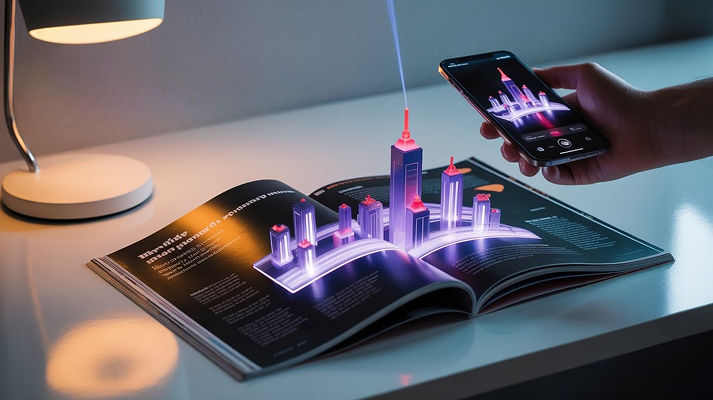
Augmented Reality in print media is a technology that adds a digital layer to a physical page. When you point a smartphone or tablet at a printed image such as a magazine cover, a catalog page, or an ad, a special marker or the picture itself triggers the phone’s camera. The camera then overlays 3D graphics or other interactive elements on top of the paper.
In other words, the flat page “comes to life,” letting readers see moving pictures, try products virtually, or play games without leaving the printed material. AR for printed media offers numerous advantages:
Higher reader engagement. Moving graphics, videos or games make a static page feel interactive, so people spend more time looking at it and are more likely to remember the brand.
Extended shelf life. A printed ad or catalog that can “come alive” stays interesting long after it’s been put on a shelf, giving the content a longer useful life.
Instant link to online sales.AR can display a “tap to buy” button or a QR code that takes the viewer straight to the product page, turning a casual glance into a purchase opportunity.
Valuable performance data. The AR app records how many people scanned a page, which items they interacted with, and how long they stayed. This gives marketers analytics that print alone can’t provide.
Easy social sharing. Users can capture short videos or photos of the AR experience and post them to social media, turning a printed piece into a free promotion.
Cost‑effective interactivity. Adding a simple AR marker to an existing print run is far cheaper than producing a full‑size video or interactive website, yet it delivers a comparable digital experience.
Having outlined how AR adds value to print media, let’s see how various applications are making those benefits tangible for both readers and brands.
Need a custom software solution? We’re ready to help!
Hymux Technologies has a team of skilled professionals ready to tackle the project. Ask me!
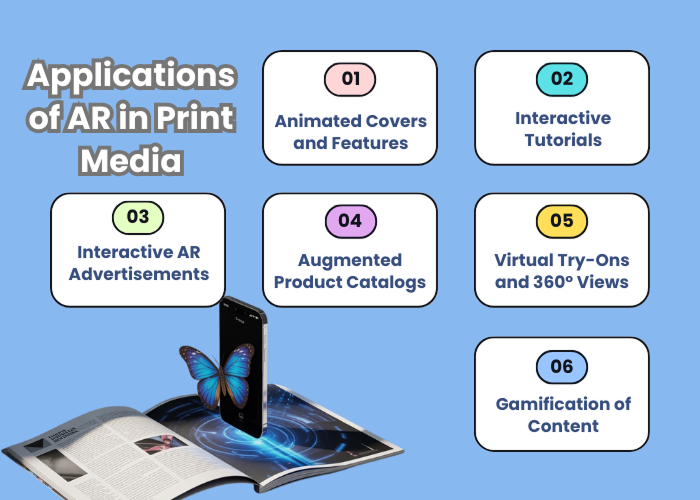
With a simple scan, a magazine page can become a 3D showcase or a mini‑game. Here are six practical Augmented Reality ideas that bring print to life.
Animated Covers and Features
Augmented Reality animates static magazine and book covers with videos or 3D effects. When readers scan a cover or page with their smartphone, they can see moving images or short clips that make the content more engaging. For example, a fashion magazine’s cover could show a model’s outfit changing colors or styles in real time, making print media feel as dynamic as digital.
Interactive Tutorials
AR turns printed instructions or educational content into hands-on learning experiences. Instead of just reading, users can scan a page to see 3D animations, step-by-step videos, or interactive guides that explain complex topics. A cooking magazine, for instance, could use AR to show how to chop ingredients properly, or a “Do it yourself” manual could overlay real-time assembly instructions on a physical object.
Interactive AR Advertisements
Print ads come alive with AR, allowing brands to create immersive experiences that capture attention. When users scan an ad with their phone, they might see a product demo, a celebrity endorsement, or a game related to the brand. One example is an AR car ad that lets readers explore a 3D model of the vehicle. Readers can rotate it and even “sit inside” it virtually from a printed page.
Augmented Product Catalogs
AR transforms static product catalogs into interactive shopping experiences. Customers can scan a page to see 3D models of products, watch demo videos, or compare different versions of an item. A furniture catalog in particular could let users place a virtual sofa in their living room to check the size and style before buying. This makes shopping from a catalog as engaging as browsing online.
Virtual Try-Ons and 360° Views
AR lets customers virtually “wear” or inspect products before buying. In fashion magazines, readers can try on sunglasses, jewelry, or makeup by scanning a page. For home goods, they can view a lamp or decor item in 360° to see every detail. This helps shoppers make confident decisions without needing to visit a store, reducing returns and increasing satisfaction.
Gamification of Content
AR technology turns print media into playful experiences by adding games, quizzes, or rewards. A children’s book could include AR puzzles or animated characters that appear when scanned. A travel magazine might offer a scavenger hunt where readers unlock hidden content by exploring pages. This makes reading more fun and keeps audiences engaged longer.
How Hymux Technologies Can Help Publishers to Implement AR
At Hymux Technologies, we developed an AR solution for a leading home decor magazine that enhances how readers experience furniture shopping. When people point their smartphone camera at furniture photos in the magazine, they can instantly see how those pieces would look in their own rooms using our AR technology.
The app lets users place virtual sofas, tables, and chairs in their living spaces, adjust colors and fabrics, and even check if items fit through doorways. Readers can save their favorite room setups, share photos with family, and tap to buy directly from the magazine page.
Here’s more of what the Hymux Technologies team can do for you:
Concept planning. We work with editorial and marketing teams to identify the most effective AR use cases (interactive covers, product demos, gamified quizzes) and map them to your goals and budget.
Content creation and 3D modeling. Our designers produce lightweight, photorealistic 3D models, animations and video assets that match the magazine’s visual style and load quickly on any device.
Custom AR authoring platform. We deliver a web‑based CMS where non‑technical staff can upload assets, assign QR‑code or image‑recognition triggers, set interactive hotspots and schedule releases without writing code.
Cross‑platform deployment. Using WebAR standards and optional native wrappers, the experience runs on iOS, Android, and desktop browsers. This ensures that readers can access AR without downloading an app.
Performance optimization. We compress assets and implement progressive streaming and device‑specific fallbacks so the AR runs smoothly even on older smartphones and low‑bandwidth connections.
Analytics and reporting. Real‑time dashboards track scans, dwell time, interaction heat‑maps and click‑throughs to eCommerce. This gives precise ROI data to refine future campaigns.
Armed with these development tools and expertise, publishers can bring their vision to life through proven AR applications.
Considering custom software?
Hymux Technologies’s team of experts can design and develop the perfect solution for your business. Let’s discuss it
Below are the most compelling examples of how publishers are using Augmented Reality in magazines and newspapers to engage audiences and boost advertising value.
1. Vogue – AR‑Enabled Fashion Covers
Vogue magazine has used AR to bring fashion spreads to life. Readers could scan images of models to see clothing in motion, try on virtual accessories, or even watch behind-the-scenes videos of photo shoots. This blend of print and digital creates an immersive experience, making the magazine more engaging and interactive for fashion enthusiasts.
2. National Geographic’s AR Animals
National Geographic used AR to bring wildlife into readers’ homes. By scanning pages, readers could see 3D animals such as lions or whales appear in their living room, complete with animations and educational facts. They could also visualize various places such as cities, mountains, rivers, valleys, masterpieces, etc. This made learning about the magazines’ subjects more engaging, especially for younger audiences, and showcased the power of AR in educational content.
3. The New York Times’ AR Journalism
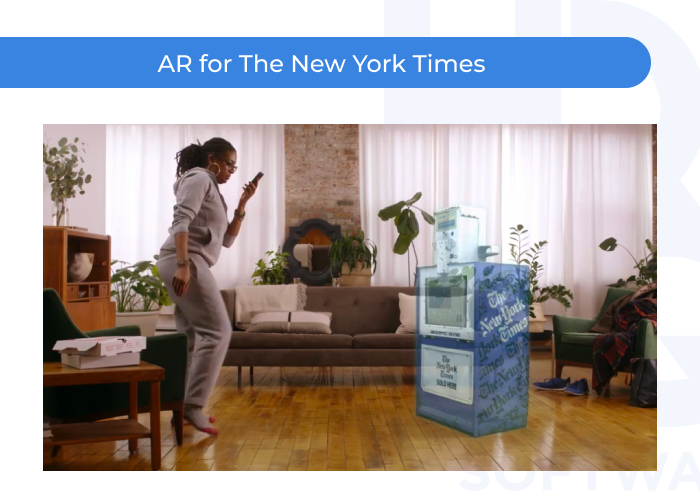
The New York Times has incorporated AR into its journalism, allowing readers to explore 3D models of news events. For example, readers could scan an article about space exploration to see a 3D model of a rocket or scan a picture of an old-fashioned newspaper booth to watch vintage footage of newspaper vendors from the 1950s selling papers on busy street corners. This added depth to the storytelling and made complex topics easier to understand.
4. Hermes AR Magazine
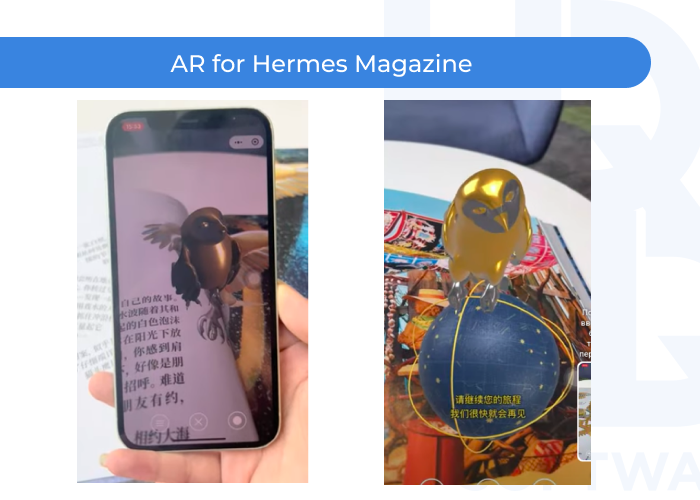
Hermes enhances its exclusive print publication, Le Monde d’Hermès, with a vibrant AR magazine. This interactive edition uses Augmented Reality to bring pages to life with flying owls, surfboards, dancing figures, and planetary models. By simply scanning the pages with their devices, readers can witness Hermès’ renowned craftsmanship presented through captivating 3D models and digital elements, creating a truly immersive and innovative reading journey.
5. Lego’s AR Magazine Ads
Lego used AR in magazine ads to let kids interact with virtual Lego sets. By scanning an ad, children could see a 3D model of a Lego set they could rotate, zoom in on, and even “build” virtually. This not only made the ads more fun but also helped kids visualize the sets before asking their parents to buy them, driving sales and engagement.
Common Challenges of AR and How to Overcome Them
While the use cases demonstrate AR’s impact, many brands stumble over technical and workflow issues. As a software development company that has delivered numerous AR/VR projects, we’ve pinpointed the toughest challenges and some proven strategies for overcoming each one.
1. Low Scan Success Rate
Challenge. QR codes or image‑recognition markers can be hard to read on glossy, creased, or low‑contrast pages. This can lead to frustrated users and abandoned experiences.
How to overcome it. Use high‑contrast, printer‑friendly markers that are at least 1 inch wide, place them on flat, uncluttered areas, and test them on multiple devices and lighting conditions before final print. Provide a short “how‑to-scan” graphic on the page to guide readers.
2. Performance and Device Compatibility
Challenge. Heavy 3D models, video, or animation can cause lag, long load times, or crashes on older smartphones, reducing engagement.
How to overcome it. Optimize assets with mesh reduction, texture compression, and progressive streaming; detect the user’s device and serve a lightweight fallback (for example, 2D animation) when needed. Use WebAR standards that work across iOS, Android, and desktop browsers without requiring a separate app.
3. Lack of Measurable ROI
Challenge. Traditional print offers no real‑time data, making it hard for advertisers and publishers to prove the value of AR campaigns.
How to overcome it. Integrate an analytics layer that tracks scans, dwell time, interaction heat‑maps, click‑throughs to eCommerce, and geographic data. Provide dashboards and post‑campaign reports so brands can see concrete performance metrics and optimize future placements.
4. Content Management and Updates
Challenge. Once a magazine is printed, the AR experience is locked in; any product change, price update, or new promotion would require a reprint.
How to overcome it. Build the AR experience on a cloud‑based CMS that separates the trigger (QR code or image) from the linked content. This lets marketers update 3D models, colors, pricing, or add new interactive layers instantly, extending the lifespan of the printed piece without additional printing costs.
As we tackle the current hurdles involved in deploying AR, it’s clear that the printing industry is on the brink of a great boost. Here’s what the future holds for Augmented Reality in print media.
Future of Augmented Reality in the Printing Industry
AR is growing fast. The market was worth $22 billion in 2024 and is expected to hit $96 billion by 2029. This rapid growth is changing publishing, turning AR from a cool gimmick into a must-have tool for engaging readers.
Thanks to faster internet and better smartphones, delivering AR experiences is now cheaper and easier. Publishers can add interactive product demos, immersive stories, and instant “buy now” links to printed pages, turning them into powerful sales tools.
In short, cheaper tech, faster networks, and smarter tools are making AR a standard part of print media. But what’s coming next? Here is what numerous studies say:
Artificial Intelligence (AI)-created 3D assets. Generative AI programs can spin out realistic product models in minutes instead of weeks. That means a fashion brand can instantly show a dress in several colors, or a furniture maker can let readers place a virtual sofa in their own living room without hiring a 3D artist for each variation.
5G makes it smoother. With faster, low‑latency 5G connections, heavy video or high‑resolution 360° tours load instantly on most smartphones. Readers won’t have to wait for a spinning wheel; the experience feels as natural as watching a short video.
Hybrid print‑digital subscriptions. Magazines are bundling AR content with their digital editions. Subscribers get exclusive behind‑the‑scenes videos, interactive quizzes, and direct links to purchase featured items, which boosts loyalty and reduces churn.
Standardized markers. Industry groups are agreeing on simple, high‑contrast QR‑style markers that work on glossy, creased, or even recycled paper. This makes it easier for designers and printers to add AR without a custom engineering effort for every issue.
In essence, Augmented Reality is breathing new life into the world of print media. By seamlessly merging the physical page with dynamic digital content, AR transforms passive reading into an engaging, interactive journey. AR not only makes stories more engaging, it also creates fresh ways to sell and interact, showing that AR is a key driver of print’s future.
Contact us to explore how AR can improve your print media today.
A developer with extensive expertise in AR/VR, very ingrained into the topic of Mixed Reality development. Shares his knowledge and the results of many years of work.
How Does AR Work With Printed Pages (QR Codes vs. Image Recognition)?
AR works with printed pages in two ways. QR codes are square barcodes you scan with your phone to trigger AR content instantly. Image recognition lets your phone camera identify specific pictures or logos on the page, then adds digital content on top. QR codes work faster, while image recognition feels more natural.
How Should We Design Pages to Be “Scannable”?
Make pages clean and simple, with high contrast between text and background. Place QR codes in obvious spots with enough white space around them. For image recognition, use bold, unique pictures or logos that stand out clearly. Avoid cluttered designs, small text, or busy patterns that confuse cameras and make scanning difficult.
How Much Does It Cost to Add AR to a Print Issue?
The cost depends on various factors, such as how complex the AR experience is, whether you use simple QR codes or advanced image recognition, how many AR features you want, and whether you build an app or use web-based AR. Simple experiences cost less, while interactive games or detailed 3D models require bigger budgets.
What Are the Most Effective AR Use Cases for Magazines, Catalogs, and Newspapers?
The best AR uses include:
product try-ons in fashion catalogs;
3D models of furniture or cars;
video news clips in newspapers;
interactive recipes in food magazines;
behind-the-scenes content.
Catalogs benefit from virtual fitting rooms and live price updates, while magazines can add games, quizzes, and extra photos that bring stories to life.
Do Readers Need an App, or Can It Run in the Browser (WebAR)?
Both options work. WebAR runs directly in phone browsers without downloading anything, making it easier for readers to use instantly. However, apps often provide better AR quality, faster loading, and more advanced features. WebAR is great for simple experiences, while complex AR interactions work better with dedicated apps that readers download first.
We are open to seeing your business needs and determining the best solution. Complete this form, and receive a free personalized proposal from your dedicated manager.