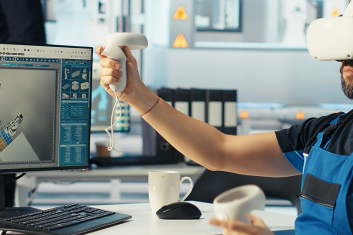
The pharmaceutical industry is a complicated field, dealing with long research and development cycles, complex production lines, and heavy regulatory burdens. What might become easier if scientists, clinicians, and manufacturing teams could see invisible data projected over the real world? For instance, molecular models hovering above lab benches, step-by-step assembly instructions projected onto equipment, and remote experts guiding technicians in real-time? By visually layering digital data over physical objects and tasks, Augmented Reality (AR) solutions can help tighten compliance, lower operational risks, and shorten time-to-market.
Below, we’ll review some AR use cases and real examples that show how this technology is transforming from a novelty to a practical must-have feature in pharma.
AR offers significant advantages in the pharmaceutical industry. Before exploring them in depth, let’s clarify what AR in pharma entails.
Augmented Reality means overlaying digital 3D models, step‑by‑step instructions, annotations, or live data on top of the real world to help people do their jobs better. It’s used on smartphones, tablets, and headsets—for instance, HoloLens or other smart glasses.
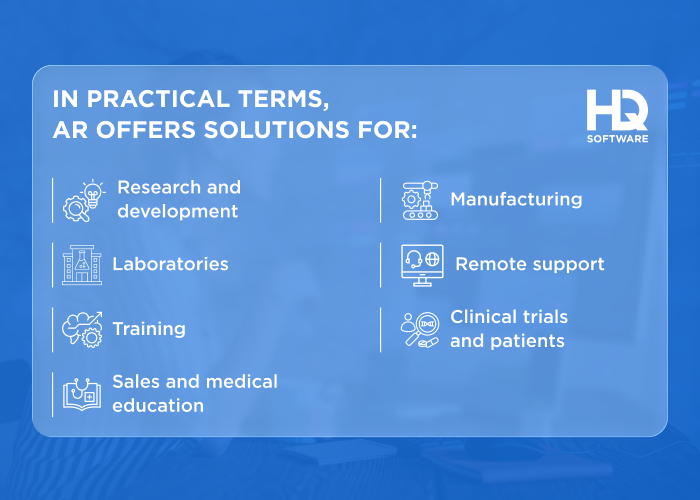
In practical terms, AR offers solutions for:
Research and development: interactive 3D molecular and structure visualization;
Laboratories: immersive 3D visualizations speed molecular design and hypothesis testing;
Manufacturing: AR-guided standard operating procedures (SOPs); assembly/maintenance overlays, and barcode recognition;
Remote support: experts annotate equipment live to troubleshoot issues;
Training: simulated procedures and hands‑on onboarding;
Clinical trials and patients: eConsent, adherence coaching, injection training;
Sales and medical education: virtual product demonstrations, interactive drug packaging.
Now let’s consider what benefits you can gain by implementing AR in your pharma business. For your convenience, we’ve presented them in a table.
Benefit
Description
Reduced manufacturing and compounding errors
AR technology provides visual prompts, checklists and tolerance overlays during production to prevent missteps and misreads.
Lower operational costs and faster time‑to‑market
By cutting training time, downtime and error rates, AR reduces recurring operational expenses across the business.
More reliable quality control and inspections
AR highlights defects, overlays acceptance criteria and guides inspectors through standardized checks.
Streamlined supply chain and warehouse operations
AR‑guided picking, inventory overlays and visual recall workflows reduce human error and speed logistics tasks.
Faster, safer training and onboarding
AR overlays instructions and simulations directly in the trainee’s field of view, allowing hands‑free learning on the job.
Faster and clearer research
AR lets researchers explore molecular models, pathways and datasets in 3D, making complex relationships easier to understand.
Remote expert support and faster troubleshooting
With AR‑enabled live video and on‑screen annotations, on‑site staff can receive real‑time guidance from remote specialists as if they were next to them.
These benefits are real and already transforming pharmaceutical companies around the world. In the next section we’ll look at the specific ways AR is being used in manufacturing and research to achieve these results.
Need a custom software solution? We’re ready to help!
Hymux Technologies has a team of skilled professionals ready to tackle the project. Ask me!
In pharmaceutical manufacturing, AR turns ordinary workspaces into high-tech environments where workers receive visual instructions directly on their AR glasses or tablets. There are two practical uses below.
AR for Guidance in Pharmaceutical Manufacturing
AR is changing the factory floor, making it a smarter, safer, and more efficient workspace. Using AR glasses or tablets, workers can see visual instructions overlaid directly onto machinery: which valve to turn, which sensor to calibrate, or where a potential fault might be hiding. All this is possible without flipping through manuals or pausing production.
AR for Faster Training and Knowledge Transfer
AR technology speeds up training by placing clear guidance and 3D demonstrations right where the work happens: on machines, in cleanrooms, or at the lab bench. Trainees can visualize hidden parts, rehearse rare failure scenarios in safe simulations, and replay expert walkthroughs. Remote specialists can annotate a live feed to coach in real time. Integrated assessments, digital signoffs, and LMS links let managers track competency and ensure compliance, while reusable AR lessons capture institutional know‑how.
Example: Pfizer taps into the metaverse and AR to reimagine how it trains teams and collaborates across borders without anyone needing to leave their desk. As highlighted in itsinformation security manual(ISM) guide’s feature, Pfizer has built immersive environments where employees can use AR-enabled devices to walk through digital replicas of labs and manufacturing facilities, or join global meetings as avatars in 3D spaces.
Credit: Cassette Group
2. AR in Quality Control and Compliance
AR technology transforms tedious inspection processes into precise, automated workflows where inspectors can instantly detect defects and verify regulatory standards through enhanced visual overlays. Here are two practical examples.
AR for Lab Workflow Optimization
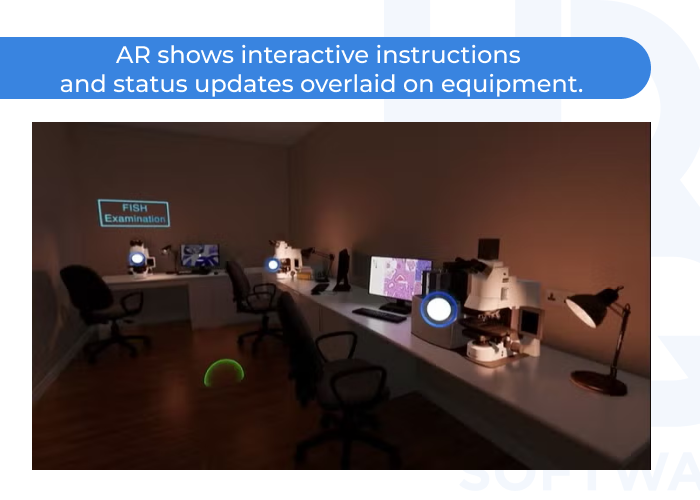
With AR, lab technicians can see real-time instructions overlaid on equipment, guiding them through SOPs for various tasks. For example, sample preparation, equipment calibration, or sterility testing. During microbiological analysis, AR can highlight specific petri dishes that require inspection, display countdown timers for incubation periods, and flag anomalies in colony growth patterns.
Additionally, AR technology integrates seamlessly with laboratory information management systems (LIMS) and enterprise resource planning (ERP) systems. This ensures that every action, from sample logging to final quality control sign-off, is digitally logged, tracked, and compliant with regulatory frameworks. Technicians can also scan QR codes on reagents or instruments to instantly access certificates of analysis or maintenance histories.
Virtual Molecule Visualization
Traditionally, scientists and quality inspectors rely on 2D diagrams or complex 3D software to analyze molecular structures. This often leads to misinterpretations or overlooked defects. AR changes this by superimposing interactive 3D molecular models directly onto lab equipment, samples, or documentation via smart glasses or tablets. For instance, during quality checks of chemical compounds, AR overlays the ideal molecular blueprint onto the real sample, spotting errors in bonds or purity.
Example: Using tools like MoleculARweb, researchers can load protein data bank (PDB) models into a browser‑based AR viewer and see molecules as if they were right in front of them. They can examine structures from every angle to better understand how ligands bind or how small changes alter function.
3. AR in Healthcare Professional Support
When healthcare providers have questions about drug administration or encounter rare side effects, AR connects them instantly with pharmaceutical experts. The remote specialist sees exactly what the doctor sees and can draw instructions or highlight concerns directly in their field of view.
Another application involves sales representatives. Instead of carrying heavy sample cases, pharma reps now use tablets to display life-sized 3D models of medical devices to doctors, demonstrating how drugs work inside the body. Additionally, pharma representatives use AR for drug packaging, offering enhanced information and interactive experiences.
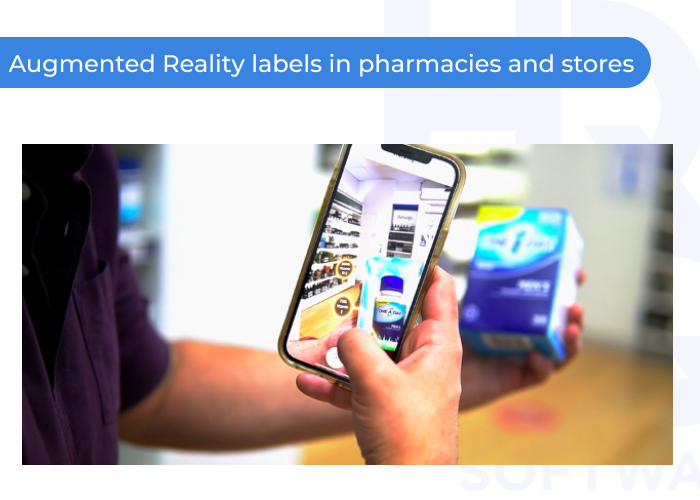
Example: Bayer Pharmaceuticals leverages AR for global scientific exchanges. At conferences, visitors scan Bayer booths or posters to unlock 3D drug models, clinical trial data visualizations, and expert-led AR discussions. In pharmacies and stores, individuals can use Augmented Reality to read detailed product information, identify medications, and receive instructions on their use.
Credit: The Medical Futurist
4. AR in Drug Discovery and Research
AR technology turns lab benches and meeting rooms into immersive workspaces where scientists can interact with 3D molecular models, overlay experimental data, and run virtual simulations using headsets or tablets. Here are two key applications.
AR Overlays for Regulatory Documentation When Researching
Researchers can utilize AR to visualize intricate molecular structures and interactions, gaining a deeper understanding of disease mechanisms. Additionally, virtual clinical trials can test new drugs safely without risking patient health. Virtual trials can speed up drug discovery, leading to faster and more efficient new treatments.
Drug Formulation
During drug formulation, AR guides technicians, ensuring every vial is filled with precise milliliter amounts, every label is barcode-scanned for authenticity, and every batch is mixed according to validated protocols. For instance, when assembling complex drug delivery systems (such as autoinjectors or inhalers), AR highlights specific components in 3D, animates assembly sequences, and flags mismatched parts.
Moreover, AR integrates with manufacturing execution systems (MES) and quality management systems (QMS). So, it automatically logs every action, deviation, and correction for full traceability.
Example: In Saudi Arabia, Badir Pharmaceuticals employs AR for cancer care. They’re using AR to design personalized cancer drugs for each patient. By seeing a patient’s genes in 3D, scientists create treatments that fit perfectly: fewer side effects, better results.
Considering custom software?
Hymux Technologies’s team of experts can design and develop the perfect solution for your business. Let’s discuss it
Custom Augmented Reality Solutions by Hymux Technologies
At Hymux Technologies, we build custom AR solutions for pharma that solve real operational, clinical, and commercial problems. For example, we built an AR drug‑label solution to make medication handling safer and easier for pharmacists and patients. Our solution allows patients to simply scan their prescription bottle with a smartphone to see interactive 3D visualizations showing exactly how and when to take their medication.
The AR overlay displays pill identification, demonstrates proper dosing with animated instructions, and shows potential drug interactions with their other medications in real time. For patients with impaired vision, large text appears with audio instructions in the patient’s preferred language.
Explore our portfolio to discover our other AR solutions.
Below are our key offerings:
AR instructions for shop‑floor workflows. We create AR overlays that guide operators through manufacturing, QC, and lab procedures with visual cues, timers, and contextual checklists.
Remote expert assistance and live annotation. We deliver live‑assist apps for smart glasses and tablets so off‑site experts can annotate an operator’s view, guide repairs, or validate steps in real time.
AR drug labels and smart packaging. We build mobile AR experiences that scan serialization/QR codes and overlay dosing, lot/expiry, safety warnings, and interactive device demos directly on the pack.
Immersive training and competency simulations. We design hands-on AR simulations and stepwise drills for onboarding, emergency scenarios, and periodic competency checks.
Digital twins and process visualization. We build AR‑accessible digital twins of equipment and lines so engineers can visualize sensor data, flows, and failure modes in context.
Integration, AI analytics and dashboards. We connect AR events and audit logs to LIMS/MES/ERP and expose KPIs (time saved, error reduction, cost avoidance) in executive dashboards.
These metrics support pilots, ROI validation, and phased rollouts across sites. As you see, AR can truly improve pharma operations, but rolling it out brings real technical, regulatory, and adoption hurdles. Next, we’ll walk you through those challenges and show how Hymux Technologies solves them.
Challenges and Limitations for AR in Pharma
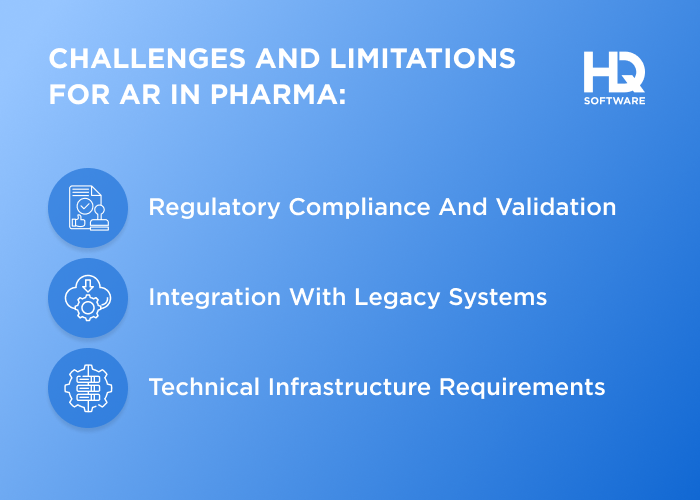
AR technology promises big gains for pharma. However, below are the main obstacles organizations face when moving from pilots to production-ready systems:
Regulatory compliance and validation. Pharmaceutical AR applications must meet strict regulatory requirements. Every system needs extensive validation, documentation, and proof it won’t compromise product quality or patient safety. This validation process can take 6-12 months and cost millions.
Integration with legacy systems. Most pharma companies run on decades-old ERP, LIMS, and MES systems that weren’t designed for AR integration. Creating bridges between AR and these systems without disrupting validated processes is extremely complex.
Technical infrastructure requirements. AR demands robust WiFi, low latency networks, and significant computing power. Many pharmaceutical facilities, especially older manufacturing plants, lack this infrastructure. Sterile environments add complexity with special equipment requirements.
Overall, as the technology gets cheaper and regulators become more comfortable with it, we’re getting close to a point where AR will be everywhere in pharma. Let’s look at what’s coming in the next few years.
Future of Augmented Reality in Pharmaceutical Industry
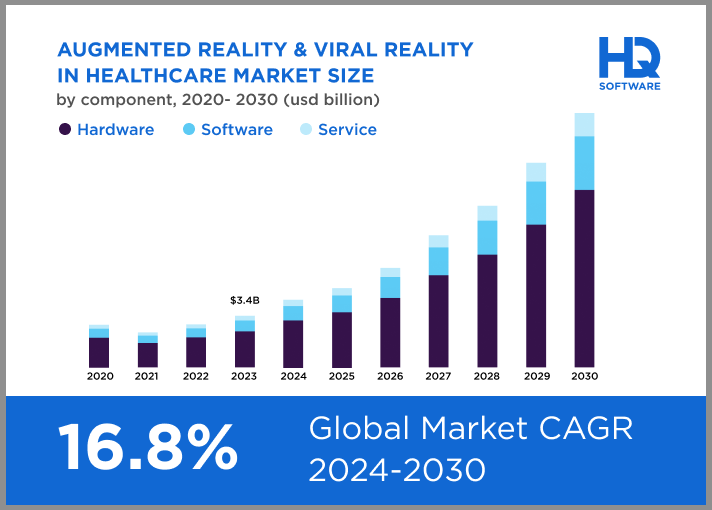
Where is AR making waves right now, and what are emerging trends to watch? A report by Grand View Research says the global AR market in healthcare was worth $3.4 billion in 2023 and is expected to grow by about 16.8% each year from 2024 to 2030. According to MarketsandMarkets, pharma is expected to make up almost 30% of the healthcare AR market by 2027.
Why is there such explosive growth? Because pharma executives are finally seeing ROI beyond the hype:
74% of life sciences companies surveyed by PwC said they’re actively piloting or scaling AR/VR solutions;
A Deloitte study found that AR training reduced onboarding time for medical reps by 40% and improved knowledge retention by 75%;
In clinical trials, AR-assisted patient education tools have shown a 30% increase in adherence and comprehension, according to research published in JMIR Medical Education.
Looking ahead, the integration of AR with other emerging technologies such as AI, Internet of Things (IoT), and 5G connectivity will unlock even greater potential. For instance:
AI-powered AR could provide real-time analytics and predictive insights during drug formulation or patient monitoring.
IoT-enabled AR devices might track environmental conditions in manufacturing plants, alerting operators to deviations instantly.
5G networks will ensure seamless, low-latency AR experiences, critical for remote collaboration and telemedicine.
In summary, AR has a bright future in the pharmaceutical industry, one full of promise. With robust growth projections and new applications on the horizon, AR is becoming an important technology that will lead the future of pharma innovation.
Pharmaceutical companies that use AR now will probably get ahead by working faster, saving money, and improving things for their workers and patients.
Contact our team to dive deeper into our development services and see how AR can solve your biggest pharmaceutical challenges.
A developer with extensive expertise in AR/VR, very ingrained into the topic of Mixed Reality development. Shares his knowledge and the results of many years of work.
Pharmacies use AR technology to show customers drug interactions visually and help them find products through indoor navigation. AR apps help patients identify pills, remember doses, and see 3D animations of how medicines work inside their bodies. By scanning packages, patients access medication details instantly. Pharmacists wear AR glasses for hands-free prescription checking and inventory tracking.
How Does AR Support Regulatory Compliance in Pharmaceuticals?
AR ensures regulatory compliance by providing real-time documentation of every manufacturing step, creating automatic audit trails for FDA inspections. Workers receive instant alerts about GMP violations, proper procedures, and safety protocols. AR systems validate correct equipment cleaning, track batch records digitally, and guide staff through compliance procedures, reducing human error and regulatory risks.
Are There Real Examples of Pharma Companies Successfully Using AR?
Yes, major pharma companies are already seeing results. Pfizer uses AR for equipment maintenance and training. Novartis employs Microsoft HoloLens for lab research and remote assistance. GSK uses AR for manufacturing quality control, while Boehringer Ingelheim uses AR for virtual drug molecule visualization.
What Is the Difference between AR and VR in Pharmaceutical Applications?
AR overlays digital information onto the real pharmaceutical environment — workers see actual equipment with digital instructions added. VR creates completely virtual worlds requiring headsets that block reality. AR lets technicians repair real machines with guided overlays, while VR simulates entire cleanrooms for training. AR enhances reality; VR replaces it entirely.
We are open to seeing your business needs and determining the best solution. Complete this form, and receive a free personalized proposal from your dedicated manager.