As healthcare delivery becomes more complex, traditional management approaches often fall short when it comes to identifying inefficiencies and optimizing medical resources. Here, data analytics emerges as a powerful solution to these challenges.
By using hospital data analytics, organizations can uncover hidden patterns in patient care, predict readmission risks, optimize staffing levels, and identify cost-saving opportunities without compromising quality. From emergency department flow optimization to chronic disease management, analytics enables evidence-based decision-making across all levels of care delivery.
In this article, we’ll explore what practical strategies healthcare organizations can use to transform their raw data into a strategic asset.
At Hymux Technologies, we understand that every data point represents a real patient journey, and each analytical insight can enhance care delivery and save lives. This is why we empower healthcare providers with intelligent solutions through tailored data analytics platforms. But how exactly does data analysis happen? Let’s take a closer look at the process and its impact.
Data analytics in healthcare involves collecting and analyzing complex sets of health-related information to uncover trends, patterns, and key insights on various medical aspects. Healthcare data can be gathered from many sources, including:
Electronic health records (EHRs)
Government health programs
State assistance programs
Lab test results
Surveys from patients and providers
Insurance claims (medical and pharmacy)
Social media and lifestyle tracking data
Then Artificial Intelligence (AI), Machine Learning (ML), and statistics help sort through massive amounts of data. Combined with smart dashboards and visualization tools, these technologies turn raw numbers into clear information.
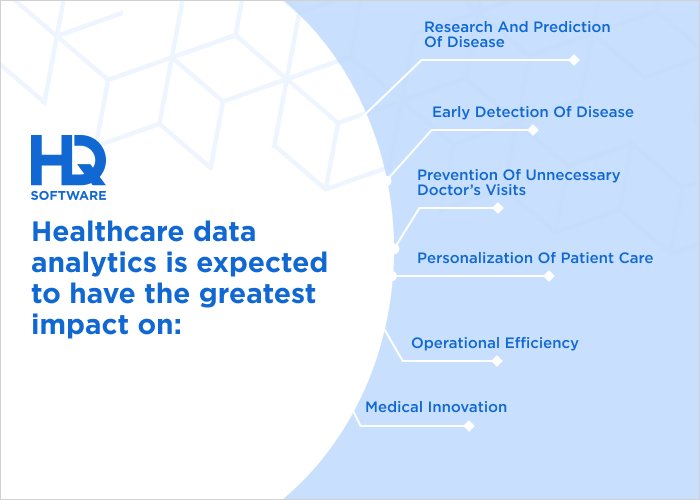
In healthcare, data analytics has the greatest impact on:
Research and prediction of disease: Analyzing large datasets can help you spot patterns and risk factors for diseases, leading to earlier predictions and more targeted research.
Early detection of disease: Identifying subtle indicators in patient data can enable earlier diagnosis and intervention.
Prevention of unnecessary doctor’s visits: Predictive analytics can find at-risk patients early to reduce costly medical visits.
Personalization of patient care: Understanding individual patient data allows for tailored treatment plans.
Operational efficiency: Using AI, hospitals can automate administrative processes, generate accurate health insurance rates, and more effectively share patient data.
Medical Innovation: Analyzing numerous types of historical and current data can help in discovery of new drugs.
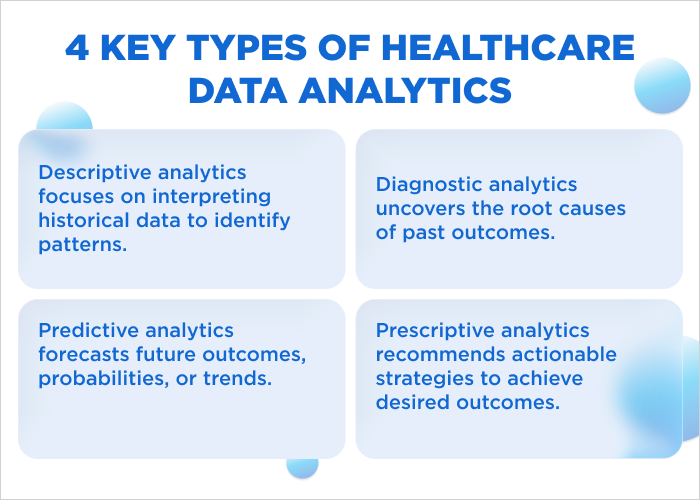
4 Key Types of Healthcare Data Analytics
Just as natural resources need to be extracted and processed to be of use, raw digital data must also be cleaned and transformed to become valuable. However, in healthcare, data analytics takes many forms. Let’s look at some of them.
Descriptive Analytics
Descriptive analytics focuses on summarizing and interpreting historical data to identify patterns and trends. It provides a clear understanding of what has happened in the past. It answers questions like “What happened?” or “What is the current state?” by aggregating raw data, often through reports, dashboards, or visualizations.
Example in healthcare: A hospital can, for example, analyze past patient data to find the main reasons for emergency room (ER) visits last year. By aggregating data on diagnoses, admission times, and patient demographics, the hospital can generate dashboards showing peak admission periods, frequent conditions (flu, injuries, etc.), and average wait times. This helps to improve staffing of nurses during high-traffic hours or stocking of specific medications in advance.
Diagnostic Analytics
Diagnostic analytics delves deeper into historical data to uncover the root causes of past outcomes, answering the question “Why did it happen?”. It identifies anomalies that may help explain specific events or trends. Unlike descriptive analytics, which merely summarizes data, diagnostic analytics contextualizes findings to reveal underlying factors.
Example in healthcare: A hospital might notice that infection rates rose after switching to a new supplier of surgical tools. Diagnostic analytics could reveal that sterilization cycles for these tools were insufficient, leading to bacterial contamination. By adjusting sterilization protocols or changing suppliers, the hospital prevents future infections.
Predictive Analytics
Predictive analytics uses historical data, statistical modeling, and ML techniques to forecast future outcomes, probabilities, or trends. By identifying patterns in past data, it answers the question “What is likely to happen?” and so enables organizations to anticipate events such as patient behavior, equipment failures, or operational shifts.
Example in healthcare: A hospital might use predictive models to identify patients at high risk of developing sepsis. By analyzing EHRs for patterns such as vital signs, lab results, and infection rates, ML algorithms can flag patients who exhibit early warning signs. This early detection allows clinicians to intervene before symptoms worsen, reducing complications and improving survival rates.
Prescriptive Analytics
Prescriptive analytics recommends strategies to achieve desired outcomes by leveraging historical data, predictive models, and optimization techniques. It evaluates the potential impact of decisions, considering constraints, risks, and opportunities, answering the question “What should we do?”. Methods such as simulation, ML, and decision trees enable organizations to automate decisions or guide human choices effectively.
Example in healthcare: A hospital emergency department might use prescriptive analytics to optimize patient flow during flu season. The system analyzes historical admission patterns, current bed occupancy, staffing levels, and predicted patient volumes to recommend specific actions. For instance, reassign two nurses from the medical ward to the ER at 3 p.m., open overflow beds in wing B, and divert non-critical cases to nearby urgent care centers.
Need a custom software solution? We’re ready to help!
Hymux Technologies has a team of skilled professionals ready to tackle the project. Ask me!
Healthcare Data Analytics Solutions With Hymux Technologies
At Hymux Technologies, we understand that each healthcare organization faces unique data analytics challenges every day. That’s why we don’t offer one-size-fits-all solutions. Instead, we work closely with our clients to understand their specific needs, whether they’re struggling with patient flow bottlenecks or seeking to reduce readmission rates.
Healthcare analytics strategy and consulting. We work closely with our clients to define clear business objectives and create a detailed roadmap for their project. Our experts help to identify KPIs and select the right technologies to turn raw data into a strategic asset.
Custom healthcare analytics platform development. For unique challenges that off-the-shelf software can’t solve, we design and develop custom data analytics platforms tailored to your specific workflows.
Data integration and warehousing. Our developers break down data by securely aggregating information from EHRs, the laboratory’s information system (LIS), billing systems, and wearable devices into a unified data warehouse. This creates a single source for reliable analysis across your organization.
Predictive analytics. Webuild and deploy custom ML models to forecast patient risk scores, predict disease outbreaks, and optimize resource allocation. These powerful models empower you to shift from reactive decision-making to proactive care.
To protect sensitive data, we build every solution to be fully compliant with healthcare regulations. Our approach safeguards patient information while enabling powerful data analytics.
What Are Some Applications of Big Data in Healthcare?
Driven by the need for smarter solutions for value-based care, AI-powered diagnostics, and digitized insurance, the healthcare data analytics market is poised for remarkable growth. It is forecast to surge from $57.16 billion in 2025 to $160.39 billion by 2030, a trend fueled by its diverse applications across the healthcare ecosystem.
To see this technology in action, let’s examine some practical applications and some of Hymux Technologies’s solutions that are already making a difference. To see more examples of our healthcare innovations in practice you can explore our portfolio.
Predictive Analytics for Risk Scoring
By analyzing thousands of variables, Big Data models can assign risk scores to patients, identifying those most likely to be readmitted to the hospital, develop chronic conditions (like diabetes or heart failure), or experience a sudden decline in health. This information helps doctors provide early care for high-risk patients, improving their health and preventing expensive emergency visits.
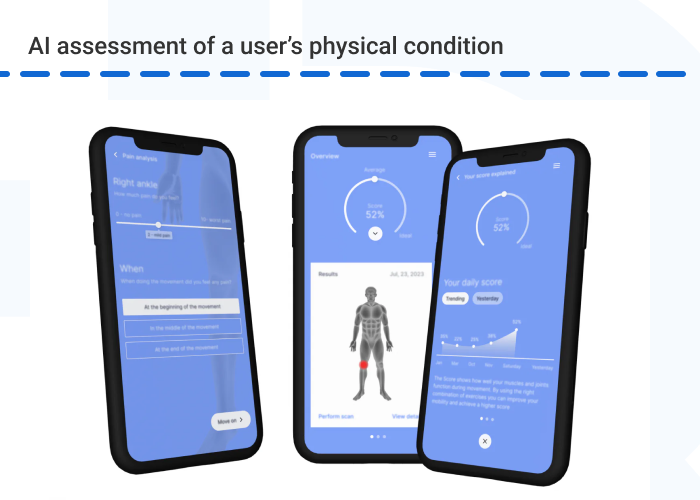
At Hymux Technologies, we’ve developed a mobile app featuring AI-driven analysis of body movements to assess functional disorders and mobility capabilities.The app uses a phone’s camera to record a user performing exercises. AI algorithms, using computer vision models, process these frames to identify and track the position of the user’s key body joints (e.g., shoulders, hips, knees, ankles).
Once the initial analysis identifies a user’s specific weaknesses (the “what”), the system uses another layer of data analytics to determine the solution (the “how”). It applies AI logic, combined with principles of “neural athletics and exercise science,” to map the identified movement flaws to a database of corrective exercises. If the results show areas of concern, a person can easily connect with a specialist for personalized advice.
Personalized Medicine
Personalized medicine uses Big Data to create treatments tailored for each person instead of a one-size-fits-all approach.This involves integrating diverse data types, including genomics, proteomics, lifestyle factors gathered from wearable sensors, and a detailed medical history. So, doctors can predict an individual’s susceptibility to certain diseases, determine how they might respond to specific treatments (particularly in oncology), and develop customized prevention strategies that are more effective than generalized care plans.
Clinical Decision Support (CDS) and Telemedicine
CDS and telemedicine solutions use Big Data to provide healthcare professionals with evidence-based recommendations and alerts at the point of care. By analyzing vast amounts of patient data, systems can help clinicians make more accurate diagnoses, suggest appropriate treatments, and reduce medical errors. These systems can also identify potential drug interactions, allergies, and other critical information.
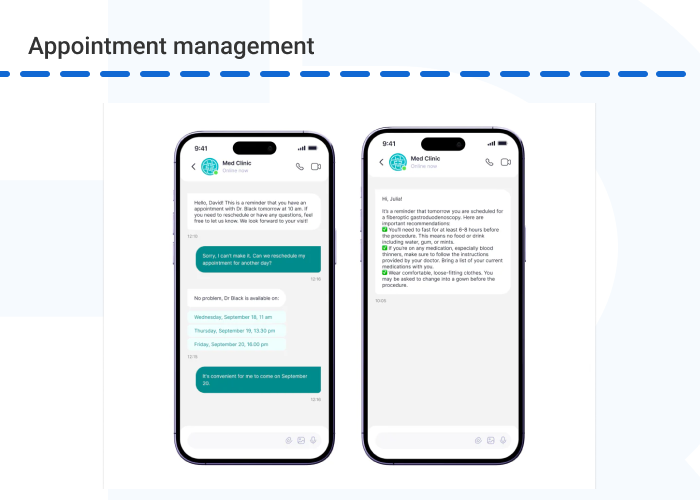
An AI-powered chatbot by Hymux Technologies integrates seamlessly with the clinic’s existing systems and analyzes real-time data. For example, to book an appointment, it analyzes the clinic’s scheduling database for open slots, doctor availability, and appointment types. For prescription reminders, it analyzes patient records to identify refill dates and medication schedules. The system also tracks metrics such as the number of incoming phone calls, the time taken to resolve a query, and the number of tasks handled by the chatbot compared to human staff.
Population Health Management (PHM)
PHM focuses on improving the health outcomes of a defined group of individuals by identifying trends and gaps in care. Big Data analytics allows public health officials and healthcare systems to aggregate and analyze information from disparate sources, such as EHRs, insurance claims, and socio-economic data. This enables organizations to:
Identify at-risk communities
Track the spread of infectious diseases
Manage chronic conditions proactively across a large demographic
Allocate public health resources more effectively to areas with the greatest need
Fraud Detection and Billing Accuracy
The sheer volume of healthcare transactions makes identifying fraud, waste, and abuse a significant challenge, but Big Data analytics provides a powerful solution. ML algorithms can sift through millions of claims and billing records to detect anomalies and patterns that indicate fraudulent activity, such as “upcoding” (billing for more expensive services than performed), billing for services not rendered, or unbundling procedures. By identifying these irregularities in near real time, Big Data helps insurance providers and government agencies prevent improper payments, recover funds, and ensure compliance.
Operational Analytics
Big Data is crucial for improving the efficiency and cost-effectiveness of healthcare administration and logistics. Hospitals and clinics generate vast amounts of operational data related to admissions, staffing, patient flow, and supply chain management. By analyzing this data, administrators can optimize emergency room wait times, predict admission rates, ensure ideal staffing levels, manage inventory of medications and equipment, and reduce appointment no-shows.
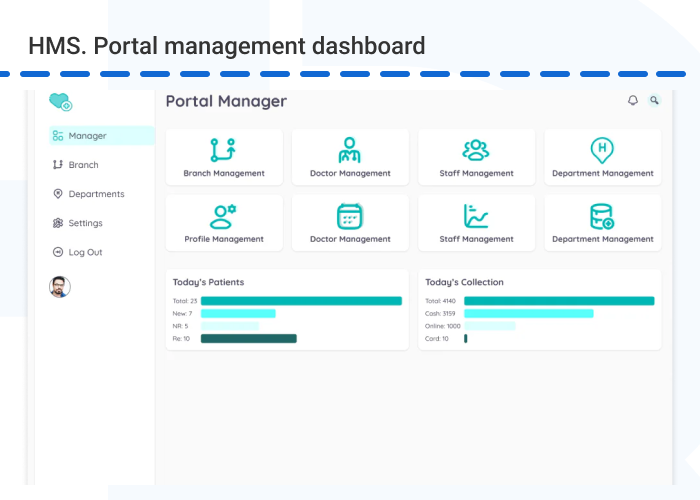
One example is the hospital management system that uses ML algorithms to analyze historical data and identify patterns. It includes:
Early detection of at-risk patients: The system analyzes data from patient records such as vitals, labs, and history to identify who is at high risk for developing complications, allowing for early intervention.
Predictive scheduling: By analyzing past appointment data, seasonal trends, and doctor availability, the system optimizes future appointment bookings to minimize wait times and maximize resource use.
Optimizing resource allocation: The system can forecast demand for beds, staff, and supplies, helping administrators plan more effectively.
After predicting an outcome, the system can recommend a specific action. For example, if a patient is flagged as “at-risk,” the system might automatically generate an alert for a nurse to perform a specific check. Or when the inventory module predicts a shortage of a critical supply, it can automatically trigger a reorder request.
So far, we have reviewed the foundational applications of data analytics in medicine. Next, we’ll look at the specific benefits of putting this technology into practice in your organization.
The Benefits of Data Analytics in Healthcare
Improved Diagnostics
Perhaps one of the most important benefits of data analytics is its ability to improve diagnostic accuracy and speed. AI algorithms can be trained on vast datasets of medical images such as X-rays, MRIs, and CT scans to identify subtle signs of disease. These could be cancerous tumors or early indicators of neurological disorders, often with a level of precision that surpasses the human eye.
Beyond imaging, analytics can sift through a patient’s symptoms, lab results, and genetic information, comparing them against millions of case files to help diagnose rare diseases that might otherwise be missed.
Minimized Medical Errors
By analyzing a patient’s complete EHR, AI algorithms can automatically flag potential issues before they cause harm. For example, clinical decision support systems can alert a physician to a potential adverse drug reaction by cross-referencing a new prescription with the patient’s known allergies and current medications. Similarly, predictive models can identify subtle patterns in vital signs that indicate a patient is at high risk for a condition like sepsis, prompting earlier intervention.
Reduced Costs
On the operational side, analytics can predict patient admission rates, allowing hospitals to schedule staff more efficiently and avoid costly overstaffing or understaffing. It also streamlines supply chain management by forecasting demand for expensive medical supplies, reducing waste.
Clinically, predictive analytics is crucial for identifying patients at high risk for readmission. By providing these patients with proactive, targeted follow-up care, hospitals can prevent costly return visits, which are often not fully reimbursed.
Enhanced Patient Experience
Data analytics helps shift the healthcare model from being reactive and impersonal to being proactive and patient-centric. On a more personal level, analytics makes it easier to create customized care plans and communication strategies tailored to an individual’s specific needs and preferences. For instance, data from wearable devices can be integrated into a patient’s record, allowing for continuous remote monitoring and proactive outreach from care teams.
Considering custom software?
Hymux Technologies’s team of experts can design and develop the perfect solution for your business. Let’s discuss it
Healthcare organizations must overcome two major hurdles when implementing Big Data solutions.
1. Data Security and Privacy
Healthcare data is extremely sensitive, so protecting it is a top legal and ethical duty. Laws like HIPAA have strict rules on how patient information is handled, and breaking them results in massive fines and reputational damage. Because Big Data involves so much information, it becomes a much larger and more attractive target for cyberattacks.
Hymux Technologies’s solution to overcome it: We fully encrypt data wherever it is (stored or moving) and use AI to monitor for suspicious activity. We enforce a “zero-trust” model, requiring strict verification for all access. We also implement multifactor authentication, use blockchain for secure sharing, and routinely test our defenses.
2. Data Integration and Interoperability
A patient’s health information is often siloed in several unconnected systems such as the hospital’s records, the doctor’s office, the lab, and the pharmacy. Because this data is stored in different formats and uses different codes, the systems can’t talk to one another. This makes it nearly impossible to get a complete view of a patient’s health, which is the essential first step for any useful data analysis.
Hymux Technologies’s solution to overcome it: We use standard data formats like HL7, FHIR and robust APIs to enable smooth data sharing. We deploy architectures that can translate different data formats and invest in systems to create unified patient identifiers and maintain data consistency. We also build data lakes to handle various data types while preserving relationships, and use middleware to connect older systems with modern data analytics platforms.
Future Trends in Data-Driven Healthcare
Healthcare is undergoing a profound improvement, driven by the exponential growth of data and the computational power to analyze it. The future of data-driven healthcare promises a shift from reactive treatment to proactive and preventative models of care.
After analyzing numerous studies, we’ve distilled the most significant five trends set to define the future of data-driven healthcare:
1. Descriptive analytics: With a 35.1% market share in 2024, descriptive analytics is the leading segment in healthcare analytics. Its primary function is to analyze historical data, including trends, demographics, and operational metrics, to inform critical decisions.
2. Generative AI and clinical automation: Generative AI, like large language models, will improve the administrative side of healthcare. These tools will be used to automate clinical documentation, summarize complex patient histories, draft patient communications, and manage insurance pre-authorizations.
3. Advanced data interoperability and “Data Fabric”: For data to be useful, it must be accessible. Today, the trend is all about moving away from siloed data storage (where data is trapped in specific departments or software) toward a unified “data fabric” architecture. This architecture connects data across disparate systems in real time.
4. The Rise of the Internet of Medical Things (IoMT):IoMT will create a continuous stream of real-time patient data. This moves monitoring beyond the clinic walls and into patients’ daily lives. Future healthcare will use this data to manage chronic conditions, such as continuous glucose monitoring for diabetes; track post-operative recovery remotely; and alert providers to potential health crises before they become acute.
Data analytics is becoming the core of how modern healthcare works. Its real power is in turning raw data into better outcomes for patients: safer treatments, earlier diagnoses, and more personalized care. As this technology improves, it promises a future where you can make smarter decisions and give every one of your patients the best possible care.
Contact us to know more about our healthcare software development services.
An experienced developer with a passion for IoT. Having participated in more than 20 Internet of Things projects, shares tips and tricks on connected software development.
Data analytics in healthcare improves diagnostics, predicts disease trends, optimizes operations, and personalizes treatments. By analyzing patient data, hospitals enhance efficiency, reduce costs, and deliver better care. All this makes healthcare smarter, faster, and more precise.
What Is an Example of Data Analytics in Healthcare?
A prime example is predictive analytics in hospitals. By analyzing patient records, labs, and vitals, AI identifies high-risk patients for conditions like sepsis or readmissions. This allows early intervention, reduces complications and lowers costs, while improving outcomes.
What Tools and Technologies Are Used in Healthcare Data Analytics?
Healthcare data analytics leverages AI/ML, predictive modeling, and Big Data platforms like Hadoop and Spark. Tools include EHR analytics, NLP for clinical notes, and visualization software (Tableau, Power BI). Cloud computing and IoT devices enable real-time insights, improving diagnostics, operations, and personalized care.
What Role Does AI Play in Healthcare Analytics?
AI identifies patterns in vast medical datasets, predicts disease risks, optimizes treatment plans, and detects anomalies in imaging. It enables personalized medicine, accelerates drug discovery, improves diagnostic accuracy, and helps healthcare systems allocate resources efficiently.
Build a smarter way to train with a custom Learning Management System. We combine modern eLearning features, seamless integrations, and scalable architecture to deliver impactful learning experiences across any device or location.
We are open to seeing your business needs and determining the best solution. Complete this form, and receive a free personalized proposal from your dedicated manager.