How fast can your team make decisions if they’re waiting for yesterday’s data? In manufacturing, delayed insights mean missed opportunities. Real-time data visualization solves this by displaying machine speeds, quality metrics, and bottlenecks as they happen on live manufacturing dashboards.
Imagine seeing a sudden drop in output on a line graph the moment it occurs or spotting a defect trend in a heat map before it affects shipments. This instant clarity empowers teams to make smarter, faster decisions, optimize their workflow, and respond to challenges before they escalate.
In this blog article, we’ll dive into how real-time insights are becoming a must-have for modern manufacturing.
What Goes Wrong When a Factory Lacks Data Visualization
To understand the problems an enterprise can solve by using data visualization in manufacturing, let’s first figure out what this tool actually does.
Data visualization takes dense, hard-to-digest raw production counts, defect rates, or inventory logs buried in spreadsheets and turns them into clear visual data. That can consist of charts, graphs, or a manufacturing dashboard. Instead of getting bogged down in raw data, employees can identify critical trends and anomalies at a glance.
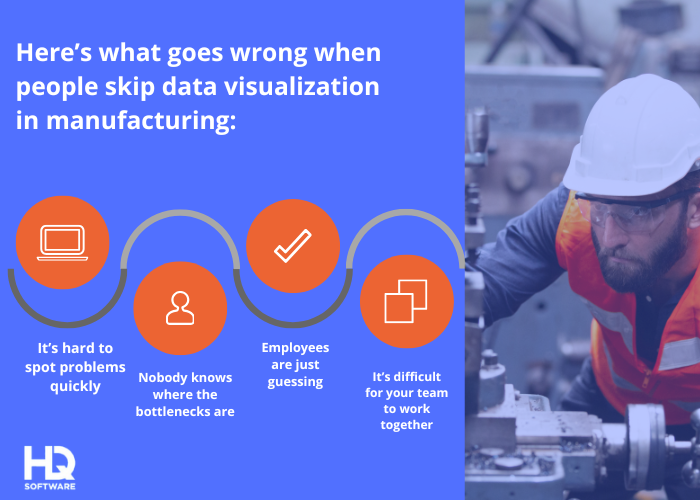
When data is visualized effectively, it empowers teams to act quickly and confidently. But what happens when that layer of clarity is missing? Here’s what goes wrong when people skip data visualization:
It’s hard to spot problems quickly. A machine might be slowing down or overheating, but without a visual chart showing it, employees only discover it when it breaks completely. This leads to major delays.
Nobody knows where the bottlenecks are. A production slowdown may be easy to notice, but it’s hard to pinpoint which specific machine or workflow step is causing the bottleneck.
Employees are just guessing. When deciding whether to buy a new machine or change a process, employers are making decisions based on feelings instead of facts. It’s like planning a budget without looking at your bank statements.
It’s difficult for your team to work together. Without a shared manufacturing dashboard showing goals and progress, teams can’t see how they are doing. When something goes wrong, it’s easy to play the blame game because no one has a clear picture of the whole process.
Clearly, the risks of “flying blind” on the factory floor are too significant to ignore. So, how do successful manufacturers avoid these pitfalls and gain a competitive edge? The answer lies in harnessing the power of real-time data visualization to illuminate every aspect of their operations.
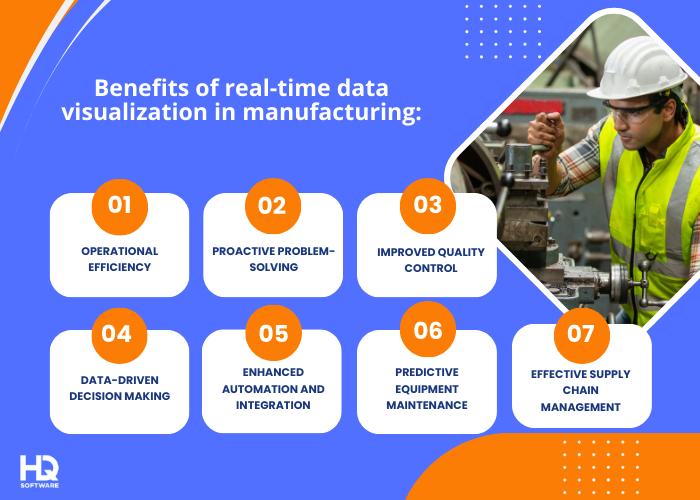
Benefits of Real-Time Data Visualization in Manufacturing
Moving beyond the pitfalls of guesswork and delayed fixes, let’s see how real-time data visualization provides tangible benefits to manufacturing businesses.
Operational Efficiency
Real-time data visualization helps factories run more smoothly and with less waste. By turning complex production numbers into simple charts and dashboards, managers can instantly see how the entire production line is performing.
For instance, a manufacturing dashboard might show a specific machine’s output dropping in real time. A supervisor can immediately investigate and fix the issue, preventing a major slowdown and keeping production on track.
Proactive Problem-Solving
Instead of waiting for something to break, data visualization in manufacturing allows teams to spot trouble early. Visual dashboards can highlight small, negative trends before they become critical failures, shifting the mindset from reactive to proactive.
An example can be a chart showing a machine’s temperature slowly rising over several hours; this alerts an operator to schedule maintenance. This proactive measure helps prevent a complete shutdown and avoids costly repairs in the future.
Improved Quality Control
Data visualization in manufacturing makes it easier to maintain high product quality. If real-time quality metrics are displayed on a screen, workers can instantly see if products are meeting standards and catch defects as they happen.
A manufacturing dashboard can show, for instance, the percentage of defective parts coming off an assembly line. If that number suddenly spikes, the team can immediately stop the line and fix the root cause, preventing waste.
Data-Driven Decision Making
This benefit means managers and teams can make smarter choices based on real facts, not guesswork. Visual reports and manufacturing dashboards present clear, undeniable evidence about what is working and what isn’t. This makes complex decisions much simpler.
When deciding whether to invest in a new machine, a manager can view a dashboard that compares the old machine’s downtime and repair costs against the projected output of the new one. This clear visualization makes the optimal financial choice instantly obvious.
Enhanced Automation and Integration
Data visualization for manufacturing helps connect different systems and automated processes so they work together as one smart unit. It provides a single view that shows how data is flowing between different software and machinery on the factory floor.
One example is a manufacturing dashboard that visualizes how the inventory system automatically instructs a production machine to start a new batch as soon as raw materials arrive. This delivers clear confirmation that the automated workflow is running flawlessly.
Predictive Equipment Maintenance
This means you can fix equipment right before it fails, instead of waiting for it to break down unexpectedly. By visualizing data from sensors on machinery such as vibration or temperature, systems can detect patterns that indicate an upcoming failure.
For instance, a dashboard can show a machine’s vibration levels slowly increasing over weeks. This visual trend triggers an alert to schedule maintenance, preventing a costly and disruptive breakdown during a busy shift.
Effective Supply Chain Management
Data visualization in manufacturing gives you a clear, bird’s-eye view of your entire supply chain, from raw materials to final delivery. Interactive maps and dashboards make it easy to track inventory levels, supplier shipments, and delivery schedules all in one place.
A manager can look at a visual map showing that a shipment of raw materials is delayed. This allows them to quickly arrange an alternative supplier and prevent a production stoppage.
Understanding these advantages is the first step toward building a smarter, more efficient factory. The next is implementing a solution that can turn these benefits into a reality.
Need a custom software solution? We’re ready to help!
Hymux Technologies has a team of skilled professionals ready to tackle the project. Ask me!
Custom Data Visualization Solutions With Hymux Technologies
At Hymux Technologies, we specialize in bridging that gap by creating custom data visualization for manufacturing tools designed for your specific needs.
Here is what we can offer:
Factory-specific dashboard development. We design custom manufacturing dashboards that visualize your most critical manufacturing KPIs, from overall equipment effectiveness (OEE) to real-time production output. This provides a clear, at-a-glance view of your factory’s health.
Seamless data integration. Our experts connect your visualization tools to all existing data sources, including Internet of things (IoT) sensors, a manufacturing execution system (MES), enterprise resource planning (ERP) systems, and databases. This creates a unified source of factual information, ensuring the data you see is always up-to-date.
Real-time and predictive alert visualizations. We embed live updates and proactive alerts into your tools, so you can spot issues such as bottlenecks or machine wear before they halt production.
Predictive analytics and Artificial Intelligence (AI) integration. We can enhance your manufacturing dashboard with predictive analytics and AI, enabling you to forecast maintenance needs, anticipate supply chain disruptions, and optimize future production runs. This transforms your data from a historical record into a powerful tool for predicting what’s next.
Role-based views and UX design. We create tailored views for different users, from shop floor operators who need immediate operational data to executives who require high-level strategic insights. It ensures every team member gets exactly the information they need to make effective decisions without being overwhelmed.
Our custom manufacturing software often integrates with or builds upon the industry’s most trusted data visualization platforms.
Explore our portfolio to discover innovative software solutions we’ve developed for the manufacturing industry.
Considering custom software?
Hymux Technologies’s team of experts can design and develop the perfect solution for your business. Let’s discuss it
Core Data Visualization Software in the Manufacturing Industry
To give you a better understanding of the landscape, here are some of the core manufacturing analytics softwaretools used today.
Power BI
Microsoft’s Power BI is a very popular and user-friendly tool, especially for businesses that already use other Microsoft products such as Excel and Azure. It makes it easy for anyone to connect to data sources, create interactive dashboards, and share reports that track key business metrics. In manufacturing, it’s often used by managers to get a quick overview of business performance, inventory levels, and sales data.
Looker
Looker, which is now part of Google, is excellent for creating a single source of data for the entire organization. It allows technical teams to define business metrics once, ensuring that everyone from the sales department to the factory floor is using the same consistent information. This makes it ideal for building reliable, company-wide reports and manufacturing dashboards where data accuracy is critical.
Grafana
Grafana is a powerful, open-source tool that is perfect for visualizing real-time, time-series data. It truly shines when displaying information that changes every second, such as live sensor readings from machinery on the factory floor. In manufacturing, it’s the go-to choice for creating live dashboards that monitor equipment temperature, production speed, and operational status, helping operators spot issues the moment they happen.
Tableau
Tableau is famous for its beautiful, highly interactive visualizations and its intuitive, drag-and-drop interface. It empowers users to “play” with their data, explore different angles, and uncover hidden patterns without needing to be a data scientist. A quality manager in a factory, for example, could use Tableau to drill down into production data and visually discover the root cause of a sudden increase in product defects.
Sisense
Sisense is designed to be a complete, end-to-end business intelligence platform that handles everything from connecting and preparing complex data to visualizing it in a single manufacturing dashboard. It is particularly strong at mashing together large datasets from many different sources, such as an ERP, CRM, and production machinery. This makes it a great option for companies that want a single, powerful tool to manage their entire analytics workflow from start to finish.
Emerging Trends in Manufacturing Data Visualization
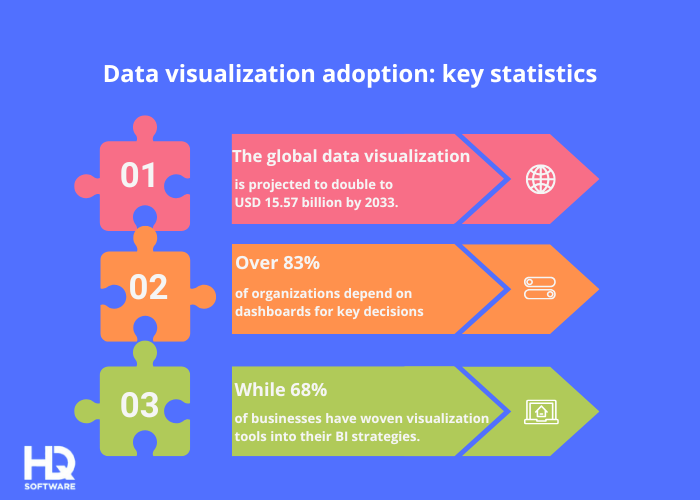
The global data visualization tools market, valued at USD 7.77 billion in 2024, is projected to double to USD 15.57 billion by 2033, growing at a robust CAGR of 9.07%. This surge is fueled by explosive digital data creation, exceeding 120 zettabytes worldwide in 2023. So, over 83% of organizations depend on dashboards for key decisions, while 68% of businesses have woven visualization tools into their BI strategies this year.
Thus, as factories evolve into smarter, hyper-connected ecosystems, the power to swiftly decode complex data streams has never been more vital. Here’s what’s unfolding right now:
Real-time dashboards. Instant visibility into machine speeds, errors, and delays as they unfold. It eliminates lags and manual reports.
Augmented Reality (AR) overlays. AR enables users to point their phone at a malfunctioning machine, instantly revealing the issue through the use of arrows, step-by-step repair instructions, or even a virtual “X-ray” view of the machine’s internal components.
Predictive alerts. Instead of waiting for machines to break, systems warn you days ahead. For example, “Belt on conveyor #3 might fail tomorrow—replace now.”
Mobile-first visuals. Mobile-first visuals empower workers on the factory floor to access live statistics using tablets, rather than being confined to office settings. The intuitive color-coded system, with red indicating a stop and green signaling a go, ensures simplicity and ease of understanding.
Crystal-clear charts. Data shows up as traffic lights, heat maps, or animated icons. Anyone can understand it in seconds.
In conclusion, by providing instant access to critical information, real-time data visualization empowers manufacturers to make informed decisions and respond swiftly to challenges.
The impact ripples outward: fortified supply chains withstand irregularity, empowered teams minimize waste, and leadership charts bold innovations. With downtime costs vanishing and margins expanding, it’s the cornerstone of operational excellence. Forward-thinking leaders are already integrating it.
Reach out to learn how real-time data visualization can improve your manufacturing performance.
An experienced developer with a passion for IoT. Having participated in more than 20 Internet of Things projects, shares tips and tricks on connected software development.
What Is the Impact of Real Time Data in Manufacturing Operations?
Real-time data can make a huge impact in manufacturing. It lets factories see machine speeds, errors, and delays, the moment they happen. This means problems can be fixed instantly, reducing costly downtime. Workers can adjust processes on the fly, improving efficiency and product quality. It also helps predict failures before machines actually break down, saving money and time.
What Are Some Key Benefits of Data Visualization?
Data visualization for manufacturing simplifies complex information, making it easy to understand at a glance. It helps spot trends, patterns, and problems quickly, leading to faster, better decisions. Visuals communicate insights clearly to teams, improving collaboration. They save time compared to analyzing raw numbers and make tracking progress or performance much simpler.
What Are the Core Types of Data Visualization?
Core types of data visualization in manufacturing include:
bar charts for comparing categories;
line graphs for showing trends over time;
pie charts for illustrating proportions;
scatter plots for revealing relationships between variables;
heat maps for highlighting intensity levels;
and tree maps for organizing hierarchical data.
These tools help turn complex data into clear, easy-to-understand pictures for better decisions.
Which Data Visualization Tools Are Commonly Used for Real-Time Analytics?
Commonly used tools for real-time analytics include Tableau and Power BI for interactive dashboards, Grafana for live metrics, Looker for cloud-based data, and open-source options like Sisense. These tools help teams monitor operations instantly, spot issues quickly, and make faster decisions based on live data.
We are open to seeing your business needs and determining the best solution. Complete this form, and receive a free personalized proposal from your dedicated manager.