How can healthcare organizations ensure their staff are always prepared, compliant, and skilled? In an industry where patient safety and regulatory standards are non-negotiable, the answer lies in adopting learning management systems (LMS) tailored for hospitals and healthcare providers.
Unsure whether investing in an LMS is the right move for your healthcare organization? Do you need solid arguments to convince your leadership team? In this article, we’ll dive into the essential features of a healthcare LMS, explore the diverse ways it can be used, and highlight the best solutions available.
An LMS for healthcare is essentially a digital classroom built specifically for the medical world. It’s a platform where medical professionals, including doctors, nurses, and administrators, can:
access training;
stay up-to-date with compliance requirements;
sharpen their skills.
What makes it special is that it’s built specifically for healthcare’s unique needs: Health Insurance Portability and Accountability Act (HIPAA) compliance, role-based learning, and integration with electronic health records (EHR) or HR systems. So, whether it’s onboarding new staff, offering continuing education, or preparing for audits, a healthcare LMS helps organizations deliver the right training to the right people, when and where they need it most.
Healthcare LMS Market Overview
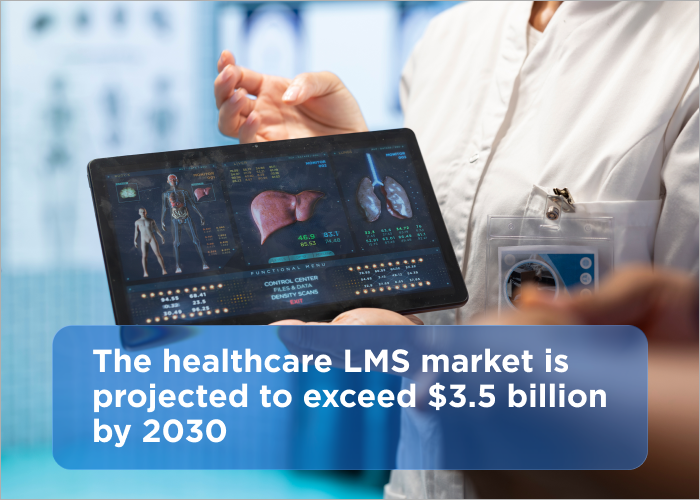
Here’s a compelling insight: the healthcare LMS market is booming and is projected to exceed $3.5 billion by 2030, growing at a robust 22% compound annual growth rate (CAGR). You may ask, “Why is this happening?” We have an answer.
Employment in the sector is expected to grow 16% between 2020 and 2030, significantly faster than most other industries. With the global healthcare market already surpassing $4 trillion, and expected to near $7 trillion by 2025, the demand for continuous, scalable training is clearer than ever.
From keeping clinicians up-to-date with compliance and best practices, to onboarding new healthcare professionals efficiently, training is not a nice-to-have item — it’s a necessity. Even patients require education these days, especially as digital health and telehealth become the new norm.
Benefits of Learning Management Systems for Healthcare
The biggest advantages of an LMS for healthcare are that it automatically tracks compliance, provides flexible training, and offers real-time insights. Below, we’ve listed other benefits that we find most important:
Streamlined training and onboarding. A healthcare LMS puts all training in one place, so new hires can easily access key courses such as HIPAA and patient safety training. This saves time for administrators and helps staff get up to speed faster.
Accessibility and convenience. With 24/7 access to training materials, healthcare professionals can learn at their own pace and on their own schedule. Mobile compatibility ensures learning can happen anywhere, even on the go.
Improved patient care. An LMS gives healthcare workers easy access to the latest training on medical procedures and best practices. This helps them stay skilled, so they can provide better care even in complex situations.
Cost-effective training. An LMS cuts costs by reducing the need for in-person training, travel, and printed materials. It ensures staff finish required training on time and automatically tracks their progress.
Data-driven Insights. Advanced analytics show where training is working and where it’s not, highlighting knowledge gaps. This helps improve future training.
Moreover, interactive and personalized learning experiences, such as gamified modules and mobile access, boost staff motivation and knowledge retention. So, engaged employees are more likely to complete training and apply what they’ve learned in their daily roles.
Now let’s take a closer look at how healthcare LMS platforms differ from general LMS solutions.
Need a custom software solution? We’re ready to help!
Hymux Technologies has a team of skilled professionals ready to tackle the project. Ask me!
This table clearly outlines how a healthcare LMS is purpose-built for the unique demands of the healthcare industry, while a general LMS serves a broader audience with less specialized functionality.
Feature
Healthcare LMS
General LMS
Primary Focus
Tailored for healthcare compliance, patient safety, and medical training
Designed for general corporate training, education, or skill development
Compliance Management
Built-in HIPAA, GDPR (for health data), Joint Commission, and other healthcare-specific standards
Supports general compliance (like ISO) but lacks healthcare-specific regulatory tools
Content Specialization
Pre-built or customizable medical and healthcare-specific courses (clinical skills, patient safety, EHR training, and medical certifications)
Generic courses or customizable for various industries (e.g., IT, sales)
Security and Data Privacy
Advanced encryption, strict access controls, and audit trails for sensitive patient/health data
Standard security measures, but may not meet rigorous healthcare data protection requirements
Focuses on course completion, assessment scores, and general engagement metrics
Integration Capacities
Often integrates with EHRs, medical devices, and hospital management systems
Integrates with HRIS, CRM, and productivity tools (Salesforce, Microsoft 365)
Customization
Highly customizable for departmental needs (like intensive care unit vs. admin training) but often requires healthcare-specific configurations
Customizable but not specifically for healthcare needs
Understanding the differences between healthcare-specific and general LMS platforms makes it clear: a general solution simply won’t meet the demands of a medical environment. That’s why more healthcare organizations are turning to custom LMS development.
Build a Custom Healthcare LMS With Hymux Technologies
In healthcare, a one-size-fits-all LMS simply doesn’t cut it. Off-the-shelf platforms often lack the specialized features needed to handle complex compliance requirements, diverse staff roles, and critical integrations with medical systems.
That’s why building a custom solution with Hymux Technologies is the strategic choice for forward-thinking hospitals, clinics, and health systems. We design solutions specifically around your operational workflows, security demands, and training goals. Our experts ensure your team stays skilled, compliant, and focused on delivering exceptional patient care.
Here’s how our custom development services empower your healthcare organization:
Tailored LMS design and development: We build platforms from the ground up, aligning with your unique workflows, branding, and specific training objectives. This can be for clinical staff, administrators, or patient education. We ensure seamless adoption and maximum relevance to your organizational needs.
Healthcare compliance integration: Our healthcare learning management systems embed HIPAA, GDPR (for health data), Joint Commission, and other regulatory requirements directly into the system. It includes automated tracking and audit trails to simplify compliance management and reduce legal risks.
EHR and medical system integration: We can connect your LMS with existing hospital systems and medical devices, enabling unified data flow and streamlined processes such as credentialing, procedure simulations, and equipment training.
Advanced role management: Supporting complex hierarchies including clinicians, nurses, residents, admins, and even patients, we implement granular permissions and personalized learning paths. We ensure that the right content reaches the right people securely.
Custom content delivery and analytics: From interactive clinical simulations to microlearning modules, we help create and deploy engaging content while providing powerful analytics to track skill gaps, competency levels, and training effectiveness for continuous improvement.
Beyond development, we offer maintenance and scalability planning, ensuring your healthcare learning management system evolves with your organization.
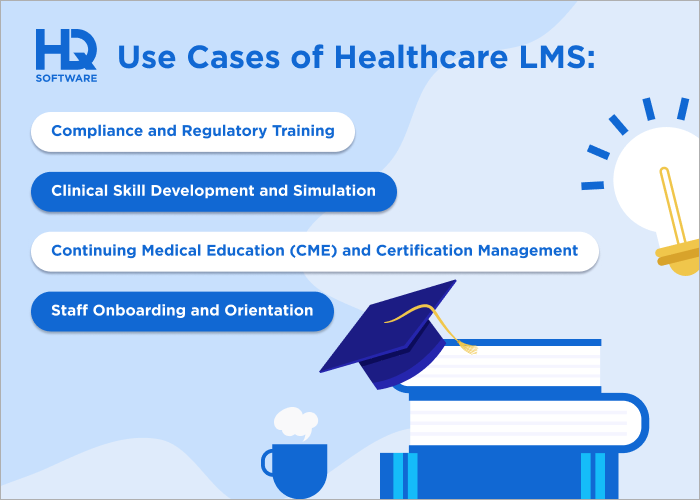
Use Cases of Healthcare LMS
But enough theory. Let’s see how it works in practice with examples.
Compliance and Regulatory Training
Healthcare organizations must ensure staff continuously meet stringent regulatory requirements, such as HIPAA, Occupational Safety and Health Administration (OSHA), infection control, and Joint Commission standards. A healthcare LMS automates the delivery and tracking of mandatory training. This can help reduce the administrative burden and ensure all personnel complete critical modules on schedule.
Example: A large hospital network can use a healthcare LMS to assign annual HIPAA and infection-control training to more than 10,000 employees across multiple locations. The system automatically enrolls staff based on their roles, sends reminders as deadlines approach, and flags incomplete courses for managers. Once training is completed, the LMS generates real-time compliance reports and audit trails.
Staff Onboarding and Orientation
A LMS for healthcare streamlines hiring of medical staff by providing a centralized repository for orientation materials, policy documents, and role-specific training. New employees can access interactive modules at their own pace, complete competency assessments, and track their progress. All these help to accelerate time-to-productivity while ensuring consistency in training across departments and locations.
Example: A regional healthcare system onboards 500 new nurses each year across multiple hospitals. Using their healthcare LMS, they can create a standardized digital onboarding program that includes interactive modules on EHR navigation, patient safety protocols, hospital policies, and department-specific procedures. New hires can complete the training remotely before their first day, take competency quizzes, and upload signed acknowledgments. All will be tracked automatically in the system.
Considering custom software?
Hymux Technologies’s team of experts can design and develop the perfect solution for your business. Let’s discuss it
A healthcare learning management system supports interactive eLearning modules, virtual simulations, and scenario-based training that replicate real-world clinical situations. This allows staff to practice critical procedures in a risk-free environment, build confidence, and maintain competencies, ultimately enhancing patient safety and care quality.
Example: A large academic medical center can use healthcare LMS to deliver virtual simulation training for emergency response protocols, including cardiac arrest and sepsis management. Nurses and residents can complete interactive eLearning modules followed by immersive, scenario-based simulations within the platform, where they make real-time clinical decisions and receive instant feedback. The LMS tracks performance, identifies knowledge gaps, and requires remediation if needed.
Continuing Medical Education (CME) and Certification Management
Healthcare professionals must regularly pursue continuing education to maintain licenses and stay updated on medical advancements. An LMS simplifies CME management by offering accredited courses, tracking credit hours, and automating certification renewals. Organizations can curate relevant content, personalize learning paths for different roles, and maintain comprehensive records.
Example: A multi-state physician group uses its healthcare LMS to manage CME requirements for over 300 providers across specialties. The platform delivers accredited courses on the latest treatment guidelines, diagnostic techniques, and emerging technologies, with automatic tracking of completed hours and certification expirations. Physicians receive personalized recommendations based on their specialty and license renewal dates. Administrators gain real-time visibility into compliance status across the organization.
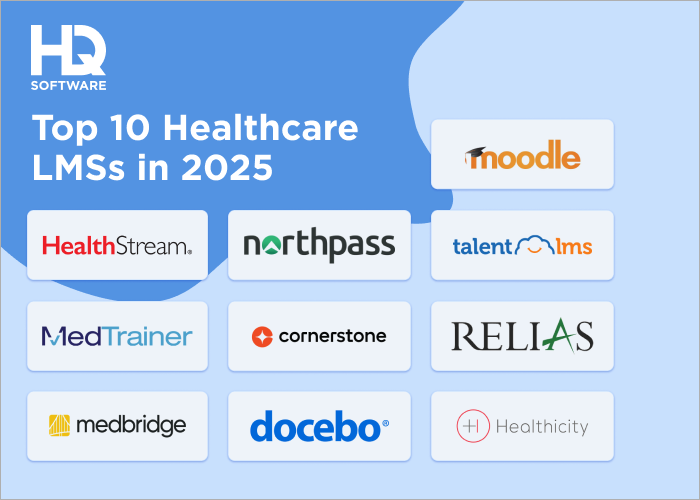
Top 10 Healthcare LMSs in 2025
Now that we’ve seen how healthcare LMS platforms drive real impact across training, it’s clear they’re essential tools for modern medical organizations. To help you find the best fit, let’s explore the top 10 healthcare LMS solutions in 2025.
1. HealthStream
HealthStream is a leading LMS built specifically for hospitals and large healthcare organizations across the U.S. It offers comprehensive compliance training, competency management, and performance analytics, with deep integration into hospital HR and EHR systems. Ideal for onboarding, continuing education, and regulatory tracking, HealthStream ensures healthcare teams stay trained, certified, and prepared.
2. Northpass
Northpass stands out for its modern, user-friendly interface and powerful content creation tools tailored to healthcare training needs. It enables organizations to build, deliver, and track engaging learning experiences with AI-driven insights and automated workflows. This LMS is especially popular among medical device and pharmaceutical companies for training their internal teams and external partners.
3. Moodle for Healthcare
A customized version of the open-source Moodle platform, Moodle for Healthcare is adapted to meet the strict security and compliance demands of medical environments. It offers flexibility for hospitals, clinics, and medical schools. So they can get private, branded learning ecosystems with sharable content object reference model (SCORM) compliance, role-based access, and EHR integration. With support for mobile learning and offline access, it’s a cost-effective, scalable solution for organizations prioritizing control and long-term customization.
4. MedTrainer
MedTrainer combines a unified LMS platform with credentialing, compliance tracking, and HR management tools. It is designed for clinics, surgery centers, and group practices. The system simplifies onboarding, tracks certifications, and ensures staff meet OSHA, HIPAA, and Joint Commission requirements. Its intuitive dashboard and automated reminders help healthcare providers stay audit-ready while reducing administrative burden and improving training completion rates.
5. Cornerstone Learning
Cornerstone Learning offers a comprehensive talent development suite with strong capabilities for healthcare enterprises. It supports personalized learning paths, skills gap analysis, and succession planning. These features make it ideal for large hospitals and integrated health systems. With AI-powered recommendations, mobile access, and integration with HRIS systems, Cornerstone helps healthcare leaders align training with workforce strategy and drive long-term organizational growth.
6. TalentLMS
TalentLMS is a cloud-based, scalable learning platform increasingly adopted by mid-sized healthcare providers and medical startups. It offers an intuitive drag-and-drop course builder, SCORM compliance, video conferencing, and multilingual support. All these make it easy to deploy training quickly. While it’s not healthcare-specific out of the box, its flexibility, affordability, and API integrations make it a strong choice for organizations building custom training programs with minimal IT overhead.
7. MedBridge
MedBridge specializes in clinical education and professional development for therapists, rehab centers, and outpatient care providers. Its LMS includes evidence-based courses, continuing education units(CEU) tracking, and patient engagement tools focused on improving clinical outcomes. With integrated video libraries, compliance reporting, and hands-on skill assessments, MedBridge helps healthcare teams enhance patient care quality and treatment consistency.
8. Docebo
Docebo is an AI-powered, enterprise-grade LMS trusted by healthcare organizations for its scalability, automation, and smart learning experience platform. It supports complex training needs across compliance, onboarding, and product training, with seamless integration into EHRs and CRM systems. Its intuitive interface, personalized learning paths, and advanced analytics make Docebo a top choice for health systems aiming to deliver engaging, data-driven education at scale.
9. Relias Learning
Relias Learning is an LMS focused on clinical upskilling, behavioral health, and long-term care training. Used by hospitals, nursing homes, and government agencies, it offers thousands of evidence-based courses with real-time compliance tracking and predictive analytics. Relias helps reduce staff turnover, improve patient outcomes, and meet regulatory standards through targeted, adaptive learning paths that evolve with workforce needs.
10. Healthicity
Healthicity provides a strategic learning and performance improvement platform tailored for healthcare leadership and clinical teams. Beyond traditional LMS features, it emphasizes organizational development, change management, and culture transformation. Its programs support quality improvement, patient safety, and leadership training, helping health systems align learning with strategic goals.
Choosing the best healthcare learning management system for your medical organization can feel overwhelming. After all, you’re not just training employees, you’re protecting patient safety and ensuring compliance in a fast-paced environment.
So, how do you pick the one that best aligns with your unique needs? Let’s break it down.
How to Choose the Best LMS for Your Medical Organization
Choosing the best LMS for your medical organization is about finding a solution that truly fits your team, your workflows, and your mission of delivering effective care. Our years in healthcare software development have revealed what actually matters when selecting an LMS. Here’s how to make a choice that drives results:
From our experience, the right system should first and foremost fit your specific needs, whether that’s onboarding nurses at multiple clinics, keeping up with regulatory standards training, or rolling out new telehealth protocols. Ask yourself: what are your biggest training challenges?
Once you understand your core needs, look for an LMS that’s secure, easy to use, and integrates smoothly with your EHR or HR systems. A custom LMS solution might be the best path forward. Because features such as automated compliance tracking, mobile access, and role-based learning paths make a big difference in real-world use. We’d also recommend involving your frontline teams early, because if the platform isn’t intuitive for them, adoption will stall.
And don’t underestimate support and scalability. Will the vendor grow with you? Can they help customize the system as your needs evolve? Whether you go with a healthcare-specific platform or a flexible custom solution, the best LMS is one that makes learning effortless, consistent, and truly effective for your team and, ultimately, for your patients.
At the end, the right LMS is the one that empowers your team to keep learning, keep improving, and keep delivering the best possible patient care.
Contact us to know more about our educational development services.
References
U.S. Department of Health and Human Services (HHS) – Training and Education in Healthcare IT https://www.healthit.gov
To ensure the outstanding quality of Hymux Technologies’s solutions and services, I took the position of Head of Production and manager of the Quality Assurance department. Turn to me with any questions regarding our tech expertise.
What Features Should I Look for in a Healthcare LMS?
A healthcare LMS should offer role-based access, compliance tracking (HIPAA, OSHA), and SCORM-compliant content. Look for mobile accessibility, offline learning, multilingual support, and integration with EHR/HR systems. Built-in assessments, certification management, audit trails, and real-time reporting are essential for training effectiveness and continuous professional development in clinical healthcare settings.
What Types of Organizations Use Healthcare LMS Platforms?
Healthcare LMS platforms are used by hospitals, clinics, pharmaceutical companies, medical device firms, insurance providers, government health agencies, and educational institutions. These organizations rely on LMS systems to train medical staff, ensure compliance, deliver continuing education, and maintain industry certifications across regulated and evolving healthcare environments.
Is It Better to Choose a Custom LMS or an Off-The-Shelf Solution?
A custom LMS offers tailored features, scalability, and integration with existing systems, ideal for organizations with unique training needs. Off-the-shelf solutions are faster to deploy and cheaper upfront but may lack flexibility. For healthcare and enterprise teams requiring compliance, branding, and specific workflows, a custom LMS often delivers greater long-term value and adaptability.
How Long Does It Take to Implement a Healthcare LMS?
Implementing a healthcare LMS typically takes 3 to 9 months, depending on complexity, customization, and content readiness. Off-the-shelf platforms may deploy in 1–3 months, while custom solutions require additional time for design, compliance integration, and data migration. Timelines vary based on organizational size, system integrations, and stakeholder involvement.
How Much Does a Healthcare LMS Cost?
The cost of a healthcare LMS depends on various factors, including the level of customization, required features, compliance standards, integration with existing systems, and deployment scale. Additional expenses may include content development, user training, maintenance, and support. Cloud-based vs. on-premises solutions and long-term scalability also influence the overall investment.
We are open to seeing your business needs and determining the best solution. Complete this form, and receive a free personalized proposal from your dedicated manager.