Table of contents:
What Is a Learning Management System (LMS)?
What Is a Learning Experience Platform (LXP)?
LMS vs LXP: What Are the Differences?
Custom LMS and LXP Software Development by Hymux Technologies

Over the past decade, learning has been rapidly moving online, offering organizations and individuals a wide range of tools for developing skills and transferring knowledge. Among them, two types of solutions stand out: learning management systems (LMS) and learning experience platforms (LXP).
Despite their similar goal of providing access to educational content, these tools differ in functionality, target audience, and customization options. In this article, we will compare LMS and LXP to understand which solution is best suited for different tasks in the field of education and corporate training.
What Is a Learning Management System (LMS)?
What Is a Learning Experience Platform (LXP)?
LMS vs LXP: What Are the Differences?
Custom LMS and LXP Software Development by Hymux Technologies
An LMS is a software platform that simplifies the organization, delivery, and management of training and educational content within an organization. The concept of LMS became widespread in the early 2000s. This coincided with the development of digital technologies and the Internet. At that time companies began seeking more efficient and scalable alternatives to traditional, in-person training sessions and paper-based manuals.
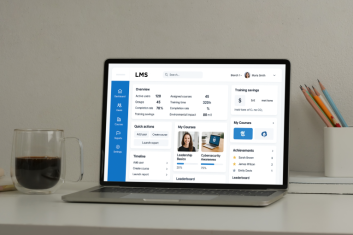
The learning management system can be compared to a centralized hub where employees can access training materials, take courses, and pass exams. For managers and administrators, an LMS offers tools to automate the training process, monitor learner progress, and generate reports on employee performance.
As the acronym implies, there are three components to an LMS :
Thus, we can conclude that the main goal of a learning management system is to create a structure where training becomes a purposeful and systematic process, rather than a chaotic set of webinars and instructions.
Need a custom software solution? We’re ready to help!Hymux Technologies has a team of skilled professionals ready to tackle the project. Ask me!
Victoria Rokash
Business Development Manager
Modern learning management systems provide a wide range of features to meet the needs of both learners and administrators. Below are the core features typically found in most modern LMS platforms:
When it comes to the advantages of LMSs, it’s important to recognize that these are powerful administrative tools that help L&D teams manage training programs, select and assign content, and evaluate learner progress. The main focus is on compliance and progress tracking.
Some employees need to complete specific training programs, such as safety or other regulatory requirements. However, LMSs cannot track activities outside the platform, such as informal discussions and online chats.
Learning experience platform (LXP) is a term coined by global HR expert Josh Bersin. It describes a new generation of educational platforms focused on personalized and interactive learning experiences. The main advantage of an LXP is the automatic selection, assignment, or recommendation of courses and materials based on built-in algorithms that analyze an employee’s previous experience, skills, and interests.
In addition to intelligent recommendations, an LXP offers modern corporate training formats that resemble social networks, blogs, and other digital communication platforms familiar to users. This helps to increase engagement and make training more attractive.
An LXP pays special attention to microlearning — short and concise educational modules that allow information to be absorbed more quickly and easily. The platforms provide greater flexibility, allowing users to choose a training format that suits them, taking into account their individual preferences and learning style.
Key mechanisms of LXP:
Considering custom software?Hymux Technologies’s team of experts can design and develop the perfect solution for your business. Let’s discuss it
Dmitry Tihonovich
Business Development Manager
A learning experience platform takes a more learner-centric approach compared to traditional LMS solutions. While an LMS focuses on managing and delivering structured training, an LXP emphasizes personalization, discovery, and engagement. It is designed to empower users to take control of their learning journey by offering intelligent recommendations, social features, and access to a wide range of content sources. Below are the key features commonly found in modern LXP platforms:
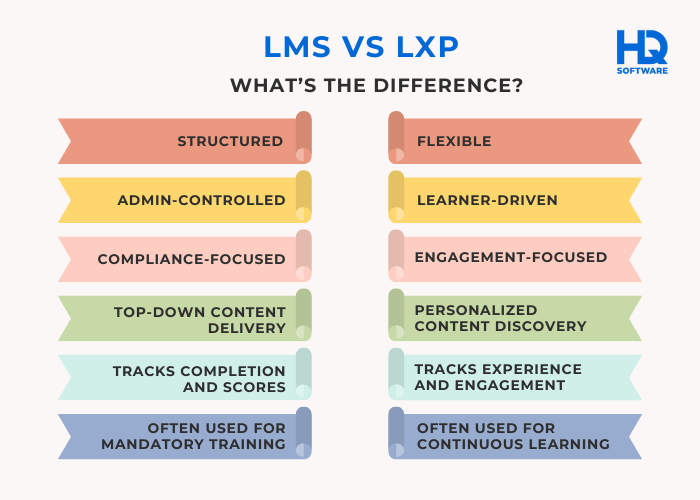
Let’s compare LMS and LXP based on key criteria.
| Criterion | LMS | LXP |
| Purpose | Managing, delivering, and controlling structured learning | Personalizing and enhancing the learning experience |
| Focus | Administrator-driven, compliance-focused | Learner-driven, experience-focused |
| Content | Formal, standardized, often internally created | Diverse, often informal, from multiple internal and external sources |
| Learning Control | Top-down: content assigned by administrators | Bottom-up: users choose what and how to learn |
| Formats | Courses, assessments, certifications | Videos, articles, podcasts, microlearning |
| Recommendations | Minimal or rules-based | AI-driven, based on interests, behavior, and skills |
| Social Features | Limited or none | Includes likes, comments, sharing, and user-generated content |
| Flexibility | Limited personalization | High flexibility in format, pace, and content selection |
| Skills Development | Limited to predefined course objectives | Focus on building real-world skills and personalized growth paths |
| Analytics and Reporting | Detailed admin-focused reports for compliance and tracking | User-centric analytics with insights on engagement and interests |
The table above shows that, while LMSs and LXPs are both designed to support learning in organizations, they serve different purposes and use different approaches. Let’s take a closer look at the differences.
An LMS is typically built for administrators, HR teams, and trainers. It offers a structured approach to learning: courses are created, assigned, and tracked in a centralized way. LMS platforms are especially effective for mandatory training, certifications, and regulatory compliance, where consistency, reporting, and control are crucial.
An LXP, on the other hand, is centered around the learner. It analyzes user behavior, interests, and existing skills to recommend relevant content. Users are free to explore, choose, and consume learning materials at their own pace, creating a more personalized and engaging learning experience.
In an LMS, content is usually formal and predefined. It typically includes structured courses, quizzes, and certificates that are created and managed internally by administrators or instructional designers.
LXPs, on the other hand, focus on diverse and dynamic content formats. These may include short videos, articles, podcasts, user-generated content, etc. This variety makes the learning process more flexible, engaging, and easier to fit into busy, fast-paced work environments.
LXPs are typically aligned with skill development and career growth, offering personalized learning paths and recommending content that helps users grow in their roles.
LMSs also focus on developing specific skills through structured training courses and assessments. Progress in skill acquisition is tracked through formal training programs, certifications, and completion of predefined courses.
LXPs also provide greater flexibility, allowing learners to choose the format and style that suits their preferences (video, text, audio, or interactive formats) and to access content anytime, anywhere.
LMSs are strong in administrative reporting. They offer compliance tracking, completion rates, test scores, and detailed analytics for HR and managers.
LXPs also provide insights, but focus more on engagement metrics, content popularity, and learner behavior rather than strict compliance.
Ready-made LMS and LXP solutions can meet basic training needs, but in many cases companies need customized platforms tailored to their internal processes, goals, and technical infrastructure.
Hymux Technologies has been providing eLearning software development services for many years. Our team helps businesses develop and implement custom LMS and LXP solutions that precisely meet user requirements and expectations.
So, what are our company’s strengths?
The Hymux Technologies team develops systems that go beyond standard functionality. This could be an LMS focused on compliance and training control in a highly regulated industry, or a flexible LXP with AI elements for skill development and employee engagement. All solutions are easily integrated with existing systems: HRM, CRM, ERP, and other corporate platforms.
To create scalable, secure, and modern solutions, Hymux Technologies developers use proven technologies:
Our work is based on a flexible methodology (Agile), which ensures transparency, flexibility, and regular delivery of results at all stages of the project.
Hymux Technologies has experience in creating custom LMS and LXP solutions for clients from various industries: education, healthcare, manufacturing, and others. Such platforms help clients increase their training efficacy, improve employee engagement, and meet industry requirements.
One example is a project for a fast-growing Danish company that provides software for employee training and performance management. The company approached Hymux Technologies with a request to develop a system that would help tailor training to business goals. Companies often found off-the-shelf LMS systems too complicated to use, preventing non-technical specialists such as HR managers from quickly creating training content.
The Hymux Technologies team created a platform that combines training management and performance evaluation. Managers can track key indicators and create individual development models for employees. The HR department develops personalized courses using a convenient visual editor with text, video, audio, surveys, and presentations.
The solution is already used in more than forty countries and covers over 50 000 users from various industries, including banks, consulting agencies, and manufacturing companies. The platform is available on computers, tablets, and mobile devices.
Check out other real-life cases in the Hymux Technologies portfolio, which features successful projects and implementation stories.
Choosing between an LMS and an LXP depends on your organization’s learning goals, structure, and workforce needs. Each system offers distinct advantages, so understanding their strengths will help you make an informed decision. Use the comparison below to determine which solution aligns best with your training strategy.
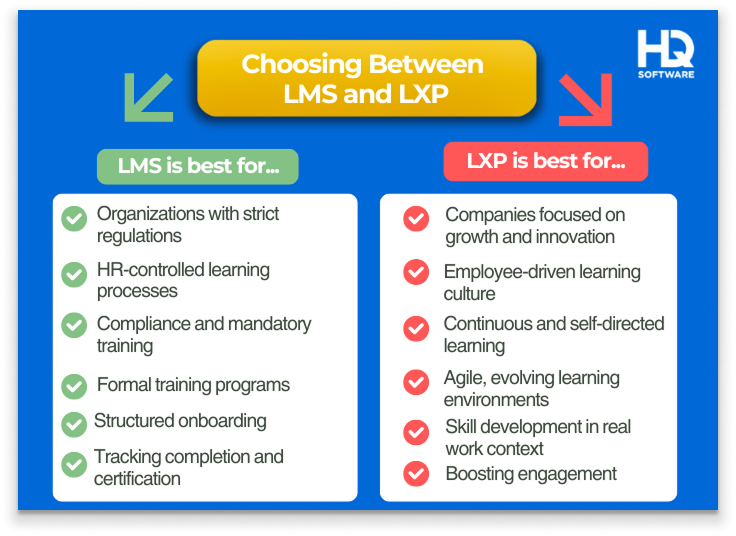
Consider an LMS system if:
The LXP platform will be useful if you want to:
LMS and LXP apply to different but equally important tasks in employee training. Therefore, it is unlikely that either of these solutions will disappear from the market any time soon. It is much more likely that the distinctions between the two types of platforms will disappear, as many companies need the capabilities provided by both LMS and LXP solutions.
In the near future, the trend may not be to abandon one of the platforms, but rather to transform LMS into LXP or to integrate these training systems.
Whether you need a structured LMS or a flexible LXP, we’ll help you choose the right solution for your goals. Contact us today for a free consultation. Our expert team will help you elevate employee training and create a solution tailored to your needs.

Lead Software Engineer
An experienced developer with a passion for IoT. Having participated in more than 20 Internet of Things projects, shares tips and tricks on connected software development.


Subscribe for more!
We are open to seeing your business needs and determining the best solution. Complete this form, and receive a free personalized proposal from your dedicated manager.

Sergei Vardomatski
Founder