What if language learning went beyond textbooks and whiteboards? This immersive potential is now possible. Virtual Reality (VR) language learning apps offer learners an interactive and engaging experience that traditional methods cannot match. Students can navigate virtual scenarios, interact with native speakers, and receive instant feedback, creating a dynamic and personalized learning experience.
In this article, we’ll explore the benefits of integrating Virtual Reality technology into your language programs and look at some brilliant existing applications, preparing students for immersive interaction like never before.
Most advice about learning a language suggests you need to practice with actual people. But VR language learning apps are great tools that can help a person learn language deeply even without constant personal interaction.
VR lets you practice speaking, listening, and interacting in realistic virtual places, giving you the opportunity to hear how words naturally flow in everyday speech. For example: observing a tour guide pointing out landmarks while describing their history makes a stronger impact than simply reading a traditional paper brochure.
Virtual Reality makes language immersion easier, more interesting, and very effective. Beyond that, VR offers important benefits for language learning, some of which we’ll explore next.
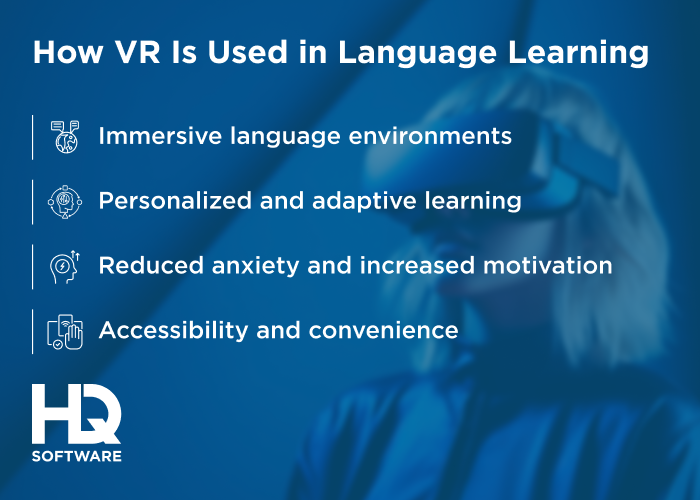
Immersive language environments
Virtual Reality brings language learning to life by immersing learners in realistic, interactive environments where they can practice speaking and listening as if they were in a foreign country. So, the person learning this way doesn’t need to travel or find a community of native speakers.
For instance, as a teacher you can put your students in lifelike simulations, such as negotiating in a boardroom or navigating a trade show, without ever leaving the office. This kind of immersion accelerates fluency and builds cultural competence, making international communication smoother and more natural.
Personalized and adaptive learning
VR-powered language platforms use intelligent algorithms to adapt in real time to each learner’s pace, proficiency level, and learning style. So, students can get a tailored training experience that focuses on their individual needs, whether that’s mastering industry-specific vocabulary or improving pronunciation. The result is faster, more effective learning outcomes that align with your organization’s goals and employee development plans.
Reduced anxiety and increased motivation
One of the biggest barriers to language acquisition is the fear of making mistakes in front of others. This way, VR language learning creates a safe, judgment-free space where learners can practice speaking without fear of embarrassment. This definitely boosts both confidence and motivation.
This pushes learners to participate in communication and apply their skills in real-work situations, such as customer support, international sales, cross-border collaboration, etc.
Accessibility and convenience
VR language learning apps make high-quality training accessible anytime and anywhere, which eliminates the need for travel, rigid schedules, or costly in-person classes. This is, perhaps, the biggest advantage for remote education, because it allows consistent training across locations. Plus, the scalability of VR means you can onboard and upskill students quickly and efficiently.
By incorporating VR into your business processes you’ll ensure your workforce is equipped to thrive in a multilingual and interconnected world.
Need a custom software solution? We’re ready to help!
Hymux Technologies has a team of skilled professionals ready to tackle the project. Ask me!
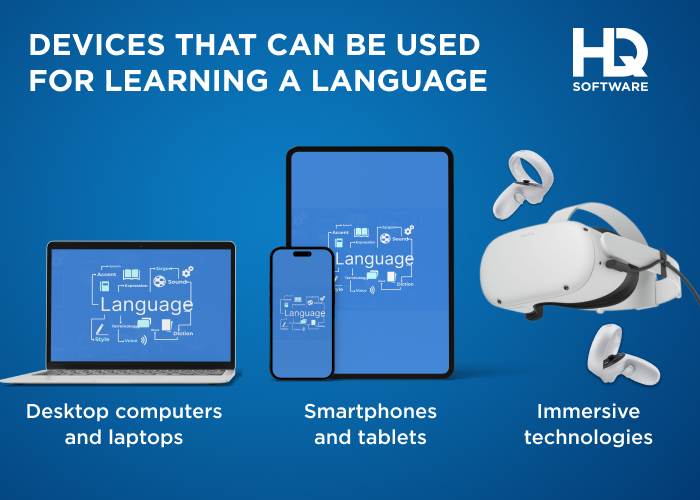
If you want to enhance language training for your students, you have several options for devices at your disposal. Among the most three popular types to learn a language are:
Smartphones and tablets. These devices support language apps such as Duolingo or Babbel and make learning flexible and accessible. These apps allow learners to access interactive content on the go, fitting seamlessly into their busy schedules.
Desktop computers and laptops remain valuable for more structured, in-depth lessons, virtual classrooms, or webinars, while AI-powered voice assistants such as Google Assistant or Amazon Alexa help with practicing pronunciation.
Immersive technologies. High-end VR headsets like the Meta Quest or HTC Vive provide immersive experiences ideal for employee training. To help your employees confidently practice their conversational skills in authentic contexts, VR elevates language acquisition by simulating realistic interactions and cultural scenarios.
All of these tools are effective, but the best choice depends on your objectives, budget, and how much you want to have language learning integrated into your students’ lives.
With the perfect device in hand, it’s time to discover some real examples of VR language learning apps. We’ve carefully selected five of the top solutions to share with you.
Top 5 VR Apps for Language Learning
1. VR language immersion by Hymux Technologies
The application allows users to “travel” to virtual markets in Morocco, cozy cafes in Paris, or historical sites in Rome. They can order coffee, ask for directions, negotiate prices, and engage in casual conversations with AI-powered avatars, receiving real-time feedback on their pronunciation and grammar.
The app’s backend tracks progress across 50+ fluency markers, from industry-specific vocabulary retention to cultural gesture recognition. Additionally, the platform offers team collaboration features where peers can role-play as clients or coworkers in shared VR spaces. Post-launch data showed the users achieved 3x faster conversational fluency compared to traditional methods, with 89% of users feeling “job-ready” after just 15 hours of immersive practice.
More examples of our VR solutions are available in our portfolio.
Considering custom software?
Hymux Technologies’s team of experts can design and develop the perfect solution for your business. Let’s discuss it
The VirtualSpeech English for Business course helps people worldwide improve their listening and speaking skills specifically for business settings. Taking this course can be a valuable step towards advancing your career.
This course teaches business English through interactive classes and Virtual Reality exercises, allowing you to practice realistic situations such as job interviews, client meetings, and stakeholder discussions. The combination of tutorials and practical VR scenarios helps you learn quickly and effectively. VirtualSpeech also uses voice analysis technology to provide specific feedback on your speaking pace and hesitation words, helping you become a clearer speaker and a more confident communicator.
3. ImmerseMe
ImmerseMe offers Virtual Reality language learning for nine diverse languages. Through this immersive platform, users can develop fluency in German, Spanish, French, Chinese, Japanese, English, Indonesian, Greek, and Italian.
The platform provides an authentic language learning experience through 360° photographic scenes filmed in countries where your chosen language is spoken. During lessons, you’ll interact with pre-recorded actors in realistic situations like restaurant ordering or casual conversations, with the app recognizing your speech and playing appropriate video responses.
While you can look around the immersive 360° environments, ImmerseMe is limited to solo practice with AI responses, and you cannot physically explore or interact with objects in the scenes.
4. Mondly VR
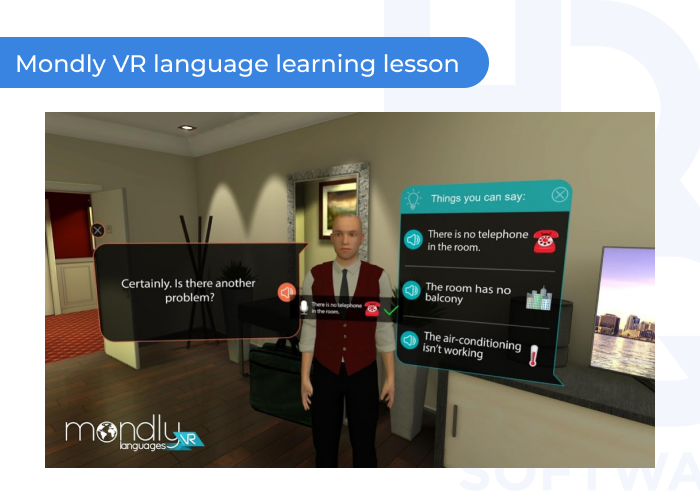
Mondly VR uses an immersive, interactive approach to place learners into virtual environments. The platform combines speech-recognition technology, game-like lessons, and attractive virtual settings.
It was the first language-learning app to incorporate speech recognition allowing users to practice conversations by interacting with chatbot avatars. Here, users can participate in realistic conversations, practice pronunciation, and enrich their vocabulary.
In a typical Mondly lesson, you choose a setting such as a restaurant or hotel reception area and practice conversations with digital avatars. This helps you build practical skills, like ordering food or reserving a hotel room. Mondly’s main advantage is the wide selection of languages it offers — currently around 30. This includes languages rarely available in VR apps, such as Turkish and Hindi.
5. Noun Town
Noun Town is one of the newer VR language-learning apps. It offers a playful approach to learn a language in Virtual Reality. Users explore a grayscale island that gradually fills with color as they complete learning tasks. The app focuses primarily on vocabulary building while teaching essential phrases through interactive environments where players can pick up objects, practice pronunciation, and chat with virtual characters.
What makes Noun Town special is its game-like progression system where colors appear and new characters unlock as you learn more than 1000 words and phrases. While it’s a solo learning experience, like other VR language apps, Noun Town’s whimsical scenes and characters create an entertaining atmosphere, and users can connect with developers and other learners through its active Discord community.
Other Ways to Learn a Language With VR
Certainly, the potential for learning languages in Virtual Reality goes beyond dedicated language apps. You can also immerse yourself and practice conversations by joining:
social language exchangeplatforms such as VRChat, Rec Room, or AltspaceVR. Here you can meet and speak directly with native speakers in casual, immersive social settings.
360° videos in your target language. You can explore YouTube’s vast library of 360° videos filmed in different countries. For instance, virtually visit popular locations or experience cultural events and immerse yourself in authentic conversations, narration, or street dialogue.
interactive games likeElixir, which supports multiple language options. Games involving puzzles, quests, and dialogue-heavy storylines will encourage you to learn vocabulary quickly, especially words related to problem-solving and interaction.
virtual theaters to attend concerts with lyrics in your target language. The beauty of learning this way is that it adapts to your personal interests. This will make the experience feel less like studying and more like enjoying your favorite activities with an added linguistic dimension.
Overall, VR language learning apps offer many benefits, including instant feedback, game-like interactions, and immersive environments. Learners practice language skills in realistic virtual situations, improving their communication abilities in a comfortable and pressure-free setting.
However, despite these advantages, there are also several challenges associated with VR language learning. Before diving into how you can tackle these challenges, take a moment to watch our brief video showcasing our VR development expertise.
Challenges of Using VR for Language Learning
Creating immersive and culturally authentic experiences
To be effective, language learning requires immersion in realistic social and cultural contexts. However, designing Virtual Reality scenarios that accurately replicate daily interactions, local cultural nuances, and realistic communication dynamics can be complex and resource-intensive. Off-the-shelf content may not always match the specific industry or regional dialects that a business requires, leading to a disconnect between training scenarios and real-world situations.
How Hymux Technologies can help: Our team of instructional designers, linguists, and VR experts will work with your specialists to develop a custom content framework, aligning language learning objectives with your business goals. We’ll identify key scenarios, topics, and industry-specific terminology to focus on.
Technical complexity
Implementing VR language learning requires some initial investment in hardware (VR headsets, high-performance computers, sensors) and software (content creation, platform development, integration with existing learning management platforms (LMS)). Ensuring seamless integration, compatibility, and user experience across various devices and platforms is a daunting task.
How Hymux Technologies can help: Our software engineers develop comprehensive VR language learning solutions that integrate with your existing LMS, reducing integration headaches and costs. We handle the complexities of VR software development and ensure its compatibility across devices and platforms.
User adoption, engagement, and measuring
Encouraging employees to use VR language learning apps can be a hurdle due to unfamiliarity with the technology, concerns about looking silly in a headset, or doubts about its effectiveness. Moreover, measuring the impact of VR-based language training on actual language proficiency and job performance is crucial, yet challenging, as traditional assessment methods may not apply.
How Hymux Technologies can help: We design and implement VR-specific evaluation metrics and KPIs. For example, conversational confidence, pronunciation improvement, and negotiation success rates that are aligned with your educational objectives. We can integrate these metrics with your existing evaluation processes, ensuring you can measure the tangible impact of VR language learning on student’s performance.
Why Work With Hymux Technologies to Develop a VR Application for Language Learning?
Virtual Reality development is complex, and our expertise ensures a stable, user-friendly, high-impact learning experience that avoids common pitfalls. For our clients we offer:
Deep technical expertise in VR: Hymux Technologies, with its established presence in software development, possesses the technical expertise in 3D modeling, game engines like Unity/Unreal, and VR platform knowledge. Additionally, it has experienced teams needed to build robust immersive experiences.
Creating engaging and motivating experiences: Our developers design and implement interactive elements, gamification, and realistic simulations. That makes the language learning process more fun, motivating, and potentially leading to higher user retention.
Customization for specific learning needs: A comprehensive VR application, developed by Hymux Technologies, allows for tailoring content, scenarios, and difficulty levels to specific target audiences, language levels, or pedagogical approaches. This ensures the solution meets unique educational goals.
Integration of advanced features: Our experts’ capabilities extend beyond basic VR development and include integration of AI for conversational partners, sophisticated speech recognition for pronunciation practice, and analytics for tracking user progress.
To sum up, developing a VR language learning solution is an effective step in EdTech. Working with Hymux Technologies can help you navigate the technical challenges and best practices in this emerging field, ensuring the product stands out and is built on a solid, future-proof foundation.
Contact us to know more about our VR development services.
A developer with extensive expertise in AR/VR, very ingrained into the topic of Mixed Reality development. Shares his knowledge and the results of many years of work.
We are open to seeing your business needs and determining the best solution. Complete this form, and receive a free personalized proposal from your dedicated manager.



 5. Noun Town